There are moments when a single tool changes how we work. In 2025, AI assistants like Cursor, Claude, Replit Agents, and Bolt.new let people turn natural language into functioning apps at speeds few expected.
The result: an intent-first approach to development. Programs from Fullstack Academy to BloomTech now teach how to pair fundamentals with copilots so learners build portfolio-ready projects faster.
This shift matters if you want faster results without losing control. Beginners can gain quick wins; experienced developers increase productivity; founders move from idea to prototype in weeks.
We will weigh outcomes, costs, and what to look for in a course or bootcamp—curriculum, AI integration, projects, and career support—so readers can choose the right path in 2025.
Key Takeaways
- AI copilots compress development timelines—expect real productivity gains when paired with structured learning.
- Look for programs that combine intent-first workflows with code foundations and testing.
- Options range from sub-$100 micro-courses to university-affiliated programs near $13,995.
- Best candidates: beginners seeking fast wins, professionals boosting velocity, and founders prototyping quickly.
- Assess trust signals: alumni outcomes, hands-on projects, and clear AI tool integration.
Vibe coding in 2025: what it is, why it’s booming, and who it helps
Teams now start with specifications and prompts, then use AI copilots to generate working features.
Vibe coding describes an intent-first approach where builders write natural-language constraints and prompts while copilots create, refactor, and debug code under human oversight. Tools like Cursor, GitHub Copilot, Gemini, Claude, Windsurf, Bolt.new, and v0.dev handle scaffolding, reducing repetitive work and speeding prototyping.
In production, teams chain prompts with unit tests and CI checks so AI output meets reliability, security, and performance standards. Human engineers keep control: they set architecture, do threat modeling, and validate data flows.
- Old workflow: scaffold, write boilerplate, integrate libraries.
- New workflow: compose specs, craft prompts, iterate with agents to ship features faster.
Who benefits? Non-coders building MVPs, designers converting mockups to web interfaces, entrepreneurs iterating quickly, and engineers who want to focus on system design instead of repetitive tasks.
| Aspect | Traditional | Intent-First | Practical Need |
|---|---|---|---|
| Starting point | Frameworks, templates | Prompts and acceptance criteria | Clear specs, reproducible prompts |
| Work done by AI | Minimal | Scaffolding, refactors, test drafts | Model choice, prompt templates |
| Human role | All code | Review, architecture, security | Adversarial testing, code review |
| Outcome | Slower prototypes | Faster, production-grade iterations | CI, test coverage, license checks |
How we selected the best programs for this Product Roundup
Selection began with curriculum depth—does each program teach fundamentals and the AI tools used in industry?
Curriculum relevance: AI, full-stack fundamentals, and real projects
Programs were scored on core languages and frameworks: JavaScript, Python, HTML/CSS, React, Node.js, and APIs.
AI integration mattered: hands-on use of GitHub Copilot, Cursor, Claude, and Gemini received higher marks.
Real projects were required—capstones and shipped apps that prove job-ready development skills.
Learning flexibility and formats for beginners and working pros
We favored formats that fit busy schedules: full-time, part-time, hybrid, and self-paced tracks.
Pricing and financing were part of the method: ranges from $458 to $13,995, plus ISAs, deferred tuition, and scholarships.
Career services, outcomes, and trust signals
Career support—portfolio help, mock interviews, employer networks, and job guarantees—shifted rankings.
Verified student satisfaction (minimum 4.25/5 across 75+ reviews) and transparent outcomes were non-negotiable.
| Criterion | Weight | Why it matters |
|---|---|---|
| Curriculum breadth | 30% | Ensures graduates have fundamentals and practical software skills |
| AI tool integration | 20% | Prepares learners for modern development workflows |
| Career outcomes | 25% | Signals real hiring impact and post-grad support |
| Accessibility & financing | 25% | Makes training viable for diverse learners |
We designed this roundup to highlight programs that balance modern productivity with durable fundamentals. For a city-specific list, see our feature on top options in New York City.
Top vibe coding bootcamps to consider in the United States
Selecting the right US program means matching curriculum, financing, and placement support to your career goals.
Fullstack Academy: full-time rigor with generative AI integration
13-week immersive focused on React, Node.js, PostgreSQL, and Express. Live instruction, pair programming, generative AI exposure, and extended 1:1 career coaching.
Tech Elevator: intensive pathways with personalized career coaching
Java-based full-stack tracks with a 93% graduation rate. The Pathway Program adds mock interviews, resume work, and access to 900+ hiring partners.
Penn LPS Coding Boot Camp: university-backed flexible learning
Offers 12-week full-time or 24-week part-time options. Tuition ranges near $12,995–$13,995 with ISAs and scholarships available.
Nucamp: affordable, part-time tracks with AI and cybersecurity focus
Low-cost web and security courses from under $500 to a few thousand. Small cohorts, live workshops, and a 30-week Solo AI Tech Entrepreneur track.
Bloom Institute of Technology (BloomTech)
ISA model, AI-integrated curriculum, and flexible pacing (4–18 months). Reported high placement rates and a tuition refund guarantee for risk-averse students.
CodeBoxx • 4Geeks • American Graphics Institute • Coding Temple
CodeBoxx: 16-week immersive with job simulations and deferred tuition. 4Geeks: lifetime 1:1 mentorship and AI mentor Rigobot. American Graphics Institute: 105-hour UX/UI course, small classes, portfolio support. Coding Temple: specialization tracks with a job guarantee.
Across programs, expect hands-on projects, AI tool training, flexible schedules, and explicit career support—essentials for web development students and early-career developers in 2025.
Best vibe coding courses to fast-start your skills
Short, focused courses can deliver practical skills and fast wins. For learners who want a clear ramp into AI-assisted development, these options balance time, price, and tangible outcomes. Below are compact courses that fit different goals—automation, full-stack fluency, agentic workflows, and prompt mastery.
- Vibe Coding with ChatGPT & Python (Udemy) — Beginner; 1.5 hours; $54.99. Teaches scraping, email automation, and API calls through guided prompting for quick, practical wins.
- The Complete AI Coding Course — Intermediate; 11 hours; $54.99. Covers Cursor, Claude, v0, and Vercel to bridge from concept to deployment.
- Vibe Coding 101 (Replit) — Free; 1.5 hours. Demystifies agentic development using integrated assistants—ideal for students and first-time builders.
- Cursor FullStack Development (Udemy) — Advanced; 7 hours; $79.99. Focuses on Supabase and Vercel workflows to help experienced devs ship faster.
- Ultimate Cursor AI Course (Instructa) — Lifetime access; $99. Mastery track with Git, advanced deployment, UI building, and an active Discord community.
- Prompt Engineering for Developers (DeepLearning.AI + OpenAI) — Free; ~1 hour. Fundamentals of prompt structure, chaining, and evaluation for higher-quality prompts.
- Vibe Coding with Cursor AI (Coursera) — 1 hour; subscription pricing. Structured practice in chat panel usage, agent modes, and context-aware debugging.
- Vibe Coding from Scratch (Udemy) — Beginner; 1h 51m; $54.99. Uses Cursor, Windsurf, v0, and Bolt to build web projects from natural language prompts.
- Vibe Coding Fundamentals (LinkedIn Learning) — ~37 minutes. Focuses on system prompts, agent modes, and responsible practices; includes a certificate.
How to combine them: Start with a 1–2 hour beginner course for immediate wins, add a prompt engineering module, then layer a multi‑hour full-stack course. This sequence builds practical skills, tool fluency, and a small project portfolio without a large time commitment.
Metana’s Vibe Coding + Full-Stack Fundamentals Bootcamp: a closer look
Metana blends speed with structure. Learners often ship a working app in about an hour using Cursor, v0.dev, Bolt.new, Replit, and Lovable. That quick win builds confidence before deeper work begins.
Quick win phase: The first days focus on intent-to-prototype workflows. Students convert prompts into a live demo in hours, learning prompt craft alongside basic debugging.
Deep dive phase
The next stage teaches front-end, back-end, APIs, and how to read and refine AI-generated code line by line. Emphasis is on fundamentals: HTML/CSS/JS, Node.js, and database integration.
Format, time, and support
Online options include full-time (~40 hours/week) or part-time (20–30 hours/week). Small cohorts, live sessions, and 1:1 coaching help maintain momentum.
Why full-stack JavaScript
Metana favors SPA-first React stacks because they match employer expectations and clear career paths for junior engineers and developers.
Bonuses & assurances: Certificate of completion, lifetime access and updates, a short refund window, and limited 1:1 coaching boosts the learning-to-hire pipeline.
| Feature | What you get | Why it matters |
|---|---|---|
| Quick app build | Working prototype in ~hours | Immediate portfolio evidence and confidence |
| Deep fundamentals | Front-end, back-end, APIs, debugging | Durable skills for software engineering roles |
| Format & support | Full/part-time, live help, 1:1s | Flexible learning with focused attention |
| Career guarantees | Certificate, lifetime access, updates | Long-term learning value and showable projects |
vibe coding bootcamps: pricing, schedules, and financing in 2025
Cost and timing decide who can enroll and how quickly they move into a new role.
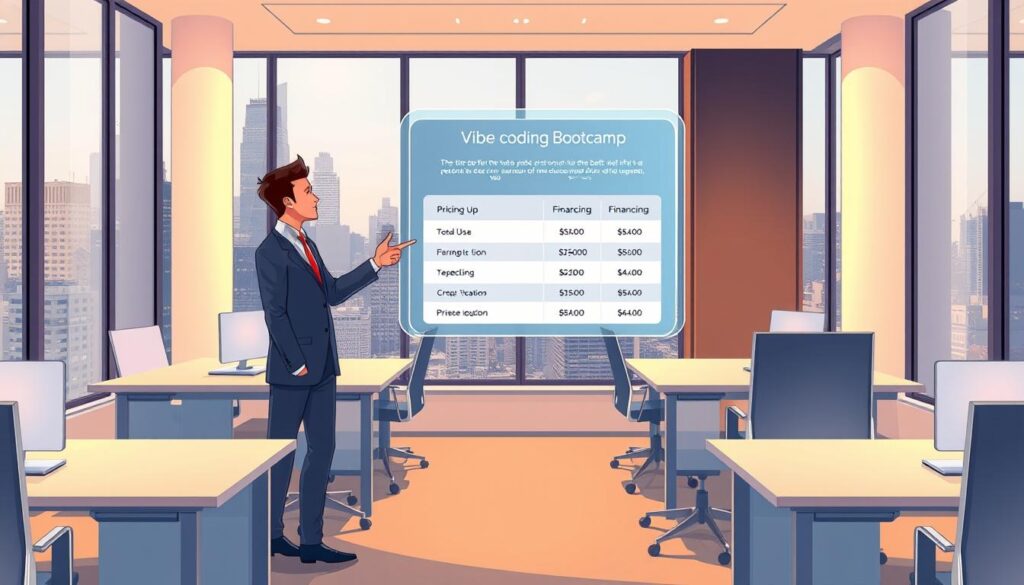
Typical tuition ranges run from about $458 for entry-level tracks to $13,995 for university-style immersives. Price reflects instructor time, career services, cohort size, and brand affiliation.
Payment options include upfront payments, deferred tuition plans, ISAs (BloomTech), and targeted scholarships such as Nucamp’s Women in Tech. Some providers add short trial windows or money-back guarantees to lower risk.
Formats and schedules
Students can choose 12–13 week full-time immersives, 24–30 week part-time tracks, hybrid models, or self-paced courses with periodic live touchpoints.
| Format | Typical Duration | Cost Range | Who it fits |
|---|---|---|---|
| Full-time immersive | 12–13 weeks (~40 hrs/wk) | $6,000–$14,000 | Career changers ready for intense training |
| Part-time / hybrid | 24–30 weeks (20–30 hrs/wk) | $1,000–$8,000 | Working professionals balancing jobs |
| Self-paced | Variable | $200–$1,500 | Students needing flexible access |
- Match financing to runway—deferred plans and ISAs align payments with outcomes.
- Value the extras: mentorship, portfolio projects, and employer networks boost hiring chances.
- Budget for incidentals like cloud credits and optional exam fees.
The vibe coding toolstack: AI copilots, IDEs, and agent workflows
A new generation of assistants now sits inside IDEs, browsers, and build pipelines to speed feature work.
These tools combine agentic prompts, inline suggestions, and fast scaffolds to boost development throughput. Cursor and Windsurf offer agent modes and large context windows for rapid edits and refactors. Replit Agents bring assistants into a browser IDE, making on-ramps easy for new builders.
Cursor, Windsurf, and Replit Agents for development speed
Cursor centralizes chat-to-code flows and repo-aware refactoring for quicker iterations. Windsurf favors light, creative generation for proofs of concept. Replit Agents package previews, quick deployments, and friendly UX for novices.
Claude, GitHub Copilot, and Gemini for reasoning and debugging
Claude and Gemini excel at multi-step reasoning and explanatory transforms across files. GitHub Copilot embeds inline suggestions and test scaffolding into mainstream IDEs for established codebases.
Bolt.new and v0.dev for rapid UI and front-end scaffolding
Bolt.new and v0.dev spin up clean UI shells and component hierarchies, cutting setup time so teams focus on UX and logic.
- Adopt disciplined practices: version control, code review, and automated tests remain essential.
- Use agents for repetitive tasks; reserve guided prompts for nuanced design decisions.
- Manage context: file pinning and summarized diffs keep AI aligned as projects scale.
| Tool | Primary use | Key benefit |
|---|---|---|
| Cursor | Repo-aware refactors & chat-to-code | Faster iterations across the lifecycle |
| Claude & Gemini | Reasoning-rich generation & explanations | Better multi-step refactors and debugging |
| Replit Agents | Browser IDE assistance & quick deploys | Low friction for new developers |
| Bolt.new / v0.dev | Front-end scaffolding | Rapid UI starts and component building |
What you’ll actually learn: coding skills, projects, and best practices
Courses teach a practical path from a natural-language idea to deployable, monitored code.
From prompts to production. Learners master prompt design, translate acceptance criteria into tasks, and vet AI output line by line. They practice reading, editing, and testing generated code until it meets team standards.
Students work across the full stack: modern web front ends with React, server logic with Node.js, and persistent data in relational or NoSQL stores. Lessons include building and securing apis, modeling data, and handling common failure modes.
What the curriculum emphasizes
- Translate natural language into structured tasks that yield reliable code from assistants.
- Develop tests, logging, and error handling to keep systems robust in production.
- Create portfolio projects that include READMEs, live deployments, and documented tradeoffs.
- Earn a certificate and access lifetime course updates to remain current as tools evolve.
Practical outcome: graduates exit able to go from a blank prompt to a deployed app with tests, monitoring, and a roadmap for iteration—balancing fast building with disciplined review. For deeper reading on best practices and pair-programming, see this guide to AI-assisted workflows.
Career impact in the United States: speed, salaries, and hiring trends
Hiring trends in the United States now reward engineers who ship reliable features quickly and explain their tradeoffs.
Productivity gains matter. AI copilots can speed coding throughput by up to 70% when paired with disciplined review. That shift lets engineering teams spend less time on boilerplate and more on system design, security, and polish.
Productivity gains and the “100x developer” narrative
The 100x developer idea is less myth than leverage: strategic use of tools multiplies impact. Developers who apply AI thoughtfully deliver more value without cutting corners.
Salary signals and roles: software engineer pathways in 2025
Salary ranges remain strong. Glassdoor lists total pay near $139,644 for software engineers; base averages hover around $113,158. Indeed shows role variance from roughly $81,552 to $159,163 depending on discipline and region.
| Role | Typical range (US) | Why it pays |
|---|---|---|
| Junior Software Engineer | $80k–$110k | Portfolio projects and core skills |
| Mid-Level Engineer | $110k–$140k | Ownership and AI fluency |
| Senior / Specialist | $140k–$200k+ | End-to-end impact and architecture |
Job support: coaching, employer networks, and post-grad services
Career services shorten job searches. 1:1 coaching, mock interviews, and portfolio reviews help students convert projects into hireable evidence.
Employer networks matter. Programs with hiring partnerships and verified outcomes—like Tech Elevator’s strong graduation stats—give candidates warm intros and a faster path to interviews.
- Employers want verifiable outcomes: shipped apps, tests, and documented design choices.
- Career services that include tailored intros improve placement velocity and fit.
- Graduates who explain testing, security, and AI tradeoffs stand out in interviews.
For a look at programs with strong placement connections, see the list of those with the highest job placement.
How to choose the right program for your goals and experience
Start by mapping your timeline and desired role—this makes comparing programs far easier.
Beginners vs. developers: newcomers should chase quick wins first. Free or low-cost intros like Replit 101, ChatGPT & Python, and Vibe Coding from Scratch build momentum and basic skills fast.
Experienced learners benefit from tool-centric courses. The Complete AI Coding Course, Coursera’s Cursor AI, Cursor FullStack, and Instructa’s Ultimate Cursor AI Course sharpen throughput while reinforcing fundamentals.
Project-focused vs. fundamentals-first
Project-first tracks accelerate portfolio growth. Fundamentals-first tracks reduce brittle outcomes. The best programs blend both: deliver a working project, then teach underlying software theory and debugging.
Time, format, and certificates
Full-time immersives suit career changers; part-time fits working professionals. Certificates add signal, but hiring managers prefer real repos, tests, and live deployments.
“Pick the shortest credible path to your goal this year.”
- Match your stack choice to SPA-first web paths if you want full-stack JavaScript.
- Seek 1:1 coaching, code reviews, and active peer communities.
- Use free prompt-engineering and responsible AI modules to raise every course’s value.
Is 2025 your year to join the vibe coding movement?
An accelerated approach can unlock fast results, but it requires explicit guardrails to protect quality.
Risk, reward, and keeping control over AI-generated code
The upside is clear: faster prototyping, richer experimentation, and more time for design and systems thinking.
Mitigate downside with disciplined practices. Teach prompt hygiene, version control, dependency audits, and explainability checks on generated code.
Students retain agency by learning to read, test, and refactor AI output. Refund windows and job guarantees reduce financial risk while you focus on learning.
Updates, lifetime access, and staying current in fast-moving stacks
Choose programs that include lifetime access and frequent updates. Toolchains shift quickly; ongoing materials help graduates adapt.
Prefer courses that explain the why behind outputs so learners can reapply skills when models or IDE features change.
- Keep language precise: clear instructions lower rework and improve generated results.
- Treat learning as continuous: schedule refreshers and revisit fundamentals regularly.
- Build for maintainability: prioritize readable code and tests so teams can iterate safely.
| Focus | What to check | Practical signal |
|---|---|---|
| Risk control | Testing, audits, code review workflow | Required TDD modules and review rubrics |
| Access & updates | Lifetime content, curriculum updates | Commitment to regular releases and alumni refreshers |
| Skill longevity | Foundations, architecture, prompt strategy | Modules that teach rationale, not just output |
| Career safety | Refunds, guarantees, employer networks | Clear placement stats and trial windows |
Conclusion
Today’s training market blends fast, AI-led workflows with steady software fundamentals.
Vibe coding is now a practical approach: short courses and full immersives both teach how to ship useful projects while keeping code maintainable. Programs span budgets—from Nucamp’s part-time tracks to Fullstack Academy’s immersive curriculum and Metana’s two-phase model.
Use tools like Cursor and Claude or tools like Bolt.new and v0.dev to cut friction. Then spend the saved time on tests, architecture, and design quality so your work stands up in interviews and on the job.
For beginners, sequence a few short courses before a software engineering bootcamp. Experienced engineers can dive into advanced toolchains. Prioritize curricula that turn intent into maintainable systems: clear repos, tests, and documented tradeoffs.
Act in 2025: pick a program, ship a project, and keep learning. The intersection of AI and fundamentals opens faster paths to career growth in software development and engineering—if you pair speed with discipline.
FAQ
What is "vibe coding" in 2025 and how does it differ from traditional software development?
Vibe coding describes intent-first workflows where developers use natural-language prompts and AI assistants to scaffold apps, generate code, and automate tasks. Unlike traditional development that emphasizes hand-written boilerplate, this approach blends human design decisions with AI-generated code, accelerating prototyping and shifting the developer role toward orchestration, validation, and system design.
Who benefits most from these modern bootcamp-style programs?
Ambitious beginners, career-switchers, and experienced engineers seeking to adopt AI-assisted workflows all benefit. Programs that combine full-stack fundamentals, practical projects, and AI tooling help beginners build portfolios while enabling seasoned developers to increase productivity and learn agentic toolchains like Cursor, Replit Agents, and GitHub Copilot.
How were the best programs selected for this roundup?
Selection prioritized curriculum relevance—coverage of AI, full-stack fundamentals, and real projects—plus measurable career outcomes, flexible learning formats, and trust signals such as university partnerships, employer networks, and transparent job support metrics.
Are university-backed or independent providers better for career outcomes?
Both can be strong. University-backed programs (for example, Penn LPS) often provide recognizable credentials and structured support, while independent providers (such as Fullstack Academy or BloomTech) may offer intensive industry-aligned training, ISA options, and nimble updates to toolstacks. Evaluate placement rates, employer partnerships, and alumni outcomes.
What kinds of courses fast-start practical skills?
Short courses focused on AI-assisted development—topics like prompt engineering, Cursor or Replit-based workflows, and Python automation—are ideal for rapid skill acquisition. Look for hands-on projects, lifetime updates, and modules that teach APIs, debugging, and responsible AI practices.
How long does it typically take to build a portfolio-ready project?
Many bootcamp formats include a “quick win” phase where a basic app is built in hours; a portfolio-ready, production-like project usually requires several weeks to months depending on part-time or full-time pacing, the depth of back-end and API work, and mentorship intensity.
What is included in a full-stack fundamentals phase compared to the quick win phase?
The quick win phase emphasizes rapid prototyping with tools like Bolt.new, Cursor, or v0.dev to produce working UIs and flows. The full-stack phase covers front-end frameworks (React/SPAs), back-end routing, databases, APIs, testing, and decoding AI-generated code to ensure maintainability and security.
How much do these programs cost and what payment options exist?
Tuition ranges widely—from low-cost part-time tracks to premium full-time experiences (roughly 8 to ,995). Common payment options include upfront payment, deferred tuition, income share agreements (ISAs), scholarships, and employer sponsorship. Cost factors include instructor access, cohort size, and career services.
Do bootcamps teach responsible AI practices and debugging of generated code?
Quality programs integrate responsible AI topics, prompt safety, and methods for auditing and testing AI-generated code. Students learn how to validate outputs, handle edge cases, and apply secure coding and error-handling best practices across the stack.
Which tools and copilots are most common in modern toolstacks?
Toolstacks often combine development copilots and agents—Cursor, Replit Agents, Windsurf—for rapid iteration; Claude, GitHub Copilot, and Google Gemini for reasoning and generation; and front-end scaffolding tools like Bolt.new and v0.dev to speed UI development.
How do career services impact hiring outcomes?
Strong career services—1:1 coaching, resume and portfolio review, employer networks, and interview prep—significantly improve placement rates. Programs that report transparent hiring metrics and maintain employer relationships offer the most reliable pathways to roles in software engineering.
Are guarantees or refunds common?
Some providers offer money-back guarantees, job guarantees, or refund policies tied to specific outcomes. Terms vary, so review contract details: eligibility windows, job search requirements, and what counts as a qualifying role.
How should a learner choose between project-first and fundamentals-first tracks?
Beginners benefit from fundamentals-first curricula that build coding literacy, testing, and architecture. Learners with some experience often accelerate faster in project-focused tracks that emphasize building deployable apps and integrating AI tools into real workflows. Match the track to prior experience and career goals.
Will these programs teach APIs, databases, and deployment?
Yes—top programs cover APIs, relational and NoSQL databases, authentication, error handling, and deployment pipelines. They emphasize end-to-end projects so students can demonstrate production-grade code quality and integrations.
How do alumni maintain skills after graduation given fast-moving stacks?
Look for lifetime access to course materials, ongoing updates, alumni communities, and periodic workshops. Continuous practice with current tools—GitHub Copilot, Claude, Cursor—and participation in open-source or freelance projects keeps skills market-ready.
Can experienced developers still gain value from these bootcamps?
Absolutely. Seasoned developers gain exposure to agent workflows, new AI copilots, and rapid prototyping patterns that raise productivity. Courses that focus on integrating AI into engineering workflows and prompt engineering offer concrete returns for experienced practitioners.
What outcomes are realistic for graduates in the United States?
Realistic outcomes include accelerated time-to-hire for entry-level roles, career transitions into software engineering, and productivity gains for existing engineers. Salary expectations depend on region and role, but strong portfolios, practical projects, and hands-on career support materially improve hiring prospects.