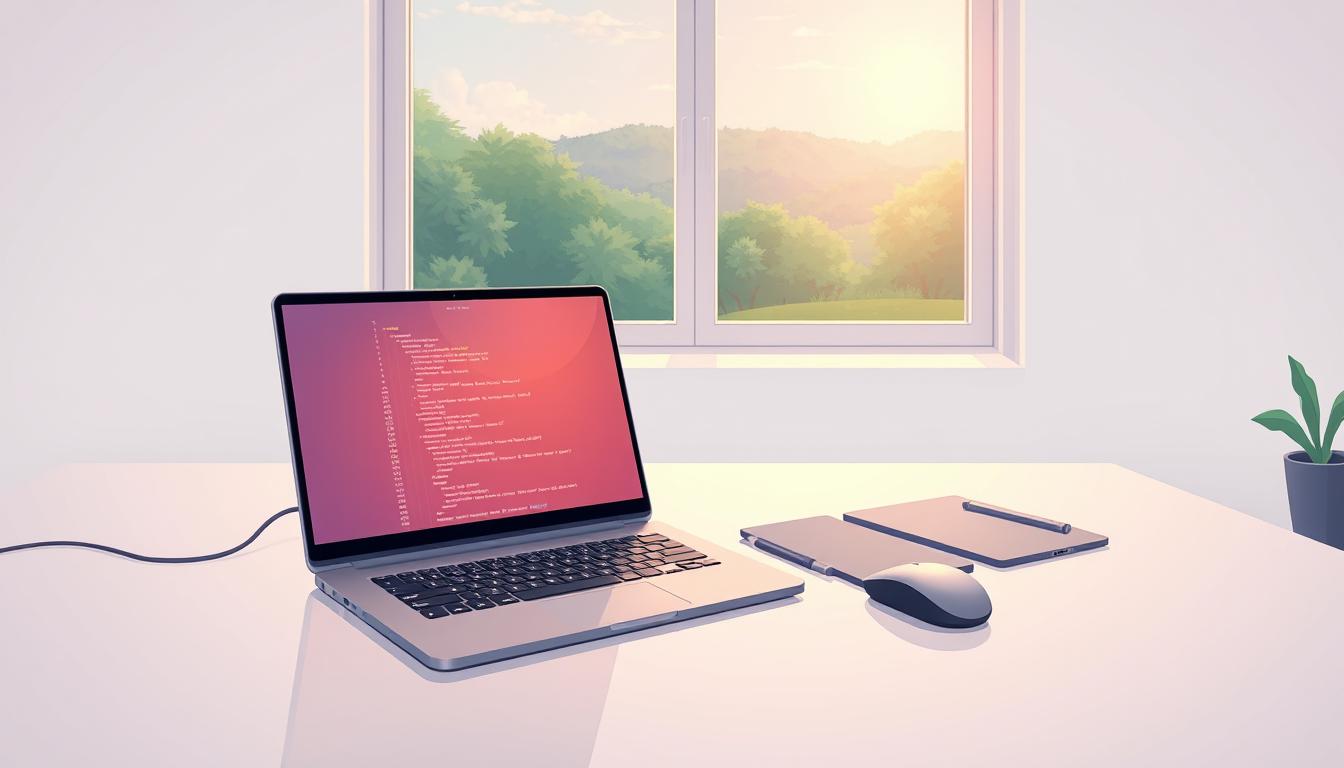
There are moments when a project feels alive before a single line of code is written. That sense—equal parts intention and craft—drives this guide. It speaks to designers and developers who want tools that turn visual ideas into reliable, scalable results.
The piece defines vibe development as the alignment of code quality, visual choices, and human-centered experience. Readers will learn which tools map intent to output, where each framework shines, and what trade-offs to expect.
We blend practical examples—Processing, p5.js, OpenFrameworks—with strategic advice. The aim is clear: fewer context switches, faster iteration, and measurable gains in feedback loops.
Key Takeaways
- Vibe development links visual intent to technical practice for consistent results.
- Choose tools based on goals: prototyping, performance, or accessibility.
- Examples like p5.js show how sketches scale into optimized applications.
- Design choices—colors, fonts, themes—improve developer experience and clarity.
- Teams gain faster feedback and fewer context switches when workflows are aligned.
Why “vibe development” matters: aligning code, colors, and experience
When teams align visual intent with technical work, products feel coherent and deliberate. This intentional approach connects developer decisions—editor choices, render paths, and runtime feedback—to the feelings a user takes away. The result is clarity: fewer distractions, faster iteration, better outcomes.
User intent and what you’ll learn in this how-to guide
We show how to set intent first: define what users should feel and do, then map those goals to tools and workflows.
The guide covers practical steps—from selecting a theme to choosing readable colors and lowering cognitive load—so teams can adopt a repeatable approach that supports both prototyping and production.
Past to present: the evolution from plain editors to personalized platforms
Development moved from monochrome terminals and editors like Vim and Emacs to highly tweakable tools such as Sublime and VS Code.
Communities like r/unixporn grew rapidly, reflecting a shift toward personalization. Research on cognitive load suggests that reducing visual noise and improving contrast frees mental resources for problem solving.
- Small changes matter: consistent theme and readable color pairings improve flow.
- AI copilots: they amplify intent when paired with clear environment choices.
Aesthetic coding frameworks: what they are and how they shape your workflow
Practical toolsets shape both the look of a project and the pace at which teams iterate. These ecosystems prioritize visual output and tight feedback loops so programming decisions show up on screen quickly.
They bundle choices about structure—file layout, rendering cycles, and asset pipelines—so teams move cleanly from prototype to production. Editor themes and runtime HUDs help too: consistent naming, color maps, and overlays speed comprehension and reduce errors.
Defining aesthetics in programming: themes, structure, and feedback loops
Good platforms enable rapid sketching of visuals and quick iteration on parameters. Teams spend less time wiring boilerplate and more time testing interactions.
Shared conventions matter: reusable components, clear module boundaries, and consistent naming create a common mental model. The faster the visual feedback, the more reliable the team’s convergence on intent.
- Reduced context switching: fewer manual steps, more focused loops.
- Tight iteration: change code, see results, refine.
- Scalable structure: prototypes that become maintainable apps.
| Focus | Benefit | When to pick | Trade-off |
|---|---|---|---|
| Render-first tooling | Immediate visual feedback | Rapid prototyping | May need refactor for performance |
| Opinionated structure | Consistent builds and assets | Team projects | Less flexibility early on |
| Theme-rich editors | Faster debugging and clarity | Long-term maintainability | Requires agreed conventions |
| Language-specific tools | Optimized performance | Production targets | Smaller community for niche tools |
These platforms are not one-size-fits-all. We’ll next map specific options to use cases so teams can choose the right framework for their language, platform, and performance needs.
Choosing your framework: Processing, p5.js, OpenFrameworks, Cinder, and beyond
A framework choice sets the tempo for iteration, performance, and platform reach. Teams should weigh language fit, community support, and available resources before committing.
Processing and p5.js excel for rapid visual exploration. They offer tight feedback loops, approachable APIs, and many tutorials—ideal when iteration speed matters more than raw native performance.
OpenFrameworks often wins for C++ work. Developers favor it for active maintenance, a large community, and the collaboratively written ofBook. That resource covers project structure, 2D/3D graphics, OpenGL meshes and shaders, audio, networking, and math via GLM.
“OpenFrameworks provides familiar functions for those coming from Processing, easing cross-framework porting.”
Quick comparison by language, community, and resources
- Processing / p5.js — best for teaching, prototyping, and web-first demos.
- OpenFrameworks — strong for native installations and performance-critical apps.
- Cinder — elegant and powerful; reviewers note OpenFrameworks often has faster onboarding.
| Toolkit | Language | Strength | When to pick |
|---|---|---|---|
| Processing | Java | Easy learning curve, abundant tutorials | Teaching, desktop sketches, fast prototyping |
| p5.js | JavaScript | Web delivery, live demos, low friction | Browser-first projects, shareable examples |
| OpenFrameworks | C++ | Deep community, ofBook, GLM, native performance | Installations, performance apps, long-term projects |
| Cinder | C++ | Polished API, professional tooling | Experienced C++ teams seeking elegance |
Match the approach to goals: validate visuals quickly in Processing or p5.js, then move to OpenFrameworks when native support and higher performance become priorities. Prototype the same concept in two toolkits to compare iteration speed and integration effort before committing.
Set up your vibe-ready environment before you code
Start by tuning the tools that shape how a project feels before any sketch runs. A stable stack reduces distractions and speeds iteration.

Editors and IDEs
Standardize on VS Code, Neovim, or JetBrains IDEs with synced settings. Keep fonts, icons, and formatting consistent so projects look and behave the same across machines.
Terminals and shells
Pick a GPU-accelerated terminal—iTerm2, Alacritty, Kitty, or Windows Terminal—and pair it with Oh My Zsh + Powerlevel10k, Starship, or Fish. Clear prompts show diagnostics and git status without clutter.
Colors and fonts
Choose a theme that balances contrast and comfort: Dracula, Nord, Catppuccin, or Tokyo Night. Use JetBrains Mono, Fira Code, or Cascadia Code for legible glyphs and helpful ligatures.
Cookie and external media considerations
Plan consent flows: essential cookies like Borlabs set “borlabs-cookie” for one year. External Media is blocked by default until users accept.
- Disclose embedded providers and cookie names—Google NID (6 months), Vimeo vuid (2 years), OpenStreetMap (1–10 years).
- Prefer consent-by-interaction overlays and tag embeds for easier audits and content reviews.
| Area | Recommendation | Why it matters |
|---|---|---|
| Editor | VS Code / Neovim / JetBrains | Consistent workflow and synced themes |
| Terminal | iTerm2 / Alacritty / Kitty | GPU acceleration and clear diagnostics |
| Fonts & Colors | JetBrains Mono; Dracula, Nord | Readability during long sessions |
| Embeds | Consent overlays; tag providers | Privacy, performance, and legal clarity |
Implementing visuals with Processing and p5.js: a step-by-step approach
A repeatable project setup makes experiments easier to reproduce and share. Start with a clear folder layout: sketches, assets, and helpers. Name files by intent and add tags in comments so refactors remain effortless.
Project structure and tags for content organization
Define a top-level README that lists canvas size, frame rate, and a random seed. Keep a palette module for semantic colors: background, primary, and highlight. Document choices so collaborators can reproduce visuals.
Sketch setup, color palettes, and performance-friendly loops
In setup(), set explicit canvas size and frameRate targets. In draw(), avoid allocations and heavy branching; cache values and reuse buffers. Encapsulate mouse and key handlers so visuals can be tested without input.
Exporting and sharing: from local demos to embedded content
Script local recording and GIF/MP4 exports with filenames that encode parameters and timestamps. For web embeds, serve a static poster and a click-to-load control to save resources and respect consent. Include fallback text and a link to source code for accessibility.
| Area | Recommended file | Why |
|---|---|---|
| Sketches | sketch.js / main.pde | Clear entry point and naming by intent |
| Assets | /assets/{images,sounds} | Cacheable and easy to swap |
| Helpers | /lib/{palette,utils} | Shared logic and palette module |
Building with OpenFrameworks: C++ power for performance and aesthetics
OpenFrameworks gives C++ projects a pragmatic path from sketch to production without unnecessary friction. It maps familiar Processing idioms to native tools so teams can advance visuals with predictable results.
Scaffolding an OF project with clear modules and namespaces
Start with a simple layout: app core, rendering, input, and utils. Use namespaces for math, colors, and constants to prevent collisions and clarify intent.
Using GLM, ofNoise, ofClamp, and time-based animation
Lean on glm::vec2/vec3 for math and pair them with ofNoise() for organic motion. Use ofClamp() to keep values stable. Drive motion from ofGetElapsedTimef() and ofDegToRad() so animation runs consistently across machines.
Interactive scenes: ofEasyCam for camera and input
Adopt ofEasyCam to orbit, pan, and zoom. It makes 3D scenes explorable and speeds composition decisions during iteration.
Porting ideas from Processing to OpenFrameworks cleanly
Map constructs to OF equivalents and keep small parity tests. Profile early to find CPU vs. GPU hotspots. Encapsulate shaders and document parameters so designers and engineers can tweak look without altering core code.
- Keep a minimal reproducible example to isolate regressions.
- Profile often and adjust buffers, draw calls, and formats for best performance.
Hands-on examples that support vibe development
Concrete experiments bridge formulas and visuals so teams can iterate confidently. The two examples below show how practical choices turn math into expressive motion without sacrificing performance.
Pixel fluid simulation: translating formulas into beautiful motion
Begin with a data structure that separates velocity, density, and divergence. Step fields using stable advection and diffusion to keep visuals coherent.
Validate on a small grid first; once behavior is correct, increase resolution and monitor frame times and artifacts. Add controlled turbulence with ofNoise(), and clamp extremes via ofClamp() so the system stays stable.
Map velocity magnitude or vorticity to hue and brightness so viewers can read flow intuitively. Porting a Processing sketch into OpenFrameworks shows how the same visual approach can move across technologies with careful API mapping.
Mandelbulb 3D: parameters, color mapping, and camera control
Implement the iterative Mandelbulb formula and expose power, iterations, bailout, and step size as parameters. Start with power 8 to balance surface detail and render cost.
Use ofEasyCam for orbit and zoom. Color gradients tied to iteration counts or distance estimates reveal structure without harsh contrast.
- Keep math, color mapping, and camera modular so one change won’t destabilize others.
- Cache costly work or use coarse steps during preview; refine for captures to stay interactive.
- Document presets as JSON so artists and engineers can share looks without touching code.
AI-powered assistance for vibe coding
The rise of practical AI assistants shortens the loop between idea and working code. Teams gain real-time suggestions, voice-driven sketches, and low-code interfaces that speed prototyping without sacrificing intent.
Getting started with GitHub Copilot inside your editor
Start with GitHub Copilot for inline suggestions that respect local context, tests, and patterns. It accelerates common routines so teams stay focused in the editor.
Going deeper with Cursor and voice-to-code workflows
Explore Cursor to add conversational and voice-to-code interactions. This reduces friction during brainstorming and helps shape scaffolds you can refine quickly.
Prototyping apps and internal tools with Lovable and Retool
Use platforms like Lovable to empower non-programmers and Retool to assemble internal tools fast. Both lower time-to-value with components and API connectors.
Reviewing AI-generated code for quality, security, and structure
- Treat AI output as a first draft: lint, test, and threat-model before merging.
- Set guardrails: formatting, static analysis, and CI gates to enforce standards.
- Log AI decisions and generate docs alongside implementations for traceability.
Calibrate expectations: AI offers rapid support for exploration, not replacement for engineering judgment. Observe trends, adopt what brings value today, and keep an eye on the future.
Performance, accessibility, and ergonomics: make the aesthetics work
Making visuals feel good requires attention to frame budgets, legibility, and the human factors that shape long sessions. This section shows practical steps to keep experiences smooth and readable for everyone.
Frame rates, GPU usage, and shader considerations
Profile where frames are spent—CPU versus GPU—and act on data before optimizing blindly. Start by measuring shader passes, buffer updates, and draw calls.
Batch state changes, prefer instancing when possible, and monitor GPU timings and memory. Add resolution scaling and frame caps so the demo adapts to varied hardware.
Contrast, color blindness, and readable themes for all
Validate contrast ratios and provide palettes that work for common color vision differences. Readable themes reduce cognitive load during long editing sessions.
Provide non-color cues—icons, line weight, and patterns—so meaning survives when color perception or themes change.
Cost-effective upgrades that improve comfort and focus
Ergonomic gains often beat flashy gear: monitor height, chair adjustment, and keyboard angle yield big returns per dollar. Respect time-on-task limits—break reminders and evening dimming reduce fatigue.
Log performance budgets in comments and doc files so teams know targets and trade-offs.
| Focus | Action | Why it matters |
|---|---|---|
| Frame budget | Profile CPU/GPU, reduce draw calls | Keeps visuals stable under load |
| Accessibility | Contrast checks, color-blind palettes | Improves legibility for all users |
| User controls | Dynamic scale, effect toggles | Preserves experience on varied hardware |
| Ergonomics | Adjust setup, schedule breaks | Reduces fatigue, increases effective time |
Resources, learning paths, and communities to sustain momentum
A clear learning path and active communities keep momentum after the first prototype. Practical guides, curated examples, and peer review shorten the time from experiment to dependable work.
Start with structured material: the ofBook offers a stepwise path through OpenFrameworks—project layout, vectors and polylines, GLM math, meshes, shaders, sound, and networking. It builds fundamentals before deep specialization.
Pair study with examples: Daniel Shiffman’s Coding Train videos are ideal for hands-on learning. Reproducing tutorials like fluid simulation or Mandelbulb gives quick intuition that informs larger programming choices.
For lower-level control, try SFML as a friendly C++ layer over OpenGL. SDL2 and GLFW remain valuable when one wants direct access to the rendering stack and finer buffer management.
- Join forums, Discords, and repos to exchange snippets and critiques.
- Curate a private library of presets and snippets; it compounds value across projects.
- Set small milestones—render, shader, interaction—to make progress visible.
- Compare technologies with short spikes to learn trade-offs firsthand.
| Resource | Best for | Why use it |
|---|---|---|
| ofBook | OpenFrameworks fundamentals | Structured chapters on project setup, math, and pipelines |
| Coding Train | Hands-on tutorials | Replicable examples that build intuition fast |
| SFML | C++ with less boilerplate | Windowing, events, and drawing without deep setup |
| SDL2 / GLFW | Low-level control | Direct rendering stack access; good for learning buffers |
Keep an eye on the future of drivers, APIs, and editor tools—but adopt changes when they offer clear wins. Together, these resources and communities sustain growth and sharpen judgment.
Conclusion
When teams lock small habits into place, the sum of those changes drives reliable creative output.
Vibe development makes aesthetics and interaction a practical part of delivery. Prototype in Processing or p5.js, then harden performance in OpenFrameworks to keep the original feel. Consistent themes, legible palettes, and sensible fonts cut friction so ideas move from draft to ship fast.
AI assistance speeds iteration but must live behind reviews and tests. Treat documentation and export pipelines as content that carries intent; that makes work reproducible and easy to teach others.
Small improvements compound over time: better camera controls, a stable code base, and clear community resources all become part of long-term success. With these practices, teams turn vision into software that looks right, works right, and feels right to build.
FAQ
What is "vibe development" and why does it matter for visual projects?
Vibe development is the practice of aligning code, colors, performance, and interaction to create a cohesive user experience. It matters because aesthetic choices influence perception, usability, and emotional impact; well-crafted vibes make demos feel polished, guide attention, and improve retention.
Which tools are best for rapid visual prototyping: Processing or p5.js?
Processing and p5.js excel at quick iteration and creative exploration. Choose Processing for Java-based desktop projects and strong educational resources. Choose p5.js for web-first work, easy embedding, and fast sharing. Both have low barriers to entry and rich community tutorials.
When should a team pick OpenFrameworks or Cinder over lighter libraries?
Pick OpenFrameworks or Cinder when performance, native C++ integration, and fine-grained control matter—such as GPU-heavy visuals, complex simulations, or production-grade installations. They offer robust libraries, community support, and better multithreading and resource control than many web-focused tools.
How should developers structure projects for maintainability and collaboration?
Use clear folders for assets, source, and builds; adopt tags and consistent naming for sketches and modules; document public APIs and data flow; and keep visual logic separated from input and rendering. This reduces friction when porting between Processing, p5.js, and OpenFrameworks.
What editors and terminal setups support a vibe-ready environment?
VS Code, Neovim, and JetBrains IDEs provide strong theme and extension ecosystems. Pair them with modern terminals—iTerm2, Alacritty, Kitty, or Windows Terminal—and shells like Zsh (with Oh My Zsh), Fish, or PowerShell plus Starship or Powerlevel10k for consistent prompts and productivity.
Which color themes and fonts improve focus and legibility?
Themes such as Dracula, Nord, Catppuccin, and Tokyo Night balance contrast for long sessions. Fonts like JetBrains Mono, Fira Code, and Cascadia Code offer clear glyphs and ligatures that speed reading. Prioritize contrast and test for color-blind accessibility.
How can one optimize performance for real-time visuals and shaders?
Profile frame rates and GPU usage, minimize draw calls, batch geometry, and keep loops performant. Use time-based animation and efficient noise functions (e.g., ofNoise or GLSL noise) and offload heavy work to shaders and GPU buffers whenever possible.
What practices improve accessibility in visually rich projects?
Ensure sufficient color contrast, provide alternative text or descriptions for demos, avoid flashing content above seizure thresholds, and allow users to toggle visual intensity or simplify effects. Test with color-blind simulators and keyboard-only navigation.
How do you export and embed interactive sketches for the web?
For p5.js, export as standard HTML/CSS/JS and host or embed with iframes. For Processing, use Processing.js or convert logic to p5.js when web delivery is required. Optimize assets and consider cookie and media policies when embedding third-party content.
Can AI tools assist with vibe-focused development, and how to use them safely?
AI tools like GitHub Copilot, Cursor, and voice-to-code systems accelerate prototyping by suggesting code and patterns. Use them for scaffolding and ideas, but always review generated code for security, performance, and licensing. Treat suggestions as drafts that require human validation.
What resources help deepen skills in visual programming and platforms?
Core resources include ofBook for OpenFrameworks, the Coding Train for p5.js tutorials, official docs for Processing and Cinder, and community forums on GitHub and Stack Overflow. Supplement with examples, reference links, and curated learning paths for steady progress.
How do you port a Processing sketch to OpenFrameworks effectively?
Map high-level constructs to C++ equivalents, isolate rendering and state, replace Java APIs with OpenFrameworks modules (GLM, ofNoise, ofMesh), and adapt memory management. Start with a minimal sketch, iterate, and run performance tests after each porting step.
Which complementary technologies should projects consider (SDL2, SFML, GLFW)?
SDL2, SFML, and GLFW provide cross-platform windowing, input, and multimedia support that complement OpenFrameworks and Cinder. Choose based on language bindings, platform targets, and community examples to extend functionality like sound, networking, or custom input handling.