There is a familiar ache when a planner watches a well-crafted session room stay half full. That feeling—of missed connections and lost potential—drives a search for smarter ways to align content with people. Planners want less guesswork and more moments that matter.
Today’s systems can read past behavior, honor preferences, and nudge attendees toward sessions that fit their goals. Research shows 70% of attendees skip valuable sessions due to discovery problems, and behavior-based targeting can lift engagement by up to 40%.
When planning leans on intelligent agendas, the promise is clear: fewer distractions, better matches, and higher satisfaction without extra staff burden. Real-time updates and continuous learning help events improve with each run.
Readers who plan conferences, manage venues, or lead event teams will find practical steps ahead—how to prepare data, set constraints, integrate tools, and measure real ROI. For a deeper look at how these systems improve event management, see this practical guide.
Key Takeaways
- Personalization raises value: behavior-based matching boosts engagement and satisfaction.
- Less friction, more focus: living agendas guide attendees to relevant sessions in real time.
- Measure what matters: track attendance, satisfaction, and repeat engagement to build the business case.
- Privacy first: opt-in controls and encryption keep recommendations trustworthy and inclusive.
- Repeatable impact: continuous learning turns each event into a better predictor for the next.
Why Automated Event-Agenda Scheduling Matters Now
Static agendas leave attendees to scan dozens of options and decide without context. That gap costs time and weakens the event experience: EventMobi found 70% of attendees miss valuable sessions due to discoverability and timing.
When discovery fails, planners watch engagement fall and perceived value drop. Less engagement means fewer renewals and weaker feedback—outcomes that hit the bottom line and long-term reputation.
Expectations have shifted. Streaming and ecommerce platforms set a new standard: people expect relevant guidance, not raw lists. Forrester reports behavior-aligned personalization can lift session engagement by 25%+.
Automated agendas address this need at scale. They improve efficiency for planners and increase participation without forcing dozens of manual agenda variants.
Benefits compound: better discoverability reduces missed moments, drives higher attendance across tracks, and produces richer insights for future planning. Scaled personalization also widens reach—making content relevant for new professionals, executives, and regional leaders in the same event.
For readers ready to move from intent to implementation, learn more about practical steps and tools in the next sections.
What AI-Powered Scheduling Is and How It Works in Event Management
Adaptive schedule software replaces guesswork with optimized matches between people and sessions. This system converts a static list into an adaptive engine that optimizes efficiency, accuracy, and scale for event management.
How it learns: The engine ingests behavioral data — registrations, session check-ins, app engagement, email clicks, downloads, ratings, and networking — to shape real-time recommendations. As attendees signal interest, the system reprioritizes content and rebalances personal schedules to keep relevance high.
Operations align: Management gains a single source of truth linking rooms, capacities, speakers, and constraints with demand signals. That reduces manual errors and improves resource allocation across events.
Cross-industry fit and tools
Healthcare tracks continuing education credits; education syncs workshops; corporate events tune tracks by role. The core engine stays the same while business rules change by industry.
- Platforms range from association clouds like Glue Up to planning platforms like Planning Pod and content assistants such as ChatGPT.
- Governance—encryption, permissions, and compliance—remains a priority.
- Deployment scales from pilot trials to enterprise plans, letting teams expand as insights compound.
| Feature | Benefit | Example |
|---|---|---|
| Behavioral data feeds | Personalized recommendations | Priority sessions based on app clicks |
| Real-time adaptation | Less disruption; higher attendance | Auto-rebalance when a room fills |
| Operational sync | Single source of truth for planners | Room capacity tied to live demand |
| Compliance & security | Trustworthy personalization | Encryption and permission layers |
AI Use Case – Automated Event-Agenda Scheduling: A Step-by-Step Implementation
Start with a clear plan that ties data to operations. The goal is to convert behavioral profiles into reliable schedules that match attendee needs and venue limits.
Prepare the data
Unify profiles, attendance history, app interactions, downloads, ratings, and networking signals. Clean the dataset and set consent and retention rules. Feature engineering then creates topic affinities, dwell time, and responsiveness indicators for models.
Configure models
Compare simple segmentation with behavior-based recommendations. Collaborative filtering and content-based approaches can lift engagement by up to 40% versus static lists.
Set rules and constraints
Encode room capacities, speaker timing, buffer windows, and conflict rules so the generator honors real-world limits.
Integrate and test
Connect CRM, registration, mobile apps, emails, and analytics so updates flow instantly. Run dry runs, pilot cohorts, and A/B tests to validate performance before full rollout.
“Behavior-based engines consistently outpace static segmentation on engagement.”
| Step | Focus | Outcome |
|---|---|---|
| Data prep | Profiles & consent | Clean, compliant input |
| Modeling | Behavior vs. segment | Higher relevance |
| Constraints | Rooms & speaker slots | Operationally valid schedules |
| Testing | Pilots & dry runs | Smoother rollout |
Delivering Real-Time, Personalized Agendas and Smart Networking
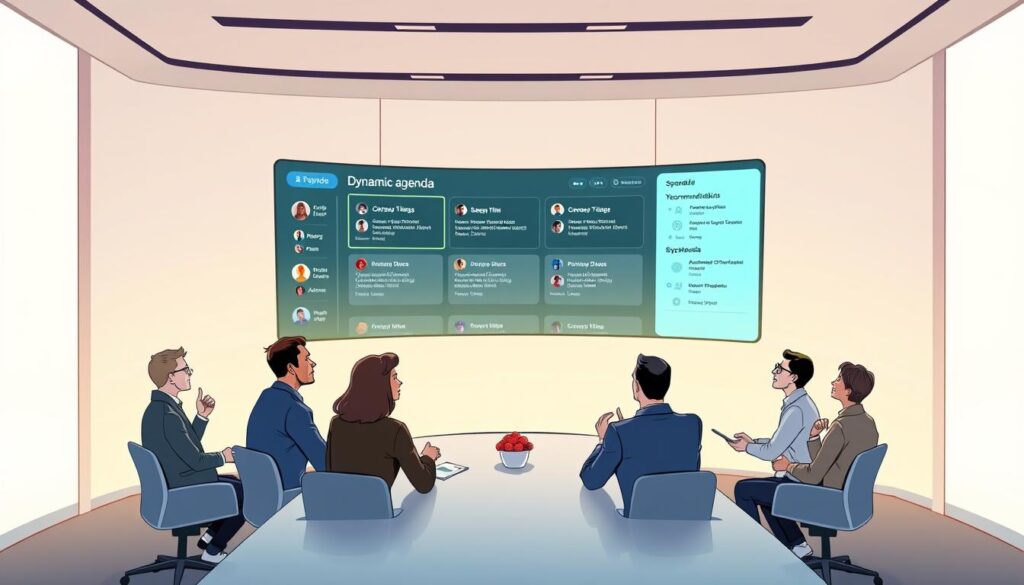
Real-time agenda updates steer attendees toward high-fit sessions as rooms fill or speakers shift. Dynamic recommendations update each attendee’s schedule with minimal interruption, preserving relevance while the event evolves.
Similarity matching checks topic, level, and proximity. When a session fills or changes, the system suggests an alternate that matches interest and is nearby. Forrester notes behavior-aligned personalization can lift engagement by 25%.
Clear nudges reduce navigation stress and improve the overall attendee experience. Simple controls let people accept, snooze, or decline a suggestion—so transparency builds trust.
Intentional matchmaking and moments to meet
Matchmaking uses shared roles, region, and session overlap to propose meaningful connections. Bizzabo found 65% of professionals link real-time flexibility to higher satisfaction.
- Networking: curated introductions based on session history.
- Moments: breaks and co-located sessions become structured networking opportunities.
- Metrics: track recommendation acceptance, reroutes, and networking matches that convert to meetings.
“Behavior-based recommendations consistently improve attendance and dwell time.”
Choosing Your Tech Stack: AI Tools and Automation for Event Planners
A compact set of well-integrated tools can transform daily operations for event teams. The right stack reduces manual work, speeds decision cycles, and protects attendee trust through encryption and compliance.
Selection criteria
Prioritize security, clear pricing tiers, proven scalability, and intuitive interfaces. These factors cut adoption time and lower long-term costs for venue and association management.
Chatbots, translation, and voice
Chatbots handle FAQs, reminders, RSVPs, and post-event feedback, freeing teams for strategic tasks. Live translation, captions, and voice services expand accessibility and deliver timely announcements across languages.
Matchmaking and scheduling engines
Matchmaking software recommends connections and content; scheduling engines keep personal agendas relevant when rooms fill. Integration with CRM and mobile apps ensures data flows without duplication.
- Map tools to needs: venues need layout and check-in; associations need CRM ties; corporate teams require analytics.
- Insist on APIs or native connectors so management tools talk to registration and email systems.
- Prototype with pilot events, then scale and standardize governance.
| Vendor | Strength | Best for |
|---|---|---|
| Glue Up | CRM & personalization | Associations |
| Planning Pod | Operations & diagrams | Venues |
| ChatGPT | Rapid content generation | Agendas & messaging |
“Consolidated management reduces context switching and improves time-to-launch.”
Measuring Impact: KPIs, Insights, and Continuous Improvement
A clear KPI framework turns scattered signals into decisions that improve future events. Measurement ties engagement to action. Planners who track focused metrics turn short-term results into long-term improvements.
Engagement metrics: session attendance, dwell time, and content interactions
Define success with three core measures: session attendance, dwell time, and content interactions. These reveal whether the agenda matched audience intent.
Attendance counts matter, but dwell time and interactions tell the deeper story about attendee engagement. Track recommendation acceptance and networking conversions to quantify personalization performance.
Compounding intelligence: using feedback loops to refine future schedules
Every click, rating, and session choice becomes training data for future events. Gartner (2024) reports continuous learning models lift satisfaction by 30% and repeat engagement by 24%.
Make learning routine: ingest post-session ratings, app signals, and reroute statistics so each event feeds the next one. Over time, insights reduce conflicts and raise relevance.
Reporting that informs planning decisions for future events
Design dashboards that translate metrics into clear decisions for planners and leadership. Tie insights to programming, sponsorship value, and resource allocation.
- Standardize a 7–14 day post-event review to capture lessons fast.
- Correlate engagement with renewals and pipeline to validate business impact.
- Experiment with notification cadence and layout to refine the process.
“KPIs that connect engagement to outcomes make it easy to prioritize changes and win stakeholder support.”
Governance, Accessibility, and Trust in AI-Driven Agendas
Clear governance turns a recommendation engine into a trusted partner for planners and attendees. Transparent rules, concise policies, and visible controls make the system predictable and safe for every event.
Data privacy and security: encryption, compliance, and transparent use
Platforms should prioritize encryption, secure access controls, and compliance with GDPR and similar rules. Limit collection to necessary signals, define retention windows, and separate identity from analytics.
Publish a short governance policy that explains data sources, consent steps, and escalation paths so management and legal teams can audit practices easily.
Inclusive experiences: opt-in controls, multi-language support, and mobile-first access
Give attendees clear opt-in choices and an explanation of “why this” for recommendations. Multi-language interfaces, captions, and a mobile-first design broaden access across roles and regions.
Human-in-the-loop: artificial intelligence assists planners without replacing them
Staff retain judgment: automation handles operational complexity while humans shape programming and community norms. Train teams with playbooks for capacity issues, speaker changes, and network failures.
- Trust pillars: transparent data use, encryption, permissions.
- Bias checks: monitor diversity in recommendations and add feedback tools.
- Venue prep: align vendors on security and mobile access for smooth on-site management.
“Automation should increase efficiency without obscuring planner control.”
Conclusion
Intelligent agenda workflows let teams move from firefighting to deliberate program design. Automated scheduling builds the right agenda for every attendee at scale, while freeing teams to focus on strategy and content quality.
Start pragmatic: prepare data, configure behavior-driven models, set constraints, integrate management tools, then test and launch with clear KPIs.
The value chain is simple: smarter recommendations drive higher engagement, cleaner schedules, and measurable business outcomes. Begin with one tool and one event; prove value and expand across portfolios.
Planners remain the architects of community and content. Trust by design—opt-in controls, transparent rationale, and robust security—keeps attendees confident as systems learn and improve for future events.
FAQ
What is automated event-agenda scheduling and why does it matter now?
Automated event-agenda scheduling uses intelligent systems to create and adapt agendas in real time. It matters because modern events need to be flexible, personalized, and scalable; this approach reduces manual coordination, increases attendee engagement, and helps organizers deliver higher-value experiences.
How do behavior and engagement data shape personalized agendas?
Systems analyze attendee profiles, historical attendance, app interactions, and feedback to detect interests and intent. Those signals drive session recommendations and routing, ensuring attendees see relevant content and networking opportunities as their needs evolve.
What data should planners prepare before implementing a scheduling system?
Gather attendee profiles, past attendance records, app engagement logs, speaker availability, room capacities, and post-event feedback. Clean, structured data speeds integration and improves recommendation quality.
How do planners balance automated recommendations with rules and constraints?
Configure the platform with business rules—capacity limits, speaker timing, room assignments, and conflict avoidance—so recommendations respect operational constraints. Human oversight remains essential to handle exceptions and strategic choices.
Which systems need to integrate for a smooth rollout?
Integrate registration platforms, CRM, mobile apps, email marketing, and analytics tools. Tight integration ensures consistent attendee records, timely notifications, and accurate measurement of engagement metrics.
What are the best practices for testing and launching a new agenda tool?
Run dry runs and pilot cohorts, monitor key metrics, and collect attendee feedback. Staged rollouts let teams calibrate recommendation models and fine-tune business rules before full deployment.
How do real-time recommendations improve attendee experience during an event?
Real-time recommendations adapt to shifting interests, capacity changes, and live feedback, guiding attendees to relevant sessions and networking moments. That responsiveness increases session attendance and perceived event value.
Can matchmaking features be tailored for different event types?
Yes. Matchmaking engines can be configured for conferences, trade shows, training sessions, or investor meetings, using different weighting for skills, goals, industry, or purchase intent to surface high-value connections.
What selection criteria should planners use when choosing tools?
Evaluate security and compliance, pricing tiers, scalability, ease of use, and integration capabilities. Prioritize vendors that offer clear SLAs, data controls, and ongoing support aligned with event complexity.
How can chatbots and automated messaging support attendees?
Chatbots handle common queries, send reminders, and collect instant feedback—reducing staff load while keeping attendees informed. They complement human staff and improve response times across channels.
What accessibility and inclusion features should be considered?
Ensure multi-language support, captions and transcription, mobile-first access, and opt-in controls for personalization. These elements broaden reach and create equitable experiences for diverse attendees.
How do planners measure the impact of personalized agendas?
Track KPIs such as session attendance, dwell time, content interactions, connection requests accepted, and post-event satisfaction. Use those insights to refine models and improve outcomes for future events.
How does continuous improvement work with recommendation systems?
Feedback loops collect post-session ratings, attendance shifts, and behavioral data to retrain models. Over time, this compounding intelligence boosts recommendation accuracy and relevance across events.
What governance and privacy safeguards are essential?
Adopt encryption, role-based access, clear consent flows, and compliance with regulations like GDPR and CCPA. Be transparent about how attendee data informs recommendations and provide opt-out options.
Will these systems replace event planners?
No. Intelligent tools augment planners by automating routine tasks and surfacing insights. Human judgment remains key for strategy, content curation, and relationship-building—ensuring technology amplifies, not replaces, expertise.