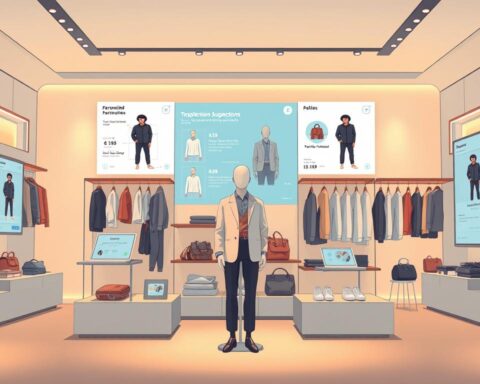
There is a quiet moment when a shopper finds a piece that feels made for them. That instant—sparked by the right suggestion at the right time—turns browsing into belonging. The gap between generic catalogs and a trusted stylist is where modern recommendation systems prove their worth.
Data drives this shift: systems read behavior, purchase and browsing history to map preferences and serve timely suggestions across web, app, email, SMS, and WhatsApp. When recommendations align with intent, customers move faster from discovery to purchase.
Retail teams see clear business benefits: higher conversion, larger average order value, and stronger lifetime value. Fast-growth brands report meaningful gains from personalization; practical details and metrics are explored in this guide and linked research at Miloriano.
Key Takeaways
- Recommendations turn data into timely, relevant suggestions that feel like a trusted stylist.
- Signals from behavior and purchase history map user intent to product fit.
- Well-placed suggestions reduce friction and lift conversion and AOV.
- Combining algorithms improves coverage across large catalogs.
- Operational governance and scalable systems keep recommendations fast and trustworthy.
What Personalized Style-Recommendation Engines Are and Why They Matter
Smart recommendation systems translate signals into useful shopping guidance. They read browsing, purchase history, preferences, and behavior to suggest products and styling choices that match a user’s intent.
At a basic level, a recommendation system delivers “recommended for you” items and size cues. At a deeper level, it provides styling advice that considers occasion, season, or climate. That context makes suggestions feel naturally helpful rather than spammy.
“Seventy-one percent of consumers expect tailored content; missed relevance drives frustration and churn.”
- Definition: reads data signals to surface products, complete-the-look bundles, and fit advice.
- Channels: activates on Web, App, Email, SMS, and social media without overwhelming customers.
- Business case: precise personalization keeps users longer, increases conversion, and supports sales growth.
- Principles: adapt recommendations in real time, protect data, and maintain consistent systems and content standards.
Bottom line: when recommendations remove friction and earn trust, the result is a better experience and stronger business performance.
How Personalized Recommendation Engines Work Under the Hood
A robust data pipeline is the unseen engine that turns clicks into timely suggestions. It begins by ingesting customer data from web and app events, purchase history, product views, and demographics.
Data must be cleaned and unified. Raw feeds contain duplicates, broken attributes, and mismatched product IDs. Deduplication and catalog harmonization make every recommendation more dependable.
Collecting and unifying signals
Systems enrich event streams with contextual media signals and session context. A Customer Data Platform (CDP) then harmonizes 100+ attributes so segments can activate in real time.
Pattern detection and segmentation
Learning algorithms scan for co-view, co-purchase, and temporal patterns to form dynamic audiences. These patterns inform both immediate recommendation slots and broader targeting.
Continuous learning loops
Clicks, add-to-carts, and purchases feed back instantly. The system updates recommendations during the same session to keep suggestions timely and relevant.
“Cleaner inputs lead to more accurate recommendations and stronger business outcomes.”
- Monitor coverage and freshness as operational KPIs—stale signals degrade results.
- Balance short-term behavior with long-term history to mix novelty and familiarity.
- Respect privacy-by-design: collect only what delivers clear value with consent and controls.
For a deeper technical primer on product recommendation pipelines, consult this product recommendation guide.
Core Algorithms: Collaborative, Content-Based, Hybrid, and Knowledge-Based
Core recommendation algorithms shape how systems translate behavior into relevant product suggestions. Each approach handles data, patterns, and user intent differently. Choosing the right mix depends on catalog size, history depth, and business goals.
Collaborative filtering
Collaborative filtering finds user-item affinity from large behavior graphs. Memory-based or model-based variants predict interests without item content. Platforms like YouTube and Coursera rely on this when purchase history and peer signals are rich.
Content-based filtering
Content-based systems match item attributes — brand, material, silhouette — to a user profile. This method helps recommend new items when peer data is sparse; Amazon and Spotify use aspects of this approach effectively.
Hybrid strategies
Hybrid approaches blend models to improve accuracy and coverage. Netflix-style stacking or sequencing mixes collaborative and content signals to serve head, mid, and long tail items across multiple recommendation slots.
Knowledge-based approaches
Rule engines and expert logic handle cold-starts and high-consideration buys. These systems apply domain constraints for size, fit, or occasion where history is limited.
“Evaluate machine learning algorithms offline and with live tests before full rollout.”
- Prefer collaborative for dense graphs; content-based for new items.
- Use purchase history and taxonomy hygiene to enrich vectors and reduce noise.
- Group similar users into cohorts to stabilize recommendations when individual data is scarce.
Generative AI’s Role in Modern Personalization
Behavioral signals and catalog metadata combine to create instant, context-aware outfit options.
Turning behavioral data into on-the-fly style suggestions
Generative systems read browsing, purchase, and profile data to craft outfit ideas that match season, event, and time. They blend short-term behavior with long-term preferences to keep suggestions fresh and relevant.
Real-time recommendations can reduce friction: a user who viewed a winter coat may see coordinated scarves and boots that fit weather and past purchases.
Dynamic creative and copy for hyper-personalized experiences
Models also produce channel-specific headlines, descriptions, and visuals that align messaging with intent. This dynamic content improves the experience across web, email, and social media without manual asset creation.
Guardrails—templates, brand guidelines, and sizing checks—ensure claims and fit advice stay accurate and safe for users.
Real-world inspirations: Amazon, Wayfair visuals, and ASOS virtual styling
Amazon augments recommendation quality with generative creative that refines product discovery at scale. Wayfair accepts user-uploaded photos and returns visually similar furniture with constraint-aware matches. ASOS applies virtual styling to factor body-type cues and cut preferences, lowering return rates.
| Company | Capability | Primary Benefit |
|---|---|---|
| Amazon | Generative product copy and suggestion ranking | Improved conversion through tailored recommendations |
| Wayfair | Visual search from user images | Faster discovery of visually similar products |
| ASOS | Virtual styling with fit-aware output | Reduced returns; higher purchase confidence |
“Generative output performs best when fed rich, clean data and clear business rules.”
Business Value: From Customer Satisfaction to Revenue Growth
When shopping feels simple and fast, conversion and average order value rise noticeably.
Reducing choice overload to increase conversion and AOV
Clear recommendations cut browsing time and guide customers toward a confident purchase.
Fewer options mean less hesitation; smart bundles and price ladders nudge higher AOV without heavy discounting.
Placing suggestions on product pages, carts, and checkout increases add-ons while protecting margin.
Boosting loyalty and engagement through relevance and timing
Consistent relevance builds trust: customers return when the journey feels curated to their needs.
Targeted messages that match intent and timing lift engagement and improve customer satisfaction over time.
We recommend measuring repeat purchase and lifetime value as primary indicators of success.
Inventory management and demand sensing with predictive insights
Data-driven patterns reveal demand shifts early, helping merchandising rebalance buys and reduce costly overstocks.
Better forecasts lower stockouts and accelerate revenue by keeping popular products available when customers want them.
Predictive recommendation signals also inform assortment and future product decisions.
- Connect recommendations to metrics: conversion, AOV, and reduced acquisition cost.
- Respect constraints—budget, delivery time, and fit—to maintain trust and repeat business.
- Encourage cross-functional feedback loops so merchandising, marketing, and operations learn fast.
| Impact Area | What to Track | Directional Benefit |
|---|---|---|
| Conversion & AOV | CTR, add-to-cart, average order value | Up to 10–20% lift in conversion and higher basket size |
| Customer Loyalty | Repeat rate, CLV, NPS | Lower acquisition costs; stronger lifetime revenue |
| Inventory & Demand | Sell-through, stockouts, pattern detection | Fewer overstocks; improved fulfillment and sales velocity |
“Personalization programs can trim acquisition costs while compounding revenue through repeat purchase.”
AI Use Case – Personalized Style-Recommendation Engines
Smart outfit assembly turns separate products into a clear look that users can buy in minutes. This approach reduces effort for the shopper and raises basket size by bundling tops, bottoms, shoes, and accessories into cohesive sets.

Outfitting and “complete the look”
Complete-the-look slots on product pages act as high-intent prompts. They recommend complementary items that match the selected product’s style and fit.
These recommendations work best when rules and feedback signals combine: visual similarity, colorway, and past purchases guide picks.
Size and fit cues
Rule-based guidance plus data feedback helps users choose confidently. Clear fit notes and size suggestions cut returns and improve satisfaction.
Cross-sell, upsell, and placement strategy
Cross-sell suggests complementary products; upsell surfaces higher-tier alternatives. Balance margin and customer value with transparent suggestions.
Map placements to intent: homepage for discovery, PDP for relevance, cart for add-ons, and lifecycle channels—email, SMS, push—for ongoing engagement.
“Sapphire achieved a 12X ROI after streamlining discovery with a smart recommender.”
| Placement | Primary Intent | Typical Recommendation |
|---|---|---|
| Homepage | Discovery | Trending products and category-based picks |
| Product Page | High relevance | Complete-the-look and fit cues |
| Cart | Purchase uplift | Complementary items and price ladders |
| Email / SMS / Push | Re-engagement | Personalized suggestions and replenishment prompts |
Merchandising teams should refresh looks seasonally and keep media-rich widgets mobile-fast. Transparency—clearly labeled recommendations—builds trust and sets expectations for customers.
Implementation Roadmap: From Pilot to Scale
Start with one placement and one metric to turn experimentation into repeatable growth. A tight pilot clarifies which data streams matter, which algorithms lift conversion, and where engineering effort pays off.
Selecting the right machine learning algorithms for your data
Choose algorithms that match catalog depth and behavior signals. Collaborative methods work when history is dense; content-based helps when product attributes are rich.
Hybrid approaches give coverage across head and long-tail items, and knowledge-based rules solve cold-starts.
Integrating data sources: Web, App, Email, SMS, and social media
Centralize customer data in a CDP with consistent IDs and taxonomy. Secure integrations reduce mismatch and make every recommendation more dependable.
Real-time pipelines and model retraining cadence
Stream events so the system adapts within the session. Define retraining tied to drift and seasonality to keep recommendations fresh over time.
Scalability planning and team enablement
Plan retrieval, caching, and vector search for millions of SKUs and users to avoid latency. Operationalize marketers with visual tools, QA gates, and safe controls.
“Start small, measure quickly, and scale the recommendations that prove measurable business lift.”
- Validate lift with one surface before broad rollout.
- Track latency, coverage, and freshness alongside conversion.
- Document governance: roles, approvals, and rollback steps.
Omnichannel and Mobile Optimization Best Practices
Consistent recommendations across channels turn scattered interactions into a single, trustworthy journey for shoppers.
Start with one recommendation brain that serves web, app, email, and messages. A single logic layer preserves intent as users shift devices and reduces duplicate or conflicting content.
Mobile commerce now dominates; fast, thumb-friendly widgets matter. Design compact carousels, scannable tiles, and clear CTAs so users can act in short sessions.
Tune copy and media by channel—short text for SMS, richer visuals for app and web—while keeping the underlying intent model steady. Cache images, optimize assets, and hit strict time budgets on cellular networks.
- Leverage device and session signals to refine ordering without being intrusive.
- Maintain parity for cart and saved lists across channels to preserve customer intent.
- Integrate in-store or event data, as Sephora does, to bridge physical and digital discovery.
- Test accessibility, contrast, and tap targets so every user benefits from recommendations.
“Consistency builds trust; speed preserves conversion.”
Ethics, Privacy, and Trust by Design
Trust begins when systems make clear what data drives each suggestion and why it matters to the user.
Programs should communicate data usage and obtain consent before personalization activates. Describe the value exchange: what customer data is collected, how it improves recommendations, and how long data is retained.
Consent, transparency, and explainability in recommendations
Give simple, readable explanations for why a user sees a product. Phrases like “because you viewed X” build trust and reduce confusion.
Offer controls so people can pause personalization, edit preferences, or clear history. These choices respect user needs and improve long-term engagement.
Bias mitigation and governance for fair outcomes
Define governance that limits who can change systems and content. Enforce review checkpoints and audit model outputs regularly.
Diversify training data, monitor for skewed behavior, and exclude sensitive attributes unless ethically justified. Retrain models on fresh, audited data to sustain fairness and accuracy.
“Effective personalization requires strong governance, robust security, and transparency about how models operate.”
- Disclose how data powers recommendations and obtain explicit consent.
- Provide clear explainability and easy user controls.
- Audit outcomes, diversify data, and schedule retraining.
- Secure customer data end-to-end with encryption and access controls.
- Document the system lifecycle and incorporate feedback loops.
| Focus Area | Action | Benefit |
|---|---|---|
| Consent & Transparency | Clear notices; opt-in controls | Higher trust and lower churn |
| Governance | Change controls and audits | Safer, accountable systems |
| Fairness | Diverse data; bias monitoring | Fairer recommendations for users |
| Security | Encryption and access limits | Protected customer data and brand trust |
For frameworks and deeper guidance on responsible practice, consult this primer on responsible governance and privacy practices.
The Tech Stack That Powers Personalization
Behind every relevant recommendation sits a coordinated set of models, databases, and streaming pipelines.
Machine learning drives ranking and retrieval while NLP interprets queries and session context. Generative models create adaptive content variations for titles and brief copy.
Audience segmentation and intent detection act as orchestration layers that pick the right recommendation strategy per user state. Dynamic pricing ties in carefully—price sensitivity and stock shape which products surface without eroding trust.
- Feature stores, vector databases, and event streams keep models synchronized.
- Modular design decouples eligibility, ranking, and presentation to speed iteration.
- Caching, batching, and fallbacks preserve latency during traffic spikes.
Governance and experiment management track model versions, metrics, and guardrails. Enterprise platforms—examples like IBM Granite families and watsonx.ai—help teams train, deploy, and monitor securely.
| Layer | Role | Primary Benefit |
|---|---|---|
| Data Pipeline | Events → feature store → vectors | Fresh, consistent inputs for models |
| Modeling | Machine learning & NLP ranking | Relevant recommendations at scale |
| Serving | Caching, retrieval, fallbacks | Low latency, resilient experience |
| Governance | Experiment, audit, deploy | Safe iteration and measured benefits |
“Pair product and engineering so marketing can iterate suggestions while protecting performance and brand standards.”
Measurement and Optimization: KPIs That Matter
A concise measurement plan separates guessing from decisions that boost conversion and lifetime value. Define a framework that connects metrics to goals so teams can act on clear signals.
Tracking CTR, conversion rate, AOV, and CLV
CTR and conversion rate show immediate engagement and purchase intent. Measure click-throughs from recommendation slots and follow-through to checkout.
AOV and CLV capture value per order and over time. Track these to understand how recommendations lift revenue and repeat sales.
Attribution for recommendation-driven revenue
Tag recommendation clicks and purchases so the business can isolate contribution. Use last-click, position-based, and incrementality tests to compare channels.
“Attribution that links clicks to purchases makes recommendation ROI visible and actionable.”
Experimentation: A/B/n tests and strategy rotation
Run controlled A/B/n tests across algorithms, eligibility rules, and creative. Validate offline on history datasets, then confirm online before scaling.
- Rotate winning strategies to new surfaces while preserving stability.
- Monitor segment lifts to improve customer outcomes and product mix.
Operational metrics: latency, coverage, and freshness
Track latency targets for fast experiences, coverage so every slot fills, and freshness so outputs reflect current data and preferences.
| Metric | What to track | Why it matters |
|---|---|---|
| Latency | Response time (ms) | Preserves engagement and conversion |
| Coverage | Slots populated (%) | Ensures consistent user experience |
| Freshness | Model retrain cadence | Prevents drift and stale patterns |
Close the loop: feed purchase history, customer data, and updated preferences back into models so performance compounds over time.
Conclusion
, Precision in recommendation logic turns scattered clicks and history into useful, timely product ideas. Discipline in data and governance makes recommendations reliable. That reliability improves the customer experience and drives measurable business results: higher conversion, AOV, and revenue.
Teams that blend strong data practices with thoughtful algorithms and creative copy can provide personalized journeys across channels without sacrificing speed or brand safety. Start with one placement and one KPI, run experiments, and let patterns in history guide model updates. Clear controls and transparency protect customer trust and boost customer satisfaction. In practice, marketing and product must collaborate so suggestions feel like service—not pressure. Pilot, learn, and scale to convert insight into outcomes for products, people, and businesses in the U.S. market.
FAQ
What are personalized style-recommendation engines and why do they matter?
Personalized style-recommendation engines are systems that analyze customer behavior, purchase history, and product attributes to suggest relevant clothing and accessories. They matter because they reduce choice overload, increase conversion and average order value, and improve customer satisfaction by delivering timely, relevant suggestions across channels.
What types of customer data power these recommendation systems?
These systems use a mix of purchase history, browsing signals, demographic data, device and session context, and social signals. That data feeds pattern detection, segmentation, and real-time decisioning to match products to individual preferences.
How is data prepared before it’s used for recommendations?
Data is cleaned, deduplicated, and unified in a customer data platform (CDP). Normalization and identity resolution create a single customer view, enabling consistent activation across web, app, email, SMS, and paid channels.
What core algorithms are commonly employed?
Common approaches include collaborative filtering (leveraging user-item interactions), content-based filtering (matching item features to user profiles), hybrid strategies that combine both, and knowledge-based rules for complex or cold-start situations.
How do these systems handle cold-start problems for new users or products?
Teams use knowledge-based rules, popularity signals, and content-based matching for cold starts. Onboarding questions, quick preference surveys, and contextual signals (e.g., referral source) also help gather initial signals rapidly.
What role does generative technology play in modern personalization?
Generative models create on-the-fly styling suggestions, personalized copy, and dynamic creatives. Retailers like Amazon and Wayfair use visual personalization and contextual recommendations to improve engagement and conversion.
Where should recommendations be placed to maximize impact?
High-impact placements include product detail pages, cart and checkout, homepages, email, push notifications, and SMS. Placement should align with intent—browse suggestions on PDPs, urgency prompts at checkout, and curated drops in email.
How do businesses measure the success of recommendation systems?
Key metrics include click-through rate (CTR), conversion rate, average order value (AOV), and customer lifetime value (CLV). Operational metrics like latency, coverage, and freshness, plus attribution for recommendation-driven revenue, are also critical.
What’s the typical implementation roadmap from pilot to scale?
Start with a focused pilot: define KPIs, select algorithms suited to your data, and integrate core data sources. Deploy real-time pipelines and set a retraining cadence. Then scale by optimizing latency, expanding SKUs, and training marketing and analytics teams to operate the system.
How do teams ensure recommendations remain consistent across channels?
Consistency relies on a central CDP and shared decisioning layer. Using unified user profiles, shared business rules, and synchronized model outputs ensures the same relevance signals drive web, mobile, email, and in-store experiences.
What privacy and ethics considerations should be addressed?
Implement consent management, transparent data practices, and explainability for recommendations. Establish governance to mitigate bias, audit models regularly, and offer users control over personalization settings to build trust.
How do organizations balance personalization with inventory and demand planning?
Recommendation systems can tie into inventory management and demand sensing to promote in-stock items, surface slow-moving SKUs, and predict replenishment needs. Aligning merchandising rules with model outputs prevents overselling and optimizes assortment.
What team skills are needed to run and evolve these systems?
Cross-functional teams are essential: data engineers for pipelines, machine learning engineers for models, product and UX designers for placement, and marketers for creative activation. Training and clear playbooks empower marketers to operate AI-led systems effectively.
How often should models be retrained and recommendations refreshed?
Retraining cadence depends on traffic and inventory dynamics—weekly or daily updates suit many retailers, while real-time learning loops are beneficial when user behavior shifts quickly. Monitor freshness, latency, and performance to decide frequency.
Which KPIs help prioritize optimization efforts?
Prioritize CTR, conversion, AOV, and CLV to measure business impact. Use A/B/n testing and strategy rotation to validate changes. Track operational KPIs—coverage, latency, and model uplift—to ensure technical reliability and broad relevance.
Can small retailers benefit from these systems, or are they only for large brands?
Smaller retailers can benefit through out-of-the-box platforms and managed services that scale recommendations without large engineering investments. Focused pilots, curated catalogs, and clear KPI targets deliver measurable returns even with modest traffic.