There are moments when a single image changes how a team thinks about safety, speed, or service. A machine that sees clearly can turn a noisy stream of visual information into calm, clear decisions that matter to people on the ground.
Computer vision blends cameras, models, and algorithms so computers can interpret images and video much like a human would. That mix powers practical outcomes: faster inspections, safer sites, and new revenue through automated applications.
Edge-capable machines bring that capability closer to where data is made—cutting latency, protecting privacy, and lowering bandwidth needs. We will outline the core process, design choices, and real-world examples so leaders can judge feasibility and ROI.
Key Takeaways
- Vision-led systems convert visual data into operational decisions that scale across processes.
- Practical definitions help teams link models and algorithms to measurable business outcomes.
- Edge inference improves latency, privacy, and cost for distributed deployments.
- Data quality and diverse datasets are essential to avoid biased performance.
- Pilots that tie model metrics to KPIs reveal true feasibility before scale.
- Explore concrete examples and tools at computer vision applications to inform strategy.
Why Computer-Vision Target Recognition Matters for Business Innovation Today
Vision systems are reshaping operations by turning everyday imagery into timely, actionable signals. This image-driven information lowers manual inspection costs and speeds interventions from factory floors to city streets.
Across healthcare, industrial automation, automotive engineering, and drone navigation, computer vision accelerates product development and improves safety. It enables early anomaly detection in medical imaging and seamless retail experiences like cashier-less checkout.
Organizations gain strategic value when models learn from continuous streams of data. That adaptability reduces the need to rebuild systems as demand and environmental changes occur. Teams can balance quick wins—occupancy counting—with high-impact projects such as ADAS features.
- Lower costs: fewer manual inspections and optimized staffing.
- Better safety: earlier hazard detection to protect humans.
- Faster innovation: mature tools and pre-trained models shorten time to market.
| Benefit | Example | Business Impact |
|---|---|---|
| Throughput | Automated inspection | Higher output, lower defects |
| Customer experience | Cashier-less checkout | Reduced friction, higher loyalty |
| Operational insight | Traffic and asset analytics | Lower OPEX, predictive maintenance |
AI Use Case – Computer-Vision Target Recognition: Fast Overview of Core Concepts
Well-designed vision systems translate images and video into automated workflows and alerts. A complete system pairs cameras and sensors with models and business logic to turn pixels into decisions.
From images to insight: pipelines start with capture, then pre-processing (denoise, normalize), followed by model inference and post-processing that triggers alerts or actuation. Edge devices reduce latency and bandwidth while keeping data private and resilient.
Detection, recognition, and tracking — practical differences
Detection finds objects and their boxes. Recognition assigns class or identity. Tracking links objects across frames. Each requires different methods and trade-offs for accuracy, speed, and hardware.
“Design the pipeline to match the goal: faster inference for alerts, richer models for identification.”
| Stage | Typical Methods | Operational Focus |
|---|---|---|
| Acquisition | RGB/thermal/depth cameras | Coverage, frame rate |
| Pre-processing | Denoising, ROI crop, scaling | Throughput, noise reduction |
| Inference | One-stage detectors, re-ID, temporal models | Latency vs accuracy |
| Post-processing | Business rules, buffering, alerts | Reliability, cost |
Practical tip: balance dataset diversity, resolution scaling, and early prototyping to reveal integration risks before wide deployment.
Transportation and ADAS: Real‑Time Object Detection on the Road
Real-time road monitoring depends on tight coordination between cameras, sensors, and optimized models. Systems must count, classify, and track vehicles and road users across lanes while meeting strict latency targets.
Multi-lane vehicle detection blends RGB cameras with thermal imaging and LiDAR to improve accuracy in rain, fog, and night. Sensor fusion reduces missed cars and false alerts, critical for traffic flow and safety.
Vehicle detection, counting, and classification across multi‑lane traffic
Modern stacks perform multi-class detection of vehicles, pedestrians, and cyclists. Classification separates cars, trucks, and buses for analytics and tolling.
Pedestrians, cyclists, and vulnerable road users: latency and safety
Milliseconds matter. Edge inference on dedicated hardware cuts round-trip time and enables closed-loop responses for collision avoidance.
ALPR and vehicle re‑identification: linking plates, make, and features
ALPR pipelines localize plates, run OCR, then validate characters; OpenALPR accelerates deployment for tolling and enforcement. Appearance-based re-identification helps trace cars across cameras but struggles with occlusion and subtle make/year cues.
Parking occupancy analytics with video, thermal, and 3D sensors
Slot-level classification uses CNNs and public datasets like PKLot and CNRPark-EXT for benchmarking. Thermal or stereoscopic 3D sensors boost accuracy in poor light and large lots.
“Small accuracy gains translate to far fewer false alerts in busy intersections and ramps.”
- Systems mapped: detection, classification, tracking for robust counts.
- Sensor fusion: RGB + thermal/LiDAR for adverse conditions.
- Operational focus: latency, retraining, and compliance for public deployments.
| Function | Typical Sensors | Primary Benefit |
|---|---|---|
| Multi-lane counting | RGB cameras, LiDAR | Accurate throughput metrics |
| ALPR | High-resolution video | Automated tolling and access control |
| Parking analytics | Thermal, stereoscopic 3D | Reliable slot occupancy at scale |
Security and Surveillance: Situational Awareness at Scale
Security teams now rely on vision systems to flag anomalies in crowds and perimeters before incidents escalate. These deployments convert live video into actionable information for operators and first responders.
Suspicious activity detection and alerting in live streams
Event taxonomies define what matters: loitering, trespassing, unattended packages, perimeter breaches, and crowd anomalies. Each event maps to detection and tracking logic that runs on cameras or nearby compute nodes.
Typical pipeline patterns include camera ingestion, object detection and tracking, rule engines that generate alerts, and operator consoles for triage and escalation.
- On-device analysis for immediate alerts and lower bandwidth.
- Central dashboards that aggregate incidents across sites.
- Operator-in-the-loop workflows to verify alerts and label edge cases for retraining.
Face detection to recognition: balancing accuracy, privacy, and policy
Face detection frameworks—from Viola-Jones to modern deep models—enable real-time face finding and later recognition when policy permits.
Practical safeguards matter: process on-device where possible, mask or hash identities, enforce retention limits, and keep audit trails to show proportional use of information.
| Event | Typical methods | Operational focus |
|---|---|---|
| Loitering | Temporal tracking, dwell-time rules | False-positive reduction |
| Perimeter breach | Multi-camera corroboration, re-identification | Speed and verification |
| Unattended object | Object detection, context filters | Privacy and rapid response |
“Multi-camera tracking and edge processing reduce false alarms and keep local sites resilient when networks are intermittent.”
Healthcare Imaging: Detection, Segmentation, and Triage
High-throughput radiology demands systems that convert raw scans into actionable clinical information. Vision-driven tools can flag urgent findings and shorten time-to-diagnosis, easing pressures on radiologists and improving outcomes.
Practical deployment ties models to workflows so alerts appear inside PACS and hospital systems where clinicians already work.
Tumor and anomaly detection in X‑ray, CT, MRI with deep learning
Deep learning supports tumor detection in MRI and CT and screening for breast and skin cancer. Models like COVID‑Net have shown how chest X‑ray analysis can triage urgent cases.
Segmentation helps plan treatment by isolating lesions and measuring volume changes over time.
OCT and pathology: model explainability with Grad‑CAM
OCT imaging yields high-resolution retinal scans; explainability tools such as Grad‑CAM and occlusion sensitivity visualize where models focus.
Those visual cues align predictions with clinical regions of interest and build clinician trust.
Movement and pose analysis for diagnosis and rehabilitation
Pose estimation quantifies gait and balance for remote assessment and rehab. Simple cameras can feed models that track progress and signal fall risk.
Integration, calibration, and continuous monitoring ensure accuracy across devices and patient populations.
- Data governance: curated, diverse datasets and privacy-preserving workflows are mandatory.
- Auditability: model versioning, validation, and clear confidence metrics support clinical adoption.
- Human factors: decision support should augment clinicians with visual evidence, not replace judgment.
| Modality | Primary benefit | Operational focus |
|---|---|---|
| CT / MRI | Lesion detection & segmentation | Throughput, calibration |
| OCT | Retinal classification | Explainability, resolution |
| Video / pose | Gait & rehab monitoring | Device compatibility, drift |
“Design pipelines to surface clinically meaningful alerts where clinicians already review studies.”
Manufacturing Quality Control: Visual Inspection and Defect Detection
Smart cameras and trained models turn routine inspections into fast, objective decisions. These systems scale quality checks across lines and shifts without the fatigue and variance of manual review.
PPE and safety compliance benefits from on-entry and on-line checks. Mask and helmet detection at gates and stations enforces rules in real time and lowers incident risk while reducing manual monitoring overhead.
Paced, scalable inspection versus manual review
Automated defect detection delivers consistent pass/fail calls at line speeds. That improves yield and reduces scrap, rework, and customer returns.
Commodity cameras plus trained models often suffice—cutting capital expense versus specialty optics and enabling faster rollouts across plants.
- Station or overhead cameras with on-edge inference integrate with MES/QMS to log outcomes and trigger escalations.
- Curate a defect library and refresh datasets to handle new variants and changeovers.
- Design worker feedback loops: visual cues at stations build trust and speed remediation.
“Catching defects earlier reduces line downtime and preserves customer trust.”
Measure value with KPIs: false reject rate, detection accuracy at target throughput, and inspection cycle time. For practical guidance on building an inspection pipeline, see building visual inspection system.
Retail and E‑commerce: Vision‑Driven CX and Operations
Retailers are deploying vision systems to link product movement with customer experience and store operations. Ceiling cameras, shelf sensors, and local compute form a pipeline that logs product interactions and inventory changes in real time.
Cashier‑less checkout relies on multi-object tracking and product recognition. Overhead video tracks people and objects to build a virtual basket. Back-end matching and receipts finalize payment when customers leave.
Cashier‑less checkout: multi-object tracking and product recognition
Ceiling cameras run object detection and tracking to follow items from shelf to bag. Edge inference keeps latency low so gates and kiosks react instantly.
Systems must handle occlusions, similar packaging, and rapid catalog changes; continual training updates models as SKUs rotate.
Virtual try‑on and shelf analytics: from images to inventory signals
Virtual try‑on maps garments or cosmetics onto people from single images or short video clips. This boosts conversion and lowers returns for fit-sensitive categories.
Shelf analytics recognize facings and out-of-stocks, then sync alerts to task tools so associates restock quickly. That improves on-shelf availability and protects revenue.
- Network and edge: local inference reduces bandwidth and ensures instant feedback.
- Privacy: minimize personally identifiable information; prefer on-device redaction and focus on product interactions.
- Operational fit: alerts should integrate with workforce tools to turn insights into action.
“Success in store deployments blends robust models, clear policies, and tight operational integration.”
| Feature | Typical Component | Key Metric |
|---|---|---|
| Basket accuracy | Multi-camera tracking + product model | % matched items at exit |
| On-shelf availability | Shelf cameras + analytics | Fill rate and replenishment time |
| Conversion from try-on | Image-based fit engines | Purchase rate & return rate |
For strategic context and implementation patterns, see research on e‑commerce vision applications and practical guides to photo-based shopping at visual search and photo-based shopping.
Agriculture and Drones: Field‑Scale Monitoring and Targeting
Drones and field-level imaging turn whole farms into repeatable, data-rich sensors that inform precise action.
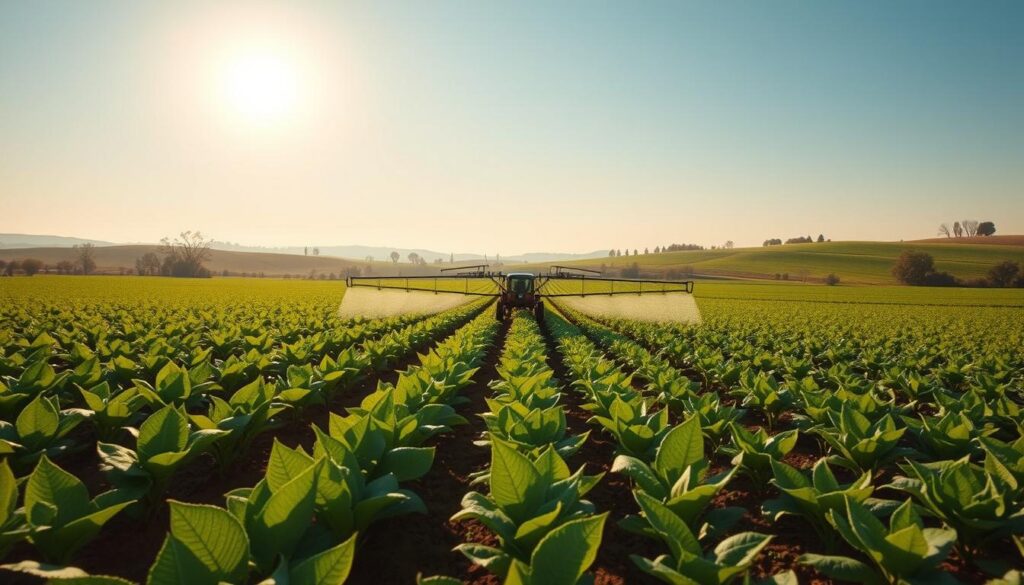
Season-long monitoring with RGB and multispectral cameras reveals nutrient stress and early disease faster than human scouting. Vegetation indices inform irrigation plans and pinpoint treatment zones.
Object detection models guide weed targeting and robotic harvesting. That cuts chemical use and raises pick accuracy by identifying ripe fruit and safe grasp angles.
- Yield estimation: per-fruit detection from UAV imaging aggregates counts and calibrates to yield models for logistics.
- Irrigation planning: multispectral indices flag water stress so schedules adjust and water use drops.
- Practical notes: flight plans, ground truth, and consistent processing pipelines ensure repeatable information across seasons.
“UAVs act as force multipliers—fast coverage, repeatability, and frequent revisits create reliable time-series data.”
| Function | Typical Sensors | Primary Benefit |
|---|---|---|
| Crop health monitoring | RGB + multispectral cameras | Early detection of stress and disease |
| Weed targeting | High-res RGB, object models | Reduced chemical use and cost |
| Yield estimation | UAV imagery, per-fruit detection | Improved planning and pricing |
OCR and Scene Text: Extracting Structured Information from Images
Practical pipelines combine classic image processing with modern detectors to harvest text from varied scenes. A well-ordered flow cleans an image, finds text regions, and runs recognition with tuned engine settings.
OpenCV pre-processing often starts with denoise and grayscale, then Canny edge detection and contour filtering to propose ROIs. Morphology merges nearby strokes and adaptive thresholding helps with uneven lighting.
For recognition, teams commonly feed ROIs to Tesseract configured with flags such as -l eng --oem 1 --psm 3. Choosing the right page segmentation and engine mode matters for forms versus paragraphs.
Documents vs scene text
Scanned pages respond well to binarization and layout analysis. Scene signage needs perspective correction, warping, and augmentations to handle blur and clutter.
“Deep-learning detectors like EAST or CRAFT boost localization before running classical OCR engines.”
- Parse outputs into JSON or CSV and validate fields for cleaner downstream data.
- Test with receipts, IDs, and road signs to tune thresholds and psm modes.
- Prefer on-device recognition for privacy; only derived fields should leave the device.
| Element | Documents | Scene Images |
|---|---|---|
| Pre-processing | Binarize, deskew, layout analysis | Perspective warp, adaptive thresh, denoise |
| Localization | Layout blocks, column detection | Edge+contour proposals or EAST/CRAFT |
| Output & QA | Field parsing, regex validation | Confidence scores, manual fallback |
Operational note: track confidence, run active learning loops, and maintain a validation set drawn from KAIST and SVHN samples to measure real-world performance before scale.
Pose, Gesture, and Action Recognition: Tracking Humans in Video
Tracking body motion converts video into clear signals for coaching, control, and safety. Pose pipelines output keypoints for joints and landmarks. Those points become posture scores, repetition counters, and form metrics used in fitness and ergonomic apps.
Gesture control can start simple: contour-based detection with convexity defects maps finger counts to commands. More robust systems pair that method with keypoint models to reduce false triggers in cluttered scenes.
Action recognition detects unsafe behaviors or fatigue near machinery and in warehouses. Models flag risky patterns and prompt interventions before incidents escalate.
“Operate on skeletal features rather than raw frames to preserve privacy while keeping analytic value.”
- Model choice: lightweight pose models run on edge for real-time feedback; higher-accuracy models suit post-process analysis.
- Data needs: multi-angle capture, varied clothing, and occlusion samples improve generalization; MPII-like datasets aid training and validation.
- Human-centered design: clear feedback, sensible thresholds, and staged rollouts build trust and adoption.
| Feature | Typical Output | Primary KPI |
|---|---|---|
| Rep counting | Joint keypoints, rep tally | Detection rate of key events |
| Gesture control | Finger count or gesture ID | Latency and command accuracy |
| Safety analytics | Action labels, fatigue score | False alarm rate and response time |
Start with core features—counting reps or simple commands—and expand to form scoring as datasets grow. We recommend iterative deployment, clear KPIs, and privacy-aware designs to unlock practical vision applications across fitness, rehab, and industrial safety.
Classical Computer Vision Methods That Still Work
Well-tuned feature detectors can deliver fast, explainable results on embedded systems and drones. These methods remain valuable when teams need predictable behavior, low power draw, and easy maintenance.
SIFT, SURF, ORB: robust keypoints for stitching, SLAM, and mapping
SIFT handles scale and rotation changes with high precision; it is ideal for stitching and 3D reconstruction but can be heavy for strict real-time loops.
SURF trades some detail for speed and fits mid-tier processing pipelines. ORB is lightweight, open-source friendly, and suits SLAM on mobile or low-power robots.
Viola‑Jones for rapid face and object detection on edge devices
Viola‑Jones uses cascaded classifiers to deliver quick detection on constrained hardware. It works well for simple scenes and bootstrapping systems, though deep models beat it in cluttered environments.
“Combine classical detectors with modern classifiers to get the best of both worlds.”
- Practical tip: descriptors act like fingerprints for images; geometric verification and optical flow raise match reliability.
- Benchmark classical methods against modern baselines and document licensing choices for long-term support.
| Method | Strength | Best fit |
|---|---|---|
| SIFT | Scale/rotation robustness | Stitching, 3D reconstruction |
| SURF | Faster than SIFT | Mid-speed processing |
| ORB | Fast, open-source | SLAM, mobile robotics |
| Viola‑Jones | Very low compute | Edge detection of faces/objects |
Modern Detectors and Segmenters: YOLO, Faster/Mask R‑CNN
Modern detectors trade off raw speed for finer spatial detail — a choice that shapes system design and operational limits.
One-stage vs two-stage: one-stage networks like YOLO prioritize throughput and work well where low latency matters. Two-stage architectures such as Faster R‑CNN often yield higher accuracy on crowded scenes and small objects. Mask R‑CNN adds instance segmentation for pixel-level masks but needs more compute.
Small objects and feature strategies
Detecting tiny or distant objects benefits from higher-resolution tiles, feature pyramid networks, and custom anchors. These features boost recall for small objects without massive model changes.
Training data, annotations, and domain changes
Quality annotation is essential: consistent class labels, polygon masks for segmenters, and review cycles reduce ground-truth noise. Domain changes — new cameras, seasons, or lighting — can degrade performance. Plan periodic relabeling, fine-tuning, and validation on operational frames.
- Practical tips: strong augmentations, class balance, and hard negative mining stabilize learning.
- Deployment: quantization, pruning, and hardware runtimes meet latency targets with minimal accuracy loss.
- Operational traceability: link data and model versions to incidents and use active learning to prioritize human reviews.
“Evaluate models on operational data — precision and recall across sizes matter more than leaderboard scores.”
| Architecture | Strength | Best fit |
|---|---|---|
| YOLO (one-stage) | High throughput | Real-time monitoring |
| Faster R‑CNN (two-stage) | Higher accuracy | Dense scenes, high accuracy |
| Mask R‑CNN | Instance masks | Pixel-level segmentation |
Frontier Models for Vision: ViT, CLIP, NeRFs, and Diffusion
C Vision Transformers and multimodal generative methods reshape how systems learn from images and videos. These models offer new paths to build robust pipelines and to synthesize rare scenarios for training.
Vision Transformers
ViTs split images into patch tokens and use self-attention to capture global context. At scale they excel for classification, detection, and segmentation; DeiT variants cut data needs for smaller teams.
CLIP and multimodal search
CLIP links images and text via contrastive pretraining. It enables zero-shot recognition and semantic search, useful when labeled data is scarce. Monitor and mitigate dataset bias when relying on broad pretraining.
NeRFs and diffusion models
NeRFs reconstruct high‑fidelity 3D scenes from 2D captures, powering digital twins and AR training assets. Diffusion techniques synthesize photorealistic images through iterative denoising and can create simulation data for edge cases.
- Practical notes: these methods often need heavy compute; prefer distilled models or edge accelerators for deployment.
- Hybrid approach: combine CLIP’s zero-shot signals with specialized detectors to cut labeling time in fast-changing catalogs.
- Health example: ViTs and diffusion augmentation can boost imaging models if privacy, validation, and bias controls are strict.
“Sandbox frontier models on non-production images and videos before integrating into critical workflows.”
Edge Deployment and MLOps: From Prototype to Production
A production-ready pipeline blends hardware, orchestration, and monitoring to make vision reliable at scale.
Hardware choices matter first: pick RGB, thermal, or depth cameras and match sensors to the task. Add accelerators—NPUs or edge GPUs—so machines meet real‑time constraints and lower latency.
Cameras, sensors, and edge accelerators for real‑time inference
Standardize on a small set of camera models and sensor types to simplify maintenance. Choose accelerators that fit power and cost goals.
Pipelines to deploy, monitor, and scale computer vision systems
Package streams in containers per camera; run model servers at the edge for fast inference. Design a flow: pre‑processing, inference, post‑processing, then event routing to downstream applications.
- CI/CD for models: automated builds, test frames, canary rollouts, and rollback rules.
- Monitoring: track throughput, error rates, and drift; health dashboards surface issues before users see them.
- Security and privacy: minimize egress, encrypt data in transit and at rest, and enforce least privilege.
“Schedule updates during low-traffic windows and keep local autonomy so sites stay resilient when connections fail.”
Manage model versions with semantic tags, A/B trials, and automated performance checks. Balance on-device compute and cloud aggregation to control costs while keeping processing close to the cameras.
Measuring What Matters: Accuracy, Latency, Drift, and Bias
What gets measured guides behavior—so choose metrics that map directly to operational risk and value. Teams should link technical measures to safety and business KPIs before rollout.
Precision and recall reveal where detection and tracking succeed or fail. Report per-class and per-size accuracy so small or rare objects do not hide flaws.
Define end-to-end latency budgets—from capture to action—and tie them to human response and security needs. Time budgets differ for traffic alerts versus retail receipts.
Monitor drift: scene, lighting, camera, or population changes erode performance. Schedule evaluations and set retrain triggers when metrics fall.
“Algorithms perform only as well as the data used for training.”
- Test fairness across demographic groups and contexts; expand datasets if gaps appear.
- Prefer privacy-by-design: on-device processing, minimal retention, and limited information collection.
- Calibrate confidence scores so thresholds match real-world probabilities.
| Metric | What it measures | Operational action |
|---|---|---|
| Precision / Recall | Frame-level detection trade-offs | Adjust threshold, retrain on hard negatives |
| Latency (ms) | Capture → decision time | Optimize model or edge placement |
| Tracking quality | ID switches, fragmentation | Tune association and re-ID models |
Governance matters: log model lineage, data sources, known limits, and clear escalation paths so teams can justify investments and act when issues arise.
Conclusion
A disciplined approach to image pipelines transforms raw frames into reliable business signals.
Across transportation, healthcare, retail, manufacturing, and agriculture, vision and computer vision examples show clear value: faster decisions, fewer mistakes, and measurable gains in safety and throughput.
The practical playbook is simple: pick the right computer model or classical method for constraints, prioritize dataset quality, and set up MLOps to monitor drift and performance over time.
Ethical guardrails protect people—privacy‑by‑design, fairness checks, and transparent logging keep deployments trustworthy for public and workplace settings.
Start with short pilots on representative image data, instrument metrics tied to outcomes, and build a reusable foundation for capture, inference, and monitoring.
Road systems—from multi‑sensor ADAS to ALPR—remain a proving ground: lessons there translate to other domains with tight latency and safety needs.
With disciplined process, the right technology choices, and a focus on quality, organizations can turn vision into lasting operational advantage.
FAQ
What is computer-vision target recognition and how does it differ from general image analysis?
Computer-vision target recognition focuses on locating and identifying specific objects or classes within images or video streams. It differs from general image analysis by emphasizing detection, classification, and often tracking of discrete items — for example vehicles, people, or parts — rather than broad scene understanding or aesthetic assessment. Pipelines combine cameras, sensors, models, and data pipelines to turn pixels into operational signals.
Why does visual detection matter for business innovation today?
Visual detection accelerates operations, reduces manual inspection costs, and enables new services. In transportation it improves safety and throughput; in manufacturing it reduces defects and waste; in retail it powers cashier-less experiences and shelf analytics. Applied well, it converts real‑time imagery into decisions that scale, increase revenue, and cut risk.
What are the core components of a production vision system?
A production system includes cameras and sensors, edge or cloud inference engines, data pipelines for storage and labeling, model training and evaluation tools, and monitoring for drift and latency. Integration with downstream systems — alerts, databases, and control loops — completes the value chain.
How do detection, recognition, and tracking differ in practice?
Detection finds object instances and their bounding boxes; recognition assigns class labels or identities; tracking links instances across frames to understand motion and continuity. Each step has unique latency, compute, and annotation needs; combining them yields actionable video intelligence.
What are practical constraints for real‑time road detection in ADAS?
Key constraints include latency, scene complexity, lighting variation, and sensor fusion. Systems must detect vehicles, pedestrians, and cyclists quickly and robustly across lanes and conditions. Edge accelerators, optimized models, and multi‑sensor fusion (radar, lidar, cameras) help meet safety and regulatory requirements.
How does license plate recognition and re‑identification work at scale?
Automated license plate recognition uses pre-processing, optical character recognition, and post-processing to extract readable plates. Re‑identification links vehicle features and temporal data to follow a car across cameras. Scalability requires robust OCR, timestamping, and careful handling of privacy and storage policies.
What privacy and policy considerations apply to surveillance and face recognition?
Privacy concerns demand minimal data retention, strong access controls, and purpose-limited processing. Accuracy and bias must be audited; consent and signage may be required by law. Teams should adopt privacy-by-design, differential access, and regular fairness testing when deploying face detection or recognition.
How are deep models used in medical imaging for detection and triage?
Deep networks assist tumor and anomaly detection in X‑ray, CT, and MRI by highlighting suspicious regions and prioritizing cases for radiologist review. Explainability methods such as Grad‑CAM help clinicians interpret model outputs. Clinical validation and regulatory clearance are essential before deployment.
Can visual systems replace human inspectors in manufacturing?
Automated inspection reduces cycle time and improves consistency, but it complements rather than fully replaces humans. Models excel at repetitive defect detection; humans handle ambiguous cases, complex root-cause analysis, and continuous improvement tasks. Hybrid workflows deliver the best ROI.
What enables cashier‑less checkout and accurate shelf analytics in retail?
Multi‑object tracking, robust product recognition, and inventory signal fusion enable hands‑free checkout. High-quality annotations, edge inference, and privacy controls ensure accurate item logging while protecting customers. Virtual try‑on uses visual modeling and pose estimation to enhance CX.
How are drones and multispectral cameras used in agriculture?
Drones capture RGB and multispectral imagery to detect crop stress, disease, and weeds. Models estimate yield, guide irrigation, and enable targeted spraying or robotic harvesting. Combining flight planning, orthomosaic stitching, and domain-specific datasets yields actionable farm insights.
What role does OCR play in extracting text from scenes and documents?
OCR pipelines pair pre‑processing (OpenCV) with engines like Tesseract to extract structured text from documents, signs, and receipts. Quality depends on image clarity, layout complexity, and language models; post‑processing and validation improve reliability.
How can pose and gesture analysis be applied beyond fitness apps?
Pose estimation supports hands‑free controls, workplace safety analytics, and rehabilitation monitoring. Tracking keypoints over time enables fatigue detection, ergonomic assessment, and interaction design in retail or industrial settings.
Do classical methods still matter alongside modern deep models?
Yes. SIFT, ORB, and other keypoint methods remain valuable for SLAM, stitching, and low‑compute settings. Viola‑Jones can provide rapid face detection on constrained hardware. Hybrid systems often combine classic and modern approaches for robustness and efficiency.
How do one‑stage detectors like YOLO compare to two‑stage models such as Faster R‑CNN?
One‑stage detectors prioritize speed and are suitable for real‑time inference on edge devices; two‑stage models typically deliver higher accuracy for small or crowded objects. Choice depends on latency targets, hardware, and object scale.
What advances do Vision Transformers and CLIP bring to visual recognition?
Vision Transformers offer global context for classification and detection, improving performance on large datasets. CLIP links images to language for robust zero‑shot recognition, enabling flexible labeling without exhaustive annotation. Both expand capabilities for transfer and few‑shot learning.
What are best practices for deploying vision models at the edge?
Optimize models for latency and power using pruning, quantization, and specialized accelerators. Implement monitoring for drift, automated retraining pipelines, and secure OTA updates. Robust data pipelines and versioning ensure reproducible rollouts.
Which metrics matter when evaluating detection systems?
Precision and recall measure detection quality; mean Average Precision (mAP) summarizes performance across thresholds. Latency, throughput, robustness to domain shift, and fairness metrics are equally important for operational success.
How can teams mitigate bias and ensure robustness in visual models?
Use diverse, representative training data; perform stratified testing; apply fairness-aware metrics; and include human‑in‑the‑loop review for edge cases. Continuous monitoring and synthetic augmentation help detect and correct drift and biases over time.