There are moments when a simple commute becomes a reminder of what matters: safety, trust, and the future we hand to the next driver.
In this article, the team explores how artificial intelligence powers the layer that turns raw sensor inputs into clear road understanding. The focus is practical: how vehicles perceive lanes, people, and obstacles to make safe choices in real time.
The narrative connects rapid advances in machine learning, sensor fusion, and edge compute with industry paths from Tesla to Waymo and Cruise. Readers will see how cameras, LiDAR, radar, and ultrasonic inputs fuse into a 3D world model that informs prediction, planning, and motion control.
We frame technical progress alongside regulation—especially the EU AI Act—and highlight why redundancy and robust design matter for safety on U.S. roads. By the end, leaders will have a clear roadmap from pixels to planning and where to invest for measurable gains.
Key Takeaways
- Perception is the critical layer that transforms sensor inputs into actionable understanding.
- Combining cameras, LiDAR, and radar builds a 3D model that supports safe decision-making.
- Edge compute and robust models are essential for real-time processing inside vehicles.
- Regulation—like the EU AI Act—shapes requirements for safety, documentation, and transparency.
- Redundancy and fail-operational design reduce risk from edge cases and bad weather.
What this AI use case means today for self-driving vehicles
Today’s self-driving vehicles translate streams of sensor data into practical features that help drivers and fleets operate safer and smarter.
Practical features include lane-keeping, adaptive cruise control, and automated parking. These functions reduce human error, which causes over 90% of crashes, and they improve on-road reaction to sudden hazards.
Traffic flow improves as intelligence optimizes routing and spacing. That reduces stop-and-go behavior and cuts emissions from inefficient driving.
Most deployments today sit at SAE Levels 2–3: supervised automation that augments drivers rather than replaces them. Full Level 5 autonomy still needs further development and wider infrastructure support.
Accessibility gains matter: cars with smart driver aids expand mobility for elderly and disabled users. In logistics, predictable uptime and less human fatigue boost delivery reliability.
We encourage readers to explore practical implementations and next steps—see a concise overview of applications for deeper context: applications in self-driving cars.
Inside the perception stack: from pixels to scene understanding
The stack converts visual and range inputs into a real-time scene that planners and controllers trust.
Object detection, segmentation, and tracking with deep neural networks
The pipeline uses computer vision models like YOLO, SSD, and Mask R-CNN for fast object detection and segmentation.
Deep neural networks run on edge compute to label vehicles, pedestrians, and cyclists, then trackers link those labels across frames.
Recognizing traffic signs, lane markings, lights, and obstacles
Specialized heads and classical algorithms parse lane lines, signs, and signal states so planners follow rules and maintain lateral control.
High-quality sensor data and precise timestamps are critical; calibration drift or jitter harms detection and tracking performance.
Handling edge cases and adverse weather in perception
Long-tail events—animals, odd road geometry, or faulty signals—need targeted data collection, simulation, and curriculum learning.
Continuous training and periodic model updates reduce bias and improve generalization across lighting and weather.
Algorithms must report uncertainty so downstream modules can weigh confidence and act safely.
Sensors that feed perception in autonomous vehicles
Choosing the right hardware mix defines what a vehicle can see and trust on the road.
Cameras, LiDAR, radar, and ultrasonic: strengths and trade-offs
Cameras capture texture and color, helping with classification and sign recognition. They excel at semantic detail but struggle in low light and glare.
LiDAR supplies accurate range and 3D structure for free-space estimation. It costs more but gives precise geometry for mapping and obstacle detection.
Radar measures radial velocity and works in rain or fog. It offers robust range at lower resolution.
Ultrasonic sensors handle near-field tasks like parking and curb detection. They are low cost and effective at short range.
Designing robust multi-sensor setups for urban and highway driving
Urban designs prioritize 360-degree short-range coverage. Highway setups favor long-range sensing and high-speed detection.
Calibration, time synchronization, bandwidth, and thermal design keep fused sensor data accurate. Over-the-air updates refine algorithms, but health monitoring and redundancy protect against failure.
| Modality | Strength | Limitation | Typical Role |
|---|---|---|---|
| Camera | Semantic detail, color | Low-light, glare | Sign/lane recognition |
| LiDAR | Accurate depth, 3D geometry | Cost, weather sensitivity | Free-space estimation |
| Radar | Velocity, weather robustness | Low spatial resolution | Long-range tracking |
| Ultrasonic | Close-range detection | Very short range | Parking and curbs |
Choosing a sensor suite aligns with a brand’s philosophy—vision-centric, LiDAR-led, or hybrid. Thoughtful placement and overlapping fields of view make vehicles safer and more reliable in complex environments.
Sensor fusion and 3D environment mapping
A unified world model turns fragmented measurements into a consistent map that vehicles rely on for safe routing.
Fusing heterogeneous inputs aligns camera images, LiDAR point clouds, radar returns, and ultrasonic echoes into a single 3D representation. Early, mid, and late fusion architectures trade off latency and accuracy so planners get timely, reliable data.
Fusing heterogeneous sensor data into a consistent world model
Probabilistic filters and learned fusion layers reconcile conflicting signals and handle missing modalities. Robust models propagate uncertainty through the pipeline so downstream modules can adopt conservative behavior when confidence drops.
Building and updating HD maps for localization and navigation
HD maps combine static features—lanes, signs, lights—with live updates for closures and works. Map-matching and loop-closure cut drift, while learning-based priors help prediction modules anticipate common road layouts.
Real-time uncertainty estimation for safer decisions
Fusion pipelines must balance accuracy with latency to support real-time planning. Systems expose health metrics (sensor dropout rates, quality flags) and validation benches compare map-ground-truth with fused perception to quantify error before deployment.
From perception to prediction: forecasting road user behavior
Predicting future motion gives a vehicle the foresight to act smoothly and safely in dense traffic.
Prediction extends scene labels into multi-horizon hypotheses about where surrounding actors will go. These outputs help planners choose trajectories that balance safety and comfort.
Socially-aware trajectory prediction for vehicles and VRUs
Socially-aware learning models capture etiquette like yielding, gap acceptance, and right-of-way. They turn observations—turn signals, head pose, crosswalk occupancy—into richer forecasts.
Incorporating etiquette, interaction, and collective dynamics
Multi-agent approaches model how one vehicle’s choice influences nearby actors. Outputs are distributions over futures, not single paths, so planners can optimize under uncertainty.
“Prediction quality directly raises planning performance—better foresight yields fewer abrupt maneuvers and smoother motion.”
| Function | Input | Output | Role |
|---|---|---|---|
| Short-horizon forecast | Recent trajectories, signals | Probable paths (0–3s) | Local collision avoidance |
| Mid-horizon forecast | Scene context, etiquette | Multi-modal distributions (3–6s) | Maneuver selection |
| Long-horizon forecast | Speed, road geometry | Coarse trajectories (6–10s) | Highway merges, planning |
Data-driven models learn from diverse geographies and traffic norms, improving robustness to regional styles.
Continuous evaluation and post-incident analysis feed edge cases back into training. That reduces blind spots and raises trust between driver, vehicle, and the road.
Planning and motion control driven by AI
Planning turns maps, sensor beliefs, and predicted motions into safe, executable paths for the vehicle.
Local planners weigh lane geometry, right-of-way, and predicted actor motion to create collision-free, comfortable trajectories. They select a spatial path and a speed profile that reflect road rules and current scene confidence.
Methods include graph-search, optimization-based solvers, sampling planners, and interpolation. End-to-end deep learning appears in research, but explainable algorithms remain the industry baseline for certification and audits.
Local path planning under uncertainty and constraints
Robust planning treats uncertainty as part of the cost. Risk-aware objectives penalize low-confidence detections and ambiguous intentions.
Optimization and sampling deliver clear trade-offs: constraints for clearance, jerk, and comfort map directly to design requirements. The planner also enforces safety margins—minimum distance and time-to-collision thresholds—so sudden intrusions are handled predictably.
Reinforcement learning and predictive control for smooth maneuvers
Reinforcement learning refines policies for merges, unprotected turns, and roundabouts through simulated experience. Learning speeds up adaptation but must run behind guardrails to avoid brittle behavior on public roads.
Predictive control converts path and speed plans into steering, throttle, and braking commands within actuator limits. The controller keeps motion smooth while honoring the planner’s constraints and fallback rules when perception confidence drops.
“Good planning balances assertiveness with restraint—the vehicle must be decisive without surprising nearby road users.”
- Planner arbitration: nominal plans vs fallbacks when confidence deteriorates.
- Online monitors: detect divergence from training distribution and trigger safe modes.
- Etiquette-aware planning: avoids aggressive maneuvers that confuse drivers and VRUs.
| Function | Typical Method | Primary Constraint | Role |
|---|---|---|---|
| Local path planning | Sampling / Optimization | Clearance, comfort | Collision-free trajectory |
| Risk-aware planning | Probabilistic cost functions | Uncertainty penalty | Safe decision under ambiguity |
| Policy refinement | Reinforcement learning | Sim-to-real guardrails | Complex maneuvers |
| Motion control | Model predictive control | Actuator limits, smoothness | Execute path and speed |
Real-time data pipelines and on-vehicle compute
On-vehicle compute brings critical workloads close to sensors so decisions happen in milliseconds.
Edge execution minimizes end-to-end latency from sensor capture to actuation, which is essential for high-speed scenarios and safety-critical responses in modern vehicles.
The software stack commonly runs on platforms such as NVIDIA DRIVE while ROS orchestrates modules across CPUs and accelerators. Stream processing frameworks prioritize perception and planning tasks, deferring non-safety workloads to background threads.
Fail-operational design isolates faults and keeps core functions—steer, brake, and core perception—available in degraded modes.
“Deterministic scheduling and QoS ensure time-critical tasks preempt less critical processes.”
- Hardware accelerators run deep models at frame rates that match sensor throughput.
- Telemetry and synchronized data capture support offline analysis and post-incident review.
- Secure boot, signed binaries, and runtime integrity checks harden the compute stack against tampering.
- CI/CD with hardware-in-the-loop validates updates; OTA delivers model and system patches with rollback.
| Feature | Role | Benefit |
|---|---|---|
| On-vehicle compute | Real-time processing | Lower latency, safer reactions |
| Deterministic scheduler | Task prioritization | Predictable timing for control loops |
| Telemetry & logging | Fleet health | Prevent performance cliffs; enable regression |
| Security primitives | Runtime protection | Integrity and trusted updates |
Together, these elements form an operational foundation for reliable systems on the road. They enable secure, iterative development and continuous learning while keeping vehicles responsive and safe.
Safety-first design: reliability, redundancy, and fail-safes
A safety-first architecture makes reliability the baseline for every vehicle feature, not an afterthought.
Built-in fail-safes and layered redundancy keep core functions active when parts fail. Multiple sensors and parallel compute paths avoid single points of failure. Separate power domains and watchdogs ensure graceful degradation instead of abrupt shutdowns.
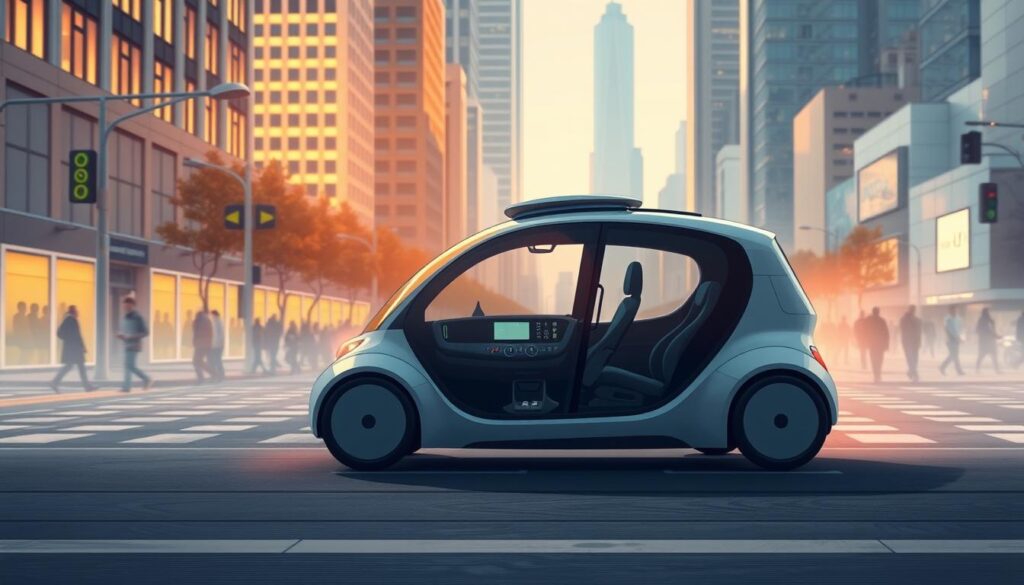
Health checks run continuously. When confidence drops, the system escalates to minimal-risk maneuvers: slow, pull over, or hand control to an operator. Event data recorders capture logs for post-incident review and accountability.
Functional safety aligns engineering with automotive standards and formal hazard analysis. Control fallback strategies limit acceleration and jerk to keep motion stable during contingencies.
“Safety depends on redundancy, clear fallbacks, and auditable records.”
- Redundant sensing (vision, LiDAR, radar) preserves perception under partial degradation.
- Security by design protects actuation and sensor integrity.
- Operator-in-the-loop measures remain where regulation or context requires human oversight.
- Continuous KPI monitoring—false positives, disengagements—drives iterative safety gains.
| Element | Primary Role | Key Benefit |
|---|---|---|
| Redundant sensors | Maintain scene awareness | Resilience to single sensor faults |
| Parallel compute paths | Preserve processing | Fail-operational behavior |
| Health monitors | Detect degradation | Automatic minimal-risk maneuvers |
| Event logging | Post-incident analysis | Accountability and improvement |
Testing and validation for trustworthy perception systems
Simulation and field testing together reveal the blind spots that matter most for safety.
Simulation at scale, scenario coverage, and post-incident analysis
Validation blends millions of simulated miles with targeted real-world runs to stress models against rare events. Scenario libraries catalog jaywalking, erratic cut-ins, and odd geometry so development teams can probe edge cases.
Data curation reduces bias and improves fairness across regions and demographics. Model audits check sensitivity to weather, lighting, and occlusion so outputs remain robust under distribution shifts.
Hardware-in-the-loop tests confirm timing and compute limits that affect perception outputs. Metrics go beyond raw accuracy: calibration, uncertainty, and latency shape safe margins on the road.
- Combine real miles and simulation to expand scenario coverage.
- Use post-incident information to retrain and close gaps in datasets and models.
- Maintain traceable artifacts—datasets, commits, experiments—for accountability.
“Independent audits and continuous regression testing keep performance stable as models and data evolve.”
Cybersecurity and data privacy in autonomous perception
Securing the vehicle’s sensing and control layers is essential to keep passengers and data safe on public roads.
Threat models target sensors (spoofing), models (adversarial inputs and extraction), and control channels (unauthorized commands). GDPR and CCPA require careful handling of personally identifiable information captured by cameras and logs.
Protecting sensor data, models, and control channels
Defense-in-depth combines encryption, authentication, secure boot, and hardware roots of trust. Regular penetration tests and red teaming reveal weaknesses before adversaries exploit them.
- Privacy-by-design limits retention of images and personal data and enforces anonymization.
- Supply-chain reviews and firmware validation reduce third-party risk.
- Access controls enforce least-privilege for operational interfaces and developer tools.
“Model integrity checks and secure update pipelines keep perception quality intact across fleets.”
| Area | Primary Control | Benefit | Notes |
|---|---|---|---|
| Sensor protection | Signal authentication | Detect spoofing | Use redundancy and cross-checks |
| Model integrity | Checksums & attestation | Prevent tampering | Monitor drift and retrain |
| Control channels | Encrypted command paths | Block remote intrusion | Fail-operational fallbacks |
| Compliance | Audit trails | Regulatory alignment | Supports verification and trust |
Incident response plans define detection, containment, and recovery steps so safety persists during cyber events. Together, these measures build resilient security and strengthen consumer confidence in modern vehicles.
Regulations and standards shaping AI in AVs
Policymakers are treating many vehicle sensing functions as high-risk, altering how teams design and test them.
The EU AI Act (in force Aug 2024) sets lifecycle obligations: risk management, data governance, technical documentation, record-keeping, transparency, human oversight, and robustness. Many onboard perception functions qualify as high-risk, so they face strict conformity checks before type approval.
Compliance pathways merge sectoral vehicle rules with horizontal regulations. Delegated acts will map high-risk requirements into motor-vehicle approval frameworks, while UNECE working groups support international harmonization.
What teams must prove
Technical documentation, traceability of datasets and models, and auditable tests are essential for conformity assessment. Post-market monitoring requires logging, incident reporting, and rapid update processes to address emerging hazards.
“Embedding compliance early reduces costly redesign and speeds safe deployment.”
| Requirement | Practical Evidence | Benefit |
|---|---|---|
| Risk management | Hazard analyses, mitigations | Reduced operational surprises |
| Data governance | Dataset lineage, labeling audits | Traceable model behavior |
| Transparency & oversight | HMI rules, human-in-loop plans | Clear driver expectations |
| Post-market monitoring | Logging, incident reports | Faster corrective updates |
Developers who incorporate regulations into development pipelines will find certification smoother. A proactive stance builds public trust and advances safe, predictable vehicles on U.S. roads.
AI Use Case – Autonomous-Driving Perception Systems in ADAS and autonomy levels
Modern ADAS functions act as stepping stones from manual driving toward limited autonomy in controlled environments.
Practical ADAS features—adaptive cruise, lane-keeping assist, blind-spot detection, and traffic sign recognition—help drivers stay safer on busy roads. They detect lane boundaries, nearby actors, and speed limits to give timely alerts or corrective action.
Autonomous emergency braking links perception to control: when sensors detect an imminent collision, braking executes in milliseconds to prevent or reduce impact. Driver monitoring adds a safety layer by detecting fatigue or distraction and prompting intervention.
Progression toward higher SAE levels
As models improve, features move from supervised assistance to limited autonomy in constrained domains. NLP voice assistants simplify interaction—drivers can request routes and settings without taking hands off the wheel.
Calibration across cars and sensors ensures consistent behavior as features roll out fleet-wide. Clear control handover strategies define when a driver must retake authority and how the vehicle transitions to minimal-risk maneuvers.
“Mapping ADAS capabilities to SAE levels helps teams scope testing and set safe operational boundaries.”
- Traffic sign recognition enforces local rules and speed compliance.
- Parking assistance fuses short-range sensors for precise, low-speed control.
- Emergency braking demonstrates the full perception-to-control chain.
| Feature | Primary Sensors | Role | SAE Alignment |
|---|---|---|---|
| Lane-keeping assist | Cameras, radar | Maintain lateral position | Levels 1–2 |
| Emergency braking | Radar, camera, LiDAR | Collision mitigation | Levels 2–3 |
| Driver monitoring | In-cabin camera, IR | Detect attention, fatigue | Levels 2–3 |
| Parking assistance | Ultrasonic, cameras | Low-speed maneuvering | Levels 2–4 (geofenced) |
We encourage teams to map each feature to an SAE level early. That clarifies testing depth, runtime controls, and the human role—so vehicles and drivers share the road with predictable behavior.
Tools and platforms powering perception models
From prototype to fleet, the right stack shortens the path between data and dependable behavior.
TensorFlow and PyTorch accelerate model development and speed research-to-production cycles. These frameworks support rapid experimentation and structured model training for detection and segmentation tasks.
OpenCV complements deep nets with efficient image operations, calibration, and preprocessing. ROS ties nodes together so sensors, planners, and loggers exchange messages reliably on vehicle hardware.
NVIDIA DRIVE delivers deterministic inference and parallel processing for high-throughput sensor inputs. Together, these components enable robust deployment of perception and planning workloads at scale.
- Deep learning frameworks shorten development time and simplify algorithm benchmarking.
- Training pipelines handle large datasets, augmentations, and reproducible evaluation.
- MLOps and hardware-aware optimization—quantization, compilation—keep models efficient without losing accuracy.
- Simulation integrates with the stack to generate edge-case data and accelerate validation.
“Tooling that aligns simulation, training, and deployment reduces surprises and speeds safe rollouts.”
We recommend matching technology choices to regulatory documentation and fleet telemetry so teams can trace decisions and close gaps with live data.
Industry examples: how leaders implement perception
Real deployments reveal how different sensor philosophies shape operational limits, cost, and safety.
Tesla favors a vision-first approach on many production cars. Camera-driven models keep hardware costs lower while leveraging dense semantic outputs for lane-keeping, adaptive cruise, and parking.
Waymo embraces LiDAR-centric stacks for high-confidence object localization. Extensive training miles improve models and edge-case coverage in varied urban settings.
Vision-, LiDAR-, and hybrid-centric strategies in real deployments
Hybrid fleets—like those from Cruise and some OEM pilots—combine cameras, LiDAR, and radar to balance cost, redundancy, and performance on mixed road types.
Freight-focused teams such as TuSimple emphasize long-range detection for highway applications. Volvo and safety-first brands tune behavior conservatively and prioritize transparent HMI for driver trust.
“Robotaxi deployments show how geo-fenced domains simplify perception requirements and speed regulatory alignment.”
| Leader | Strategy | Primary role | Key benefit |
|---|---|---|---|
| Tesla | Vision-first | Passenger car ADAS | Lower hardware cost, rich semantics |
| Waymo | LiDAR-led | Robotaxi urban service | High-confidence localization |
| Cruise | Hybrid | Electric robotaxi | Redundancy and regulatory fit |
| TuSimple / Embark | Long-range sensing | Freight trucking | Stable highway lane keeping |
Operational lessons: fleets stage model updates with canary rollouts, maintain strict calibration routines, and partner with municipalities to expand scenario coverage. For a deeper technical primer on vision and decision pipelines, see this concise lesson: vision and decision-making overview.
Trends to watch: 5G, edge AI, and next‑gen sensors
Faster links and richer sensors let cars see farther, react quicker, and learn from shared experience.
5G-enabled V2X augments on-board awareness with timely information about hazards beyond line of sight. Low latency helps vehicles receive traffic updates, signal priority, and temporary work-zone alerts in real time.
Edge execution places models inside the vehicle so inference runs even when connectivity is intermittent. For hands-on guidance about local inference strategies, see this primer on edge AI for autonomous vehicles.
Next-generation LiDAR and high-res cameras deliver better range and clarity. Together with AI-enriched HD maps, they improve localization and rule compliance at complex junctions.
Faster V2X, better HD maps, and improved robustness
Fleets can share anonymized data through federated approaches that preserve privacy while improving models across cities and highways.
- Traffic coordination improves when infrastructure broadcasts priorities to approaching vehicles.
- Systems increasingly quantify uncertainty so vehicles adapt driving style to information quality.
- Security and authentication are vital as connectivity expands to trust V2X messages.
| Trend | Impact | Primary concern |
|---|---|---|
| 5G V2X | Faster hazard information | Security & message authentication |
| Edge execution | Lower latency decision-making | Hardware validation |
| Next-gen sensors & HD maps | Better detection, localization | Data interoperability |
“When networks, sensors, and on-vehicle processing converge, the result is smoother traffic flow, richer information sharing, and higher robustness on mixed roads.”
Benefits and challenges for U.S. deployment
Widespread deployment across U.S. roads promises clear gains, but practical hurdles remain.
Key benefits include fewer accidents as automated sensing and control reduce human error. Traffic becomes smoother and emissions fall when vehicles optimize speed and gaps. Accessibility improves: seniors and people with disabilities gain reliable mobility through automated assistance and voice interfaces.
Continuous uptime and fleet telemetry also speed development and service reliability. Shared, anonymized data helps models learn faster while preserving privacy.
Main challenges range from long-tail edge events—wildlife crossings and broken signals—to uneven infrastructure. V2X and mapping vary by state, which hinders consistent rollouts. Cybersecurity and data security must meet strict expectations to earn public trust.
“Public education and transparent performance metrics will determine how quickly communities accept new vehicle capabilities.”
| Area | Benefit | Primary challenge |
|---|---|---|
| Safety & traffic | Fewer collisions; smoother flow | Edge-case handling |
| Security & data | Faster learning; OTA updates | Cybersecurity, privacy rules |
| Infrastructure | Better coordination via V2X | State-level variance in coverage |
| Workforce & regulation | Skilled ops teams, clear rules | Evolving regulations across jurisdictions |
- Coordinate data sharing with municipalities while protecting privacy.
- Invest in safety engineering and operational training to scale fleets.
- Align development roadmaps to emerging regulations and security expectations.
Conclusion
When models, sensors, and software align, vehicles make predictable, safe choices in complex environments.
Perception is the core that converts sensor streams into timely decisions that improve driving and reduce incidents. Robust learning models, neural networks, and fused sensor inputs power object detection, traffic-sign recognition, and path planning—giving planners calibrated signals they can trust.
Design that pairs redundancy, fail‑operational behavior, and clear documentation accelerates deployment of autonomous vehicles while preserving public confidence. For teams navigating regulation and lifecycle obligations, see guidance on the EU AI Act implications.
In short: invest in data quality, continuous training, and transparent validation. Those priorities shorten the path from prototype to safer cars on U.S. roads.
FAQ
What does this use case mean today for self-driving vehicles?
It describes how perception converts raw sensor inputs into a reliable scene model so vehicles can navigate. Today it enables driver assistance features and higher levels of automation by improving object detection, lane keeping, and emergency braking through continuous learning and validation on real-world and simulated data.
How do deep neural networks power object detection, segmentation, and tracking?
Convolutional and transformer-based networks extract features from images and point clouds to classify objects, separate foreground from background, and follow trajectories over time. These models run on optimized inference stacks to meet latency needs and are retrained with edge-case data to reduce failures.
How are traffic signs, lane markings, lights, and unexpected obstacles recognized?
Perception pipelines combine camera imagery, LiDAR contours, and radar returns. Image models read signs and lights; segmentation isolates lane markings; fusion with depth sensors confirms obstacle geometry. Redundancy and cross-checks reduce false positives in complex scenes.
How do systems handle edge cases and adverse weather?
Robustness comes from diverse training sets, domain adaptation, sensor fusion, and specialized preprocessing—like de-noising and HDR imaging. Simulators generate rare scenarios; alternate sensors such as radar preserve detection when cameras and LiDAR degrade.
What are the strengths and trade-offs of cameras, LiDAR, radar, and ultrasonic sensors?
Cameras offer rich appearance cues but struggle in low light. LiDAR provides accurate 3D geometry but adds cost and sensitivity to weather. Radar excels at velocity and poor-visibility detection but has lower resolution. Ultrasonic sensors are cheap for short-range tasks. Designers combine these to balance cost, coverage, and reliability.
How is multi-sensor design adapted for urban versus highway driving?
Urban setups prioritize wide field of view and high-resolution close-range sensing to detect pedestrians and cyclists; that often means more cameras and short-range LiDAR. Highway rigs emphasize long-range detection and velocity accuracy, so long-range LiDAR and radar placement is key.
What does sensor fusion achieve in a 3D environment map?
Fusion merges heterogeneous measurements into a single, consistent world model. It aligns timestamps and coordinates, compensates for individual sensor weaknesses, and produces occupancy grids, object tracks, and semantic maps used for planning and control.
How are HD maps built and updated for localization and navigation?
HD maps are created from fleet-collected LiDAR and camera sweeps, then post-processed to extract lane geometry, traffic control points, and landmarks. Continuous updates come from edge reporting and server-side validation to reflect construction, changes, and anomalies.
How is real-time uncertainty estimated to support safer decisions?
Perception models output confidence scores and covariance estimates for positions and classes. Probabilistic filters and Bayesian approaches propagate uncertainty into prediction and planning modules, enabling conservative maneuvers when certainty is low.
How do systems forecast road user behavior?
Trajectory predictors use historical motion, map context, and interaction models to forecast future intent. Socially-aware models consider nearby agents’ responses and right-of-way rules to generate plausible multi-agent futures for planning.
How are etiquette and interaction modeled in trajectory prediction?
Models learn typical behaviors—gap acceptance, yielding, and merging patterns—from large datasets. Rule-based layers encode legal constraints and etiquette, while learning components adapt to regional driving styles and dynamic interactions.
What approaches guide local path planning under uncertainty?
Planners combine sampling, optimization, and model-predictive control to generate feasible, safe trajectories. They incorporate dynamic constraints, collision checks, and uncertainty margins to choose maneuvers that balance safety, comfort, and efficiency.
How are reinforcement learning and predictive control used for smooth maneuvers?
Reinforcement learning can discover policies for complex scenarios, often in simulation, while predictive control optimizes trajectories using explicit vehicle models. Hybrid strategies use learned components for high-level decisions and MPC for low-level execution to ensure stability.
What enables low-latency processing on vehicles?
Edge compute platforms—such as NVIDIA Drive—or specialized accelerators run optimized models with quantization and pruning. Real-time pipelines prioritize critical perception tasks, use deterministic scheduling, and include fail-operational mechanisms to maintain functionality after faults.
How do designers ensure reliability, redundancy, and fail-safes?
Systems use hardware redundancy, diverse sensing modalities, watchdogs, and graceful degradation strategies. Safety architectures define fallback behaviors—like controlled stops—and continuous diagnostics to isolate faults and preserve safe operation.
What role does simulation play in testing perception?
Simulation provides scalable scenario coverage, enabling testing of rare events and edge cases that are impractical to collect on road. It supports model training, validation, and post-incident replay to refine detection and decision logic.
How is sensor data and model integrity protected against attacks?
Cybersecurity measures include secure boot, encryption, anomaly detection on sensor streams, signed over-the-air updates, and network segmentation. Protecting ML pipelines from poisoning and evasion attacks requires robust validation and runtime monitoring.
Which regulations and standards affect perception components in vehicles?
Safety and high-risk AI requirements come from bodies like NHTSA and emerging EU AI regulations. Standards such as ISO 26262 for functional safety and ISO/SAE 21434 for automotive cybersecurity set compliance pathways for perception and control components.
How does perception fit into ADAS and higher SAE levels?
Perception underpins driver assistance features like adaptive cruise and lane-keeping and scales toward higher automation by improving scene understanding and prediction. Progression to SAE Levels 3–5 requires more robust redundancy, validation, and regulatory approval.
What tools and platforms power perception model development?
Development commonly uses TensorFlow, PyTorch, OpenCV, ROS, and NVIDIA DRIVE for model training, sensor integration, and deployment. These tools accelerate prototyping, simulation, and hardware integration across the AV stack.
How do industry leaders approach vision-, LiDAR-, and hybrid-centric strategies?
Some companies optimize camera-first stacks for cost and scalability; others center on LiDAR for precise 3D geometry; hybrids combine both to leverage complementary strengths. Choices reflect mission profiles, regulatory targets, and cost-performance trade-offs.
Which trends should U.S. deployers watch—5G, edge AI, and next-gen sensors?
Faster V2X communications, lower-latency edge inference, and improved LiDAR and radar resolution will enable richer cooperative perception, more accurate HD maps, and better robustness in challenging conditions—accelerating safe deployment.
What are the main benefits and challenges for U.S. deployment?
Benefits include reduced collisions and new mobility services. Challenges cover infrastructure readiness, regulatory alignment, public acceptance, and scaling validation across diverse weather, road, and traffic patterns.