There are moments when a single alert changes a life. A clinician who adjusts treatment after a night of restless readings. A parent who spots a clear pattern in a child’s routine. Those moments come from continuous streams of data captured by tiny devices on the body.
Today’s wearable technology feeds those streams into systems that turn signals into action. The market is large and growing; familiar names like Apple and Fitbit sit alongside niche sensors that surface new clinical signals.
This introduction frames a practical playbook: how to build platforms that translate high-frequency measurements into decision-ready insight for providers and care teams. We outline the foundations—governance, integration, and workflow—so providers can scale programs that shift care from passive tracking to proactive health management.
Key Takeaways
- Signals to significance: Continuous device readings become useful only with robust platform design.
- Market momentum: Growing adoption and willingness to share readings open pathways for scalable programs.
- Design matters: Integration into clinician workflows drives adoption and better outcomes.
- Vendor ecosystem: From Apple Watch to specialized sensors, diverse devices feed modern intelligence.
- Trust and governance: Success depends on clear policy and transparent data handling.
- Practical guidance: This guide reads as a best-practices playbook for providers and innovators.
- Learn more about the benefits of these
Why Smart Wearables + AI Matter Now: Market Signals and User Momentum
A growing base of device owners and consent to share readings create a new operational runway for providers.
One in three Americans now uses a wearable device regularly, and 80% say they would share readings with a care provider. That combination—mainstream adoption plus high consent—signals readiness to scale programs across healthcare and wellness.
Adoption snapshot
In 2017, 115 million units shipped, up 10.3% year over year. Apple, Xiaomi, Fitbit, Garmin, and Huawei held major market share. The Apple Watch leads with ECG and arrhythmia alerts, showing consumer products moving closer to clinical pathways.
Market leaders and categories
- Core devices: smartwatches and fitness trackers anchor the market.
- Rising form factors: rings, patches, and specialized sensors expand monitoring options.
- Why now: better sensors, longer battery life, and continuous connectivity make longitudinal data useful for providers and analytics.
| Segment | Leading Brands | Primary Signals | Clinical traction |
|---|---|---|---|
| Smartwatches | Apple, Garmin | heart rate, ECG | ECG alerts |
| Trackers | Fitbit, Xiaomi | activity, sleep | Behavioral insights |
| Emerging | Wearable rings, patches | temperature, SpO2 | Remote monitoring pilots |
Defining Smart Wearables Data-Insight Platforms for Healthcare and Wellness
At its core, the stack converts streams of device readings into trusted metrics for care teams.
From raw signals to clinical-grade insight: The stack begins with secure ingestion—APIs and middleware collect multi-sensor feeds from HealthKit, Google Fit, and the Fitbit Web API. Those inputs unify into a consistent data layer that maps to standards such as HL7/FHIR for Epic and Cerner.
Core capabilities: Normalization turns varied time series into standardized metrics. Machine learning and algorithms create risk scores, trends, and alerts aligned to clinical and wellness objectives.
Visualization surfaces prioritized insights in dashboards tailored by role: clinician, care manager, or patient. Action routing closes the loop—outreach tasks, care-plan updates, orders, and behavioral nudges follow directly from flagged metrics.
Scalability depends on modular technology and standards-first integration. Governance is embedded across layers: consent, encryption, and access control protect health data and sustain trust.
How to think about the stack
- The stack is the operating system for programs that turn continuous signals into outcomes.
- Real deployments—from QardioMD to Propeller Health—show how normalized feeds drive clinical workflows.
- Design for standards, privacy, and action to move beyond collection to measurable impact.
Data Foundations: What Wearables Capture and How AI Transforms It
Modern body sensors capture continuous streams of physiologic signals that form the raw material for clinical insight. These streams include heartbeat and electrocardiogram traces, respiration rate, body temperature, SpO2, physical activity, sleep stages, glucose readings, and location context.
Preprocessing matters: signal cleaning, artifact removal, and calibration reduce noise before any modeling. Context-aware filters flag movement or poor contact, improving metric fidelity for clinicians.
Model approaches: anomaly detection surfaces sudden deviations; pattern recognition identifies sleep stages and activity types; personalization tailors baselines to individual users. Together these algorithms convert raw rate and rhythm traces into reliable metrics.
That transformation drives outcomes: early detection of arrhythmias, respiratory dips, and glucose swings supports timely intervention. Personalized recommendations improve recovery, sleep quality, and daily activity targets.
Standards and integration: mapping to consistent schemas preserves comparability across devices and time. High-fidelity conversions of raw readings to actionable insights reduce uncertainty and boost clinician confidence—connecting continuous monitoring to real-world healthcare workflows like those described in the guide to integrate wearable streams into EHRs.
AI Use Case – Smart Wearables Data-Insight Platforms
Continuous readings from consumer gadgets increasingly inform clinical triage and population programs.
Bridge consumer signals to clinical workflow. An Apple Watch ECG alert can prompt a user to seek care; those alerts also feed triage engines such as QardioMD to prioritize reviews based on vitals and trends.
Scale to population and environment. Propeller Health links inhaler events with air quality using machine learning to forecast exacerbations. That blend of medication signals and environmental data reduces risk for large cohorts.
Reframe safety and guardianship. Lumenus embeds on-device logic for zero-UI lighting and turn signals, improving rider visibility through autonomous cues. Jiobit learns daily routes for children and pets, cutting manual rules and surfacing anomalies.
Extend beyond humans. Trackener and Whistle analyze activity, location, and behavior to surface stress and wellness patterns in animals. These examples show how algorithms generalize across species.
- Model diversity: machine learning, rules, and context models work together.
- Outcomes: earlier detection, safer mobility, and clearer guidance for users and care teams.
- Implication: varied inputs prove the value of robust integration and insight delivery.
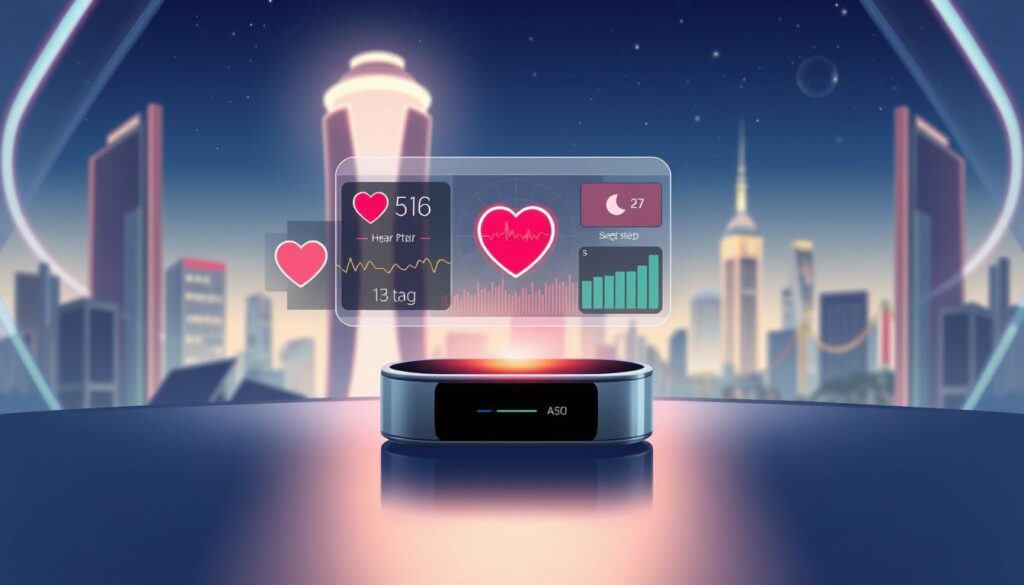
| Example | Input signals | Method | Outcome |
|---|---|---|---|
| Apple Watch → QardioMD | ECG, heart rate | Rule + triage scoring | Prioritized clinical review |
| Propeller Health | Inhaler events, air quality | Machine learning | Asthma risk forecasts |
| Lumenus / Jiobit | GPS, sensors, routines | On-device logic, learning | Zero-UI safety; anomaly alerts |
| Trackener / Whistle | Activity, location, behavior | Behavioral algorithms | Animal health insights |
Integration Best Practices: From HealthKit/Fitbit Streams to HL7/FHIR and EHRs
Consolidating device feeds into a single, governed stream is the practical starting point for reliable integrations.
Start with APIs and middleware: consolidate Apple HealthKit, Google Fit, and the Fitbit Web API through a middleware layer that enforces consent, schema, and security. This creates a unified data layer that simplifies downstream work.
Standardization playbook
Map normalized records early to HL7 and FHIR profiles so Epic and Cerner accept patient-generated data without custom adapters. For practical guidance, consult this HL7/FHIR mapping guide.
Real-time routing and noise reduction
Implement validation, deduplication, and timestamp reconciliation at ingest. Route context-aware alerts into care team queues to avoid fragmentation.
“Reliable integrations depend as much on governance and routing as they do on sensors.”
- Use agent-based baselining to learn patient-specific trends and suppress false alerts.
- Secure transport with token auth, encryption, and strict access controls protects health information.
- Design write-back and audit trails to close the loop with providers and EHRs.
| Layer | Function | Outcome |
|---|---|---|
| API/Middleware | Ingest HealthKit, Google Fit, Fitbit | Unified, governed data |
| Normalization | Map to HL7/FHIR | EHR compatibility (Epic, Cerner) |
| Routing | Validate, dedupe, contextualize | Accurate alerts to care teams |
Operationalizing Insights: Workflows for Remote Patient Monitoring and Care Teams
Structured escalation ladders make monitoring useful: they guide who acts, when, and how for each patient.
Risk-stratified triage and escalation paths
Build triage ladders where risk scores trigger progressive steps—from outreach to telehealth, in-person evaluation, or hospital referral.
Thresholds should be context-aware and learn from individual baselines to cut false alerts and focus provider time.
Condition-specific loops
Design tailored workflows for diabetes, cardiac rhythm, sleep disorders, and respiratory issues. Each loop links device metrics and clinical tasks.
For arrhythmia, prioritize ECG and heart rate trends; for diabetes, combine glucose, activity, and adherence; for sleep, ingest sleep patterns and recovery scores.
Performance and wellness coaching
Sensoria, WHOOP, Oura, and Ultrahuman convert signals into coaching that reinforces adherence and recovery. Coaching supports long-term behavior change and fitness training.
“Continuous monitoring enables earlier interventions and more personalized management.”
- Harmonize metrics: unify heart rate, sleep, activity, and adherence into patient-centric health metrics.
- Align teams: define roles, SLAs, and documentation expectations for healthcare providers.
- Measure impact: track utilization, time-to-intervention, and outcomes to refine management and scale programs.
| Workflow | Key Inputs | Outcome |
|---|---|---|
| Triage ladder | Risk score, trends, context | Prioritized outreach |
| Condition loop | Device metrics, thresholds | Targeted care tasks |
| Coaching | Recovery, sleep, training | Adherence and prevention |
Governance, Security, and Trust: HIPAA, FDA, and State Privacy Essentials
Robust security and transparent governance turn continuous monitoring into dependable clinical information.
Data protection
Encrypt in transit and at rest, enforce granular access controls, and retain complete audit trails to protect patient information.
Token-based APIs and least-privilege patterns harden apps and devices at the edge. Maintain breach response plans and vendor agreements to cover every link in the chain.
Compliance compass
Align with HIPAA by defining PHI handling, access logs, and BAAs across the ecosystem. For regulated functions, follow FDA expectations for validation, labeling, and reporting.
State laws such as CCPA/CPRA add consumer rights—operationalize requests for access, portability, and deletion for users.
Equity and usability
Design inclusive datasets and accessible UX to reduce bias and support diverse users and clinicians.
Deliver concise insights so providers can act without extra cognitive load; transparency and explicit consent build trust across the market.
- Anchor on safeguards: encryption, access control, audit trails.
- Validate intended uses; document labeling and quality management.
- Respect user rights under state privacy laws and disclose information flows.
“Trust is technical design plus transparent policy.”
| Area | Priority | Outcome |
|---|---|---|
| Encryption & Auth | High | Protected information |
| Regulatory | High | Validated device functions |
| Equity & UX | Medium | Broader adoption |
Conclusion
Monitoring vitals around the clock gives providers earlier, clearer opportunities to intervene.
Pairing modern sensors with validated pipelines turns continuous readings into repeatable insights for real-world care. Standardized integration and governance make that promise operational across EHRs and clinical teams.
Programs show wins in triage, earlier detection, and tailored interventions that improve fitness, activity, heart rate, and sleep outcomes. Trust—built on privacy, consent, and transparent controls—keeps users and providers engaged.
The market momentum and growing adoption invite a pragmatic path: start with targeted cohorts, measure outcomes, then scale. For evidence on adoption and outcomes see adoption and outcomes, and for practical commercial guidance review this case study.
Result: better experiences, less hospital utilization, and measurable improvements in heart, sleep, and related risk levels—ready to accelerate across healthcare.
FAQ
What are smart wearables data-insight platforms and how do they relate to healthcare?
These platforms ingest streams from wrist wearables, patches, rings, and implantables, then normalize signals such as heart rate, SpO2, temperature, activity, and sleep. Machine learning models clean noise, detect anomalies, and generate clinical-grade insights that integrate with electronic health records (EHRs) or population health systems for remote monitoring, triage, and personalized coaching.
Which devices and brands lead this space?
Market leaders include Apple Watch, Fitbit, Garmin, Oura, WHOOP, Xiaomi, and Huawei. Each offers distinct sensors and ecosystems; Apple Health and Fitbit Web APIs are commonly used to consolidate streams for analytics and clinical workflows.
What specific biometric streams do platforms typically capture?
Key streams include continuous heart rate and EKG signals, blood oxygen (SpO2), skin and core temperature, activity and step counts, sleep stages, respiration rate, and GPS or proximity for location-context. Some integrations extend to continuous glucose monitors and external spirometers.
How do platforms ensure signal quality and reduce false alerts?
Platforms apply signal cleaning, artifact rejection, and denoising algorithms. They establish patient-specific baselines, use anomaly detection, and implement context-aware filtering to reduce alert fatigue. Validation, deduplication, and clinician-configurable thresholds further cut noise.
Can consumer-grade wearables provide clinically useful data?
Yes—when processed through rigorous pipelines. Raw signals from consumer devices can support screening, trend analysis, and remote monitoring after calibration, validation, and mapping to clinical standards such as HL7/FHIR. For diagnostic decisions, FDA-cleared devices or validated algorithms are preferred.
How do these platforms integrate with EHRs and clinical systems?
Integration relies on APIs and middleware that map device data to HL7 and FHIR resources. Common flows use Apple HealthKit, Google Fit, and vendor APIs to ingest data, then transform and route it into Epic, Cerner, or cloud-based care platforms with secure OAuth, tokenization, and audit trails.
What governance and security safeguards are required?
Essential safeguards include encryption at rest and in transit, role-based access controls, detailed audit logs, and secure APIs. Compliance with HIPAA is mandatory for protected health information; state privacy laws like CCPA/CPRA and FDA guidance apply when claims meet device or software-as-a-medical-device criteria.
How do platforms support chronic disease management and early detection?
Models track longitudinal trends and flag deviations linked to conditions such as atrial fibrillation, COPD exacerbations, diabetes-related patterns, and sleep disorders. Combined with clinical workflows, platforms enable risk-stratified triage, automated escalation, and personalized interventions to improve outcomes.
What role does personalization play in improving accuracy?
Personalization tailors baseline models to an individual’s physiology, activity patterns, and environment. That reduces false positives, improves sensitivity for subtle changes, and enables adaptive coaching—delivering recommendations that fit each user’s lifestyle and risk profile.
Are animal and pediatric monitoring covered by these platforms?
Yes. Specialized trackers—such as pet wearables and child-location devices—feed into similar analytics stacks. Solutions like Whistle for pets or Jiobit for children apply behavior and location analytics to detect anomalies and support caregivers, while respecting different consent and regulatory needs.
How do companies validate algorithms and meet regulatory requirements?
Validation typically combines retrospective studies, prospective trials, and real-world performance monitoring. Teams document labeling, performance metrics, and risk assessments for FDA submissions when clinical claims are made. Ongoing post-market surveillance and model drift checks are standard practice.
What operational challenges should healthcare teams expect when adopting these platforms?
Challenges include workflow integration, clinician training, managing alert volumes, data standardization, and patient engagement. Successful deployments prioritize middleware that maps streams to clinical contexts, clear escalation protocols, and interfaces that surface actionable insights rather than raw signals.
How do privacy and equity considerations shape platform design?
Platforms must build inclusive datasets to avoid bias, ensure accessibility in UX, and provide transparent consent flows. Privacy-by-design principles, granular sharing controls, and equitable algorithm testing across demographics help maintain trust and clinical fairness.
What business models support sustainable deployments?
Common models include subscription services for monitoring, value-based contracts tied to outcomes, device-as-a-service bundles, and API licensing for third-party integrations. Payers and health systems increasingly fund solutions that demonstrably reduce utilization and improve metrics.
How do platforms handle interoperability across multiple device vendors?
They implement adapters and normalization layers to translate vendor-specific formats into unified schemas. Standardization to FHIR resources, use of middleware platforms, and ongoing mapping libraries enable multi-vendor interoperability and consolidated clinician views.