
It hits hard when a hot contact slips through the funnel — a missed call, an unanswered email, a small signal gone unread. Many leaders feel that loss as a personal cost: lost revenue, strained teams, and a quiet worry about wasted time.
Modern organizations can change that by unifying website, email, CRM, and social data into a single system that ranks prospects by purchase likelihood.
That ranking comes from a trained model using machine learning to learn patterns from past outcomes, not static points. This approach improves accuracy and keeps scoring aligned to market shifts. For a practical primer, learn how modern scoring models work.
The result is faster routing to sales, clearer marketing handoffs, and data-driven decisions that protect conversion and lifetime value.
Key Takeaways
- Unify website, email, and CRM data for a single view of prospects.
- Train a model so scoring adapts over time and boosts accuracy.
- Integrate scores into sales workflows to speed response and protect conversion.
- Monitor model performance and retrain to stay aligned with market changes.
- Focus on revenue impact and practical thresholds, not just higher scores.
Why Predictive Lead Scoring with Machine Learning Matters for Sales Teams
Sales operations win when qualification moves from opinion to a consistent, data-driven practice. U.S. sales teams gain a clear edge by shortening the time from inbound contact to a qualified meeting while keeping accuracy high.
Fast routing alone is not the goal. A study of 88,000 inbound leads showed features that automate scoring cut service time by 31%. That speed matters—only when it pairs with improved conversion rates and real opportunity creation.
Future-ready lead qualification in the United States market
Centralized data across website, email, CRM, and social channels delivers clearer intent signals. Teams see which customer actions predict deal progress, not just activity counts.
From speed-to-contact to revenue impact: setting expectations
“Consistent scores free reps to spend time on conversations that actually move deals forward.”
Monitor accuracy by comparing qualification to second meetings and opportunity creation. Teams that validate score bands weekly protect conversion and sustain revenue growth.
Understanding the Basics: Lead Scoring, Models, and Predictive Analytics
A good scoring framework separates activity from intent and prioritizes what matters. Point systems assign points for actions and attributes—email opens, page visits, job title—but they stay static unless someone updates the rules. That simplicity makes points easy to explain and quick to launch.
By contrast, learned models analyze broader data and adapt over time. They pull website behavior, email interactions, CRM history, and purchase trends to find patterns that match won deals. This learning helps scores reflect real buying signals rather than raw counts.
Point-based lead scoring vs predictive lead scoring
Point-based scoring is transparent but rigid. A predictive approach uncovers combinations of actions that matter most and updates as behavior changes.
Manual vs automated scoring: trade-offs in accuracy and scale
Manual inputs add valuable context but slow down operations and struggle at volume. Automated models apply consistent criteria at speed, which improves accuracy for growing inbound streams.
Key data types
Demographic and firmographic data measure fit. Behavioral and engagement signals show interest. Third-party intent adds timely buying cues. Comprehensive data collection—from CRM, website analytics, marketing automation, and social media—lets a system distinguish high intent from mere activity.
“Prioritize meaning over motion: repeated pricing visits often matter more than many generic pageviews.”
| Method | Strength | Limit | Best for |
|---|---|---|---|
| Point-based | Transparent, fast to deploy | Static; needs manual tuning | Small teams starting scoring |
| Learned model | Adapts, finds patterns in broad data | Needs historical outcomes and setup | High inbound volume and growth |
| Hybrid | Human oversight plus automation | Requires governance | Teams scaling while preserving context |
AI Use Case – Predictive Lead Scoring with ML
Models sift vast behavior and profile data to surface the signal behind conversion. They learn which combinations of actions and attributes correlate with wins, not just single clicks.
Patterns such as webinar attendance followed by a pricing-page visit within 48 hours often indicate high buying readiness. The system assigns weights to those features so frequent product-page visits can outweigh a simple title match.
How machine learning identifies patterns to forecast conversion rates
Models analyze historical outcomes to find multi-factor patterns that predict conversion rates. They compare bands of scores to actual conversion to validate that a “Highly Likely” tier truly correlates with faster cycles and higher win rates.
Weighting factors and dynamic scoring thresholds
Scores typically run on a 0–100 scale. A practical tiering is: ≥95 Highly Likely, 50–94 Likely, and <50 Unlikely. Dynamic thresholds let teams map bands to actions and retune them as rates shift.
- Weights are learned from data; recent behavior often carries more influence via time decay.
- Models continuously update as new outcomes arrive, improving accuracy over time.
- Explainability surfaces top factors per lead, building trust across sales and marketing.
“A clear score scale and transparent factors make rapid routing simple and defensible.”
Benefits That Move the Needle: Accuracy, Efficiency, and Alignment
A unified scoring system reduces variance and turns volume into dependable opportunities. Consistent scores cut human error by applying one model across channels, so top prospects are less likely to be missed when inbound spikes.
Faster response matters. Automated scoring and routing trimmed inbound service time by 31% in a study of 88,000 leads. That time savings lets sales teams contact the right person faster without adding headcount.
Error reduction and consistent scoring at scale
Consistent scoring reduces bias and variance. Teams get repeatable results whether volume rises or bandwidth falls.
Faster speed-to-lead and resource efficiency
Embedded lead scores surface in the CRM so sellers act in one place. That keeps time focused on calls and discovery instead of manual triage.
Sales and marketing alignment on MQL/SQL handoffs
Shared thresholds anchored by scores remove disputes and smooth handoffs. Marketing and sales follow the same objective criteria for next steps.
Improved forecasting using lead scores and win probability
When score bands map to ACV, cycle length, and win rates, forecasting improves. Leaders can quantify revenue impact by tracking opportunities by band.
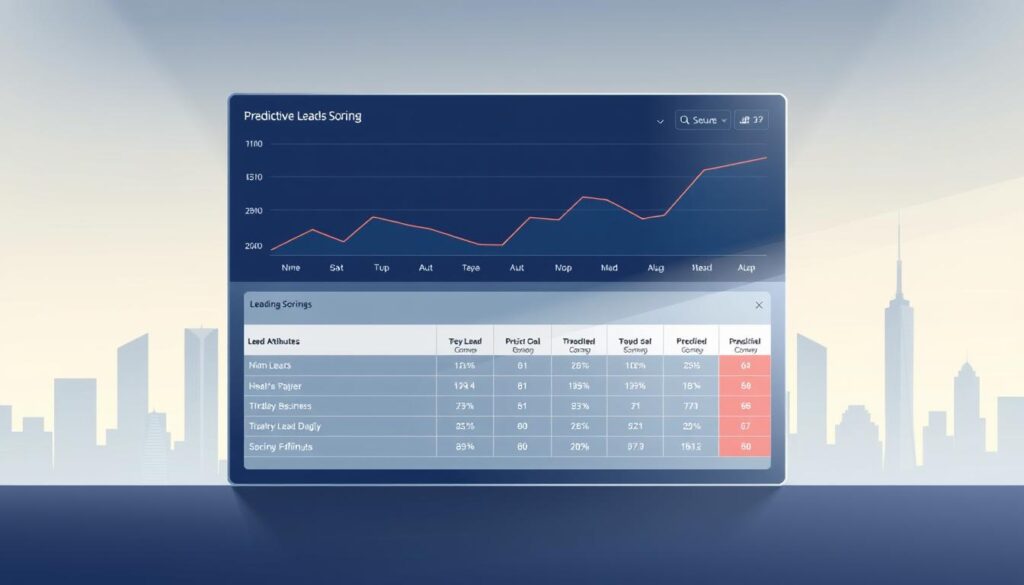
| Benefit | What changes | Business impact | Measured by |
|---|---|---|---|
| Consistency | Single model across channels | Fewer missed high-quality leads | Variance in qualification rates |
| Efficiency | Automated routing and CRM surfacing | Faster contact, lower cost per lead | Time-to-contact; headcount per volume |
| Alignment | Shared MQL/SQL thresholds | Smoother handoffs and higher conversion | Conversion rates; dispute incidents |
“A clear score scale and transparent factors make rapid routing simple and defensible.”
Data Foundation: Collection, Cleaning, and Feature Engineering
A reliable model starts on a dependable data foundation. Teams must collect consistent signals from CRM, marketing automation, website analytics, email campaigns, and social media into a single system of record.
Consolidation and hygiene
Consolidation prevents fragmented profiles and ensures the model sees full customer journeys. A defined process for data collection and normalization keeps information comparable across channels.
De-duplication, enrichment, and standardization remove noise. Scheduled audits, enrichment checks, and field normalization stop skewed outputs and protect long-term accuracy.
Feature engineering that matters
Raw events become useful predictors when transformed into metrics such as engagement minutes, recency-weighted visits, or composite interaction depth. These features help the model learn real patterns tied to conversion.
- Track freshness and completeness SLAs so inputs remain current.
- Automate lead-to-account matching to avoid score dilution from duplicates.
- Document a lightweight data dictionary to align teams and speed audits.
“Consolidation gives the model more information to learn meaningful patterns without overfitting.”
For a practical guide to tying data into revenue-focused analytics, review this overview on predictive analytics in marketing.
Choosing a Lead Scoring Model Strategy
Strategy matters: models can be tuned to favor buying signals, firm fit, or steady engagement.
Teams pick an approach that maps to their go-to-market priorities. A clear choice helps marketing and sales act on the right prospects at the right time.
Purchase intent models
Purchase intent models prioritize timely buying signals: comparison pages, repeat pricing visits, and demo requests.
These features push prospects straight into rapid outreach.
When speed drives conversion, intent weight should dominate the scoring model.
ICP-focused models for account-based selling
ICP-focused models emphasize fit: industry, company size, and tech stack.
They suit account-based strategies that value relationship depth and expansion.
In enterprise segments, raise ICP weights; expect longer cycles and higher ACV.
Engagement-driven models
Engagement-driven models reward consistent brand interaction.
They work where education and affinity predict conversion.
Nurture tracks pair well with this approach to build value over time.
Negative scoring to filter low-fit profiles
Negative scoring suppresses churn-prone or low-fit leads.
It protects seller time and improves lifetime value by removing noise from the funnel.
| Strategy | Primary signal | Best for |
|---|---|---|
| Purchase intent | Pricing, demos, repeat visits | Fast-moving SMB segments |
| ICP-focused | Industry, company size, tech fit | Account-based enterprise sales |
| Engagement-driven | Consistent interaction, content depth | Brand-driven markets and education plays |
| Negative scoring | Indicators of churn or low fit | Improve seller productivity and pipeline quality |
A combined scoring model can weight intent, ICP, and engagement by segment. Quarterly reviews of model weights keep outputs aligned to industry shifts and product strategy.
“Time-bound experiments (60–90 days) reveal which strategy mix produces the best balance of pipeline quality and velocity.”
Operational playbooks must map actions to bands: direct outreach for high intent, ABM plays for ICP fit, and nurture for engagement. Sales and marketing should agree on success metrics per model type to measure impact.
How-To Implementation: From Audit to Optimization
Begin with a clear audit that quantifies where the current process drops high-potential prospects.
Audit current scoring and identify gaps
Map existing criteria, tag data sources, and measure accuracy against outcomes. Document missed high-value leads and patterns that hurt conversion rates.
Select platforms and tools
Prioritize vendors that offer explainability and native CRM connectors—examples include Demandbase, Salesforce Einstein, and HubSpot. Choose tools that make factors visible so sales and marketing trust the system.
Integrate, train, and customize
Build real-time flows between CRM and marketing automation. Clean and enrich data before training the model on historical outcomes.
Customize features and set thresholds that map to routing rules: outreach, nurture, or recycle.
Deploy, monitor KPIs, and retrain
Launch with clear KPIs: lead-to-opportunity, velocity, deal size, and revenue per band. Gather seller feedback and run time-boxed pilots to validate impact.
Retrain regularly so learning reflects recent wins and losses. Define SLAs and playbooks for each score band to ensure consistent follow-through.
“A short audit and disciplined pilots prove the process before scale.”
Tooling Landscape: Platforms and Integrations to Consider
A platform’s integrations determine whether data flows keep pace with buying behavior. Choose tools that centralize first- and third-party information so scores update as website and email signals arrive.
Demandbase One aggregates first- and third-party plus intent signals to produce predictive scores for account prioritization. Scores appear after a data sync and feed ABM plays.
Salesforce Einstein and HubSpot
Both offer native scoring inside familiar CRMs, lowering friction for sales adoption and surfacing factor contributions in the record.
ActiveCampaign and 6sense
ActiveCampaign provides dynamic scoring and win probability to guide outreach and nurture. 6sense and peer platforms surface cross-channel buying signals and enrich models that single systems miss.
- Default workflows connect enrichment, qualification, routing, scheduling, and nurture for full-funnel automation.
- Prioritize explainable outputs, real-time updates, and team dashboards so sales and marketing act on the same information.
- Evaluate pricing, scalability, and a model’s ability to retrain as outcomes change.
| Platform | Strength | Best for | Integrations |
|---|---|---|---|
| Demandbase One | ABM signals; intent fusion | Account prioritization | CRM, marketing, intent feeds |
| Salesforce Einstein / HubSpot | Native scoring in CRM | Teams using existing CRM | Native CRM connectors |
| ActiveCampaign | Dynamic scores; win probability | SMB outreach and nurture | Email, automation, CRM |
| 6sense + peers | ML-driven buying signals | Cross-channel insight and enrichment | Data lakes, CRMs, workflow tools |
For tool comparisons and practical tracking guidance, review resources on tools for tracking affiliate performance.
Operationalizing Scores: Routing, Nurture, and Real-Time Workflows
A score is only useful when it drives a predictable process from assignment to follow-up. Operational rules convert numeric bands into clear routing, SLAs, and automated steps so teams act fast and with context.
Score-based triggers for assignment and scheduling
Translate bands into concrete rules: high scores route to sales instantly; mid bands queue for nurture; low bands stay in awareness streams. Integrate the system with CRM and marketing automation so updates flow in real time.
- Immediate assignment: auto-assign high-intent leads and set a minutes-based SLA for first touch.
- Automated scheduling reduces friction and shortens time-to-meeting for top-tier contacts.
- Post score explanations to the CRM record so sellers see why a lead is prioritized.
Designing nurture paths for mid- and low-score leads
Mid-range leads enter sequenced email, remarketing, and website personalization to build engagement. Low-score streams keep brand awareness alive while conserving seller time.
- Trigger workflows when scores change so a lead moves to sales in real time.
- Map content to the behaviors the models flag as buying signals to accelerate readiness.
- Equip teams with playbooks that pair score thresholds to specific outreach tactics.
“Fast routing plus clear context turns volume into reliable revenue.”
Monitor time-to-first-touch, response times by band, and reporting by stage. Periodic reviews of tools, triggers, and data flows keep the process aligned as models evolve.
Real-World Examples and Industry Applications
Real deployments show how distinct engagement patterns can predict faster closes and higher deal value.
SaaS CRM example: webinars, pricing visits, and deal correlation
In many SaaS companies, a clear pattern emerges: prospects who attend a webinar, then visit a pricing page, receive higher scores. That sequence correlates with shorter sales cycles and higher win rates.
Score explanations help account executives tailor discovery calls by referencing the content consumed and website behavior. Teams map those signals to banded playbooks: instant outreach for top scores, targeted education for mid scores, and light-touch nurture for lower tiers.
Fintech growth and scoring opportunities
The fintech market is expanding rapidly, making model-driven filtering essential. Companies rely on data to prioritize prospects across complex segments where timing and trust matter.
Explainable scores are especially valuable in regulated environments. They provide the information stakeholders need to approve outreach and to comply with governance rules.
“Time-to-meeting drops when real-time scoring triggers outreach sequences—critical in competitive, fast-moving markets.”
| Industry | Common pattern | Business impact |
|---|---|---|
| SaaS CRM | Webinar → pricing visits | Faster cycles; higher conversion rates |
| Fintech | Repeat comparison visits; demo requests | Better prioritization; compliance-ready signals |
| Enterprise software | Account engagement + ICP fit | Higher ACV; targeted ABM plays |
- Data-backed examples show measurable lifts in conversion when routing prioritizes pricing- and demo-related engagement.
- Sales leaders measure revenue impact by comparing opportunity creation and close rates across score bands.
- Real-time scoring reduces time-to-meeting and improves chances to convert high-intent prospects.
Conclusion
When teams align on thresholds and playbooks, scores stop being guesses and start driving revenue. Predictive lead scoring marries multi-source data, clear process, and practical tooling into a reliable system.
Clean inputs, CRM and automation integration, and an explainable model boost accuracy and seller trust. Regular retraining keeps outputs matched to market shifts.
Start small: validate lift through short pilots, measure conversion, velocity, and ACV by band, then expand successful playbooks across sales and marketing.
With disciplined governance and constant monitoring, a scoring program becomes a durable advantage—routing the right prospects at the right time and improving customer outcomes and business revenue over time.
FAQ
What is the practical difference between point-based lead scoring and predictive scoring?
Point-based systems assign fixed values to actions or attributes — for example, 10 points for a demo request. Predictive models use historical data and machine learning to weigh many factors simultaneously, producing a probability that a prospect will convert. Predictive scoring adapts as patterns change, offering higher accuracy and better prioritization for sales and marketing teams.
How does machine learning identify patterns to forecast conversion rates?
Models ingest historical CRM, website, email, and social engagement data, then detect correlations between behaviors and closed deals. Algorithms rank features by predictive power, learn non-obvious interactions, and output a score that reflects conversion probability. The result is a dynamic score that improves with more labeled outcomes and ongoing retraining.
Which data types matter most for an effective scoring model?
High-impact inputs include demographic and firmographic details, behavioral signals (page views, content downloads, time on site), engagement metrics (email clicks, social interactions), and transactional history. Enrichments and intent signals — such as search activity or third-party intent data — further sharpen accuracy.
What are common trade-offs between manual scoring and automated models?
Manual scoring is transparent and quick to implement but tends to be brittle and labor-intensive. Automated models scale and find complex patterns, yet require quality data, technical resources, and explainability to gain stakeholder trust. The best approach often blends both: rules for immediate routing plus models for prioritization.
How should organizations prepare their data before building a model?
Start by consolidating CRM, marketing automation, website analytics, email, and social media records. Cleanse duplicates, standardize fields, and enrich missing attributes. Feature engineering — such as session duration, recency of activity, or composite engagement minutes — creates stronger signals for the model.
What is negative scoring and why is it useful?
Negative scoring deducts points for behaviors or attributes that indicate low fit or churn risk, such as unsubscribes, expired contracts, or competitors’ firmographics. It prevents wasting sales effort on poor-quality prospects and helps refine routing and nurture strategies.
How do weighting factors and dynamic thresholds work in practice?
Weighting assigns relative importance to features based on their predictive impact; dynamic thresholds adjust the score cutoffs for MQLs or sales handoffs according to seasonality, pipeline coverage, or campaign goals. This keeps qualification aligned with business needs rather than fixed rules.
What KPIs should teams monitor after deploying a scoring model?
Track conversion rate by score band, win rate, average deal size, speed-to-contact for high-score leads, and funnel velocity. Monitor model accuracy metrics like AUC and precision, plus business KPIs such as revenue influenced and sales cycle length to measure impact.
How often should models be retrained and monitored?
Retrain cadence depends on data velocity — monthly to quarterly is common. Continuous monitoring for model drift, changing feature importance, or shifts in buyer behavior is essential. Automated alerts for performance degradation help teams retrain proactively.
Which platforms support explainable models and CRM integration?
Solutions such as Salesforce Einstein, HubSpot, Demandbase One, 6sense, and ActiveCampaign offer varying degrees of explainability and direct CRM or marketing automation integrations. Choose tools that expose feature contributions and integrate with existing workflows for real-time score updates.
How can sales and marketing align on score-based handoffs?
Define shared MQL/SQL criteria, document routing rules, and agree on SLA for follow-up times. Use score bands and intent signals to automate assignments. Regular retrospective meetings to review closed-loop feedback and adjust thresholds foster ongoing alignment.
What are effective nurture strategies for mid- and low-score prospects?
Segment by score and intent, then design multi-step nurture journeys: educational content for low scores, targeted offers and case studies for mid scores, and trigger-based outreach if intent spikes. Use personalization and re-engagement paths to move prospects down the funnel.
Can predictive scoring improve forecasting accuracy?
Yes. Incorporating probabilistic lead scores into pipeline models improves forecast granularity by weighting opportunities according to conversion likelihood. This yields more reliable revenue projections and helps prioritize resource allocation.
What internal processes enable continuous improvement of a scoring system?
Establish data governance, regular audits, and a feedback loop between sales, marketing, and analytics. Log outcomes, retrain the model with new closed-won and closed-lost cases, and run A/B tests on thresholds and routing to validate impact.
How do privacy and compliance affect data collection for scoring?
Follow regional regulations like CCPA and applicable privacy frameworks. Limit PII usage, document consent, and use secure enrichment providers. An ethics-minded approach protects customer trust while maintaining the data signals needed for accurate models.
What are common pitfalls when deploying scoring models?
Common issues include poor data quality, overfitting to historical winners, lack of explainability, and weak sales buy-in. Address these by improving data hygiene, choosing interpretable models, and involving stakeholders in design and validation.
Which model strategy suits account-based selling?
ICP-focused models that score accounts using firmographic fit, technographic signals, and account-level engagement work best for ABM. Combine account and contact signals to drive targeted outreach and measure expansion opportunities.
How can companies measure ROI from implementing a scoring solution?
Compare conversion rates, deal velocity, and average deal size before and after deployment. Calculate time saved on triage, increased quota attainment, and revenue uplift attributable to higher-quality handoffs to quantify ROI.
Are there industry-specific considerations for fintech or SaaS?
Yes. Fintech benefits from transactional and compliance signals, while SaaS models often weight product usage, pricing-page activity, and webinar attendance. Tailor features and thresholds to domain behaviors and sales cycles.
How should teams handle leads that suddenly change behavior?
Implement real-time scoring updates and triggers. Rapid intent spikes should escalate leads into higher-touch workflows. Ensure routing rules and notifications enable immediate action by sales to capitalize on intent windows.