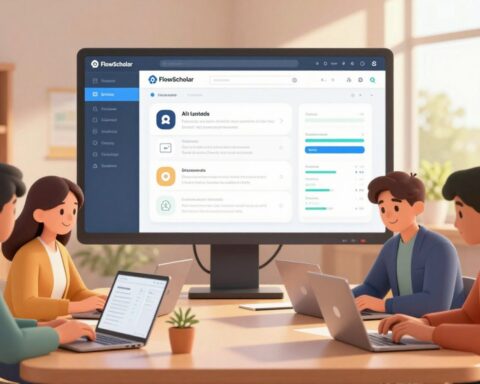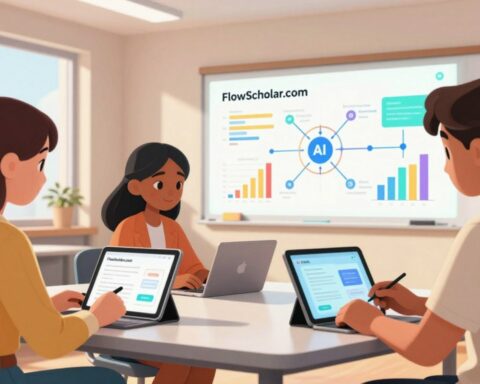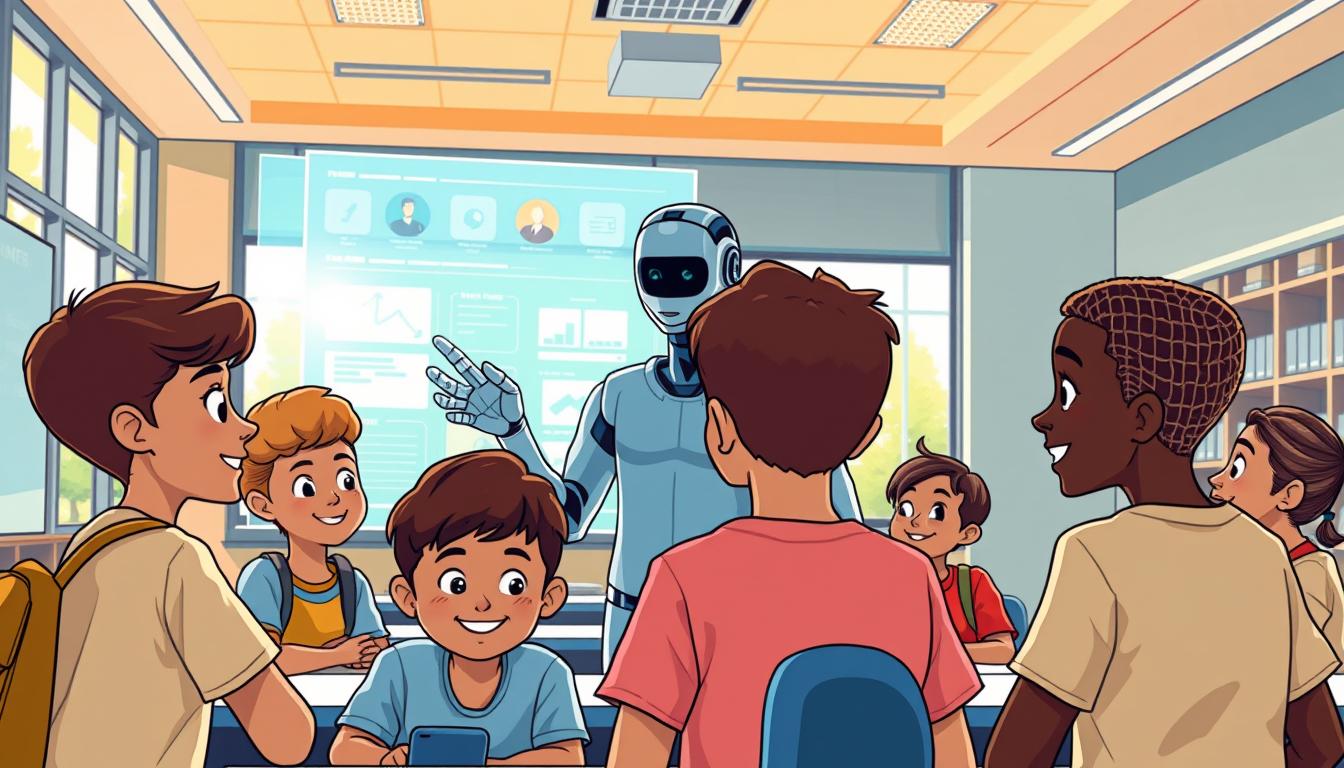
Learning can feel lonely and urgent at once: a student stares at a problem and needs help now. This introduction explores how modern intelligent tutoring systems bridge that gap. It is for U.S. educators and leaders who want evidence-based tools that scale one-to-one support.
These platforms deliver targeted instruction, real-time feedback, and adaptive content paths powered by artificial intelligence. Studies between 2010 and 2025 report average gains of about 20% in student performance, while individual human tutoring still shows higher gains but is costly and hard to scale.
Today’s intelligent tutoring evolved from drill practice into dialog-based, natural-feeling experiences. A four-part architecture—Domain/Knowledge, Student, Tutor, and User Interface—makes assessment and personalization practical at scale.
Readers will find a clear path: definition, architecture, implementation, analytics, ethics, and future trends. The goal is simple: combine human strengths with robust systems to sustain better learning outcomes across schools and programs.
Key Takeaways
- Intelligent tutoring systems offer scalable, one-to-one style instruction.
- Evidence shows ~20% average gains in student performance in real settings.
- Modern platforms provide adaptive content and real-time feedback.
- Four-component architecture enables accurate assessment and personalization.
- Combining human tutors and scalable systems can sustain long-term gains.
Why Intelligent Tutoring Systems Matter in Education Today
Scalable platforms now bring one-to-one instruction into large classrooms and distance programs, changing who can access quality education.
These systems deliver individualized instruction and prompt feedback so teachers can focus on higher-order tasks. They support personalized learning paths that address each student’s needs without overburdening staff.
Equity and consistency are core benefits: the same instructional logic and data-driven guidance reach students across schools, reducing variability in educational experiences. Timely feedback raises engagement and builds confidence, helping learners persist through challenges.
- Evidence matters: reviews from 2010–2025 show promising performance gains but call for rigorous evaluation designs to confirm impact at scale.
- Complement to teachers: tutoring systems enable targeted interventions, freeing time for classroom instruction and complex teaching tasks.
- Practical adoption: success depends on readiness, professional development, and standards alignment.
In short, these platforms are a pragmatic, student-centered approach for districts seeking measurable engagement, data-informed instruction, and sustained learning growth.
Defining Intelligent Tutoring Systems and What Makes Them “Intelligent”
Contemporary tutoring software personalizes tasks and feedback to match a learner’s moment-to-moment needs. These platforms are advanced educational programs that adapt instruction, content, and feedback to each student’s understanding and learning styles.
From drill-and-practice to adaptive, dialog-based tutors
Early tools focused on repetition and rote practice. Modern designs use natural language and decision rules to sustain a richer learning experience. This shift produces more engaging, conversational interactions that guide a student through problems.
How these systems compare to human tutors and traditional instruction
Human tutors still offer the most nuanced, empathetic support. Yet scalable platforms deliver consistent, 24/7 personalized learning at lower cost and with reliable data for teachers.
“When systems capture real-time evidence, they shorten time to mastery and reveal misconceptions early.”
- Core strengths: student modeling, domain expertise, and tutorial decision-making.
- Content sequencing responds to errors and supports productive struggle.
- Tradeoff: subtle human judgment vs. broad reach and actionable analytics.
Vision: these systems augment educators and broaden equitable access to high-impact support.
Core Architecture of Intelligent Tutoring Systems
Four complementary components work together to turn student signals into precise learning guidance. This architecture provides the data flow and decision logic that make adaptive learning reliable, scalable, and aligned to curriculum goals.
Domain/Knowledge Model
The Domain/Knowledge Model holds expert content, solution paths, and error models. It anchors precise alignment between curriculum and practice.
Why it matters: well-structured content lets the system map student answers to misconceptions and craft targeted feedback quickly.
Student Model
The Student Model tracks progress, misconceptions, and affect. It uses data techniques—Bayesian networks and machine learning—to predict mastery.
This live profile updates with each interaction so the platform refines estimates and selects the next best task for students.
Tutor Model
The Tutor Model applies pedagogical strategies: hints, prompts, explanations, and targeted practice. It chooses instruction tailored to learners’ needs.
Instructional rules reduce cognitive load and keep practice productive, while preserving opportunities for productive struggle.
User Interface
The User Interface shapes the learning environment with clear dialogue, visualizations, and actionable feedback. Interfaces must present feedback aligned to a student’s demonstrated approach.
| Component | Primary Role | Key Methods | Impact |
|---|---|---|---|
| Domain/Knowledge | Content and error models | Expert maps, solution paths | Accurate alignment and targeted feedback |
| Student Model | Progress and misconception tracking | Bayesian networks, ML, data mining | Personalized pacing and prediction |
| Tutor Model | Pedagogical decision-making | Hint logic, scaffolding rules | Optimized instruction for learners |
| User Interface | Human-computer interaction | Dialogue UI, visual cues | Engaging, actionable learning experience |
Data flows continuously between components: content and rules inform diagnosis; student signals update the profile; the tutor model picks interventions; the interface delivers feedback. Interoperability with LMS platforms preserves workflows and supports scale.
Result: a coherent architecture that supports durable learning, reliable progress monitoring, and consistent instructional fidelity across education settings.
Personalized Learning Experiences and Adaptive Learning in Practice
Adaptive platforms shape instruction so each student receives tasks that fit their current skill level and goals. This dynamic alignment—sequencing, pacing, and content—targets the Zone of Proximal Development to keep work challenging but attainable.
Personalized learning in these platforms relies on models such as Bayesian networks and neural networks to adjust difficulty, hints, and examples in real time. Learning environments read student signals and customize problem sets, worked examples, or dialog prompts to match learning styles without fragmenting the experience.
Dynamic pacing and custom learning paths
Systems surface just-right practice and nudge progress using mastery thresholds rather than fixed schedules. Adaptive sequencing supports both remediation and acceleration for individual learners.
Immediate feedback loops that guide students
Immediate feedback guides students through problem-solving, reducing unproductive struggle and reinforcing transferable strategies. Dialog-based platforms like Korbit personalize micro-interventions, drawing on ML and NLP to provide targeted prompts that guide students effectively.
- Transparency: learners should see why a path or hint appears.
- Instructor role: teachers monitor progress and adjust content policies to provide personalized learning within course constraints.
- Assessment pairing: adaptive features must align with assessments to confirm improved transfer and retention.
Student Modeling: The Engine Behind Personalization
Student models convert interaction logs into a running estimate of what a learner truly knows. This profile is the core mechanism that powers personalized learning, turning raw data into actionable instructional decisions.
Techniques include Bayesian networks to estimate mastery probabilities, plus machine learning and data mining to surface patterns and predict next steps. These methods detect affect, predict likely errors, and suggest targeted feedback.
Longitudinal tracking separates slips from persistent gaps by monitoring performance, engagement, and misconceptions over time. Assessment traces and interaction logs refine predictions about which content or feedback will help most.
- Inference: models infer preferences and learning styles from choices and outcomes to balance modality and scaffolding.
- Privacy-by-design: protect sensitive data while enabling tailored experiences.
- Interpretability: dashboards translate probabilities into clear teacher-facing insights.
Robust evaluation—A/B tests and delayed post-tests—confirms whether updates improve progress and retention. Institutions should iterate models with local data to align with curriculum and student populations; for methods and standards, see a recent technical review on model evaluation at student-model evaluation.
NLP and LLMs in Intelligent Tutoring: Toward Human-like Tutoring
Natural language dialogue now lets learning platforms ask clarifying questions and scaffold solutions like a human coach. This shift makes feedback feel conversational and timely.
Dialogue-based hints and explanations
Natural language processing enables a back-and-forth that mirrors classroom talk. The system can ask for a student’s next step, offer a stepwise hint, or nudge toward a correction.
Clarifying prompts help students reveal intent so the platform supplies a targeted explanation rather than a generic tip.
Large language models for context-aware feedback
Large language models produce adaptive, context-aware feedback aligned to a student’s current solution path. They can simulate Socratic questioning and decide when to probe or when to demonstrate a strategy.
Outcome: higher-quality instruction because the system recognizes intent and addresses specific misconceptions.
“When feedback matches a student’s reasoning, learning progresses faster and engagement rises.”
Safeguards are essential: controlled generation, rubric-aligned content, and error detection keep outputs accurate and pedagogically sound. Teachers retain controls to set tone, depth, and constraints so feedback complements classroom instruction.
Data and interaction logs feed continual model updates and rigorous evaluation—see recent student-model evaluation at student-model evaluation—to confirm gains and check for bias.
Learning Analytics and Assessment for Effective Learning
Continuous measurement turns every learner interaction into a signal for timely instructional choices. These signals feed dashboards and guide formative decisions for both teachers and students.
Continuous assessment, progress monitoring, and valuable insights
Continuous assessment transforms clickstreams, answers, and time-on-task into clear metrics. Dashboards surface common error patterns, revision habits, and anomalies in time spent.
Teachers can monitor student understanding and spot stalled progress before gaps widen. This yields valuable insights that inform small-group instruction and personalized practice.
Automated grading, formative assessment, and real-time interventions
Automated grading accelerates feedback cycles and frees teachers for coaching and planning. Formative signals trigger targeted hints, adaptive practice, or teacher alerts to prevent misconceptions from hardening.
“When feedback is timely and transparent, students act sooner and retention improves.”
- Metrics beyond accuracy: track perseverance, revision behavior, and transfer tasks to measure deeper learning.
- Transparency: learners should see how data shape recommendations and what steps improve performance.
- Interoperability: align analytics with LMS reporting and standards for program-level review.
We recommend delayed post-tests and longitudinal tracking to validate gains and guard equity. For guidance on rigorous evaluation and long-term measurement, see a recent review on durable outcomes at delayed post-test and longitudinal tracking.
Benefits That Improve Student Performance and Engagement
Personalized platforms help students move from confusion to confidence by matching tasks to what they already know.

Personalized instruction at scale and self-paced learning
Personalized learning aligns challenges to current readiness so students master concepts faster. The platform paces practice to avoid boredom or overload.
Self-paced pathways respect individual variability: students can revisit lessons or accelerate when they show mastery. This flexibility reduces stress and boosts voluntary practice.
Engaging, multimedia learning environments and gamification
Modern learning environments host simulations, videos, and games that capture attention and support persistence. Gamified elements reward progress and shape positive study habits.
Immediate feedback and targeted hints cut frustration and reinforce strategies that transfer to new problems. Clear goals and progress indicators keep learners focused.
- Adaptation to learning styles: the system varies presentation format without weakening rigor.
- Measurable gains: higher engagement links to improved student performance and more optional practice participation.
- Educator support: dashboards turn engagement data into timely nudges and enrichment assignments.
- Inclusive design: multimodal materials broaden access for diverse students.
“Personalization, timely feedback, and engaging design work together to create educational experiences that sustain momentum.”
In short, personalized learning, actionable feedback, and engaging design combine to produce learning experiences that raise engagement and lift performance across classrooms and programs.
Supporting Educators: Augmenting Human Tutors and Teachers
Classroom educators gain a practical partner when software turns raw interaction logs into clear, actionable steps.
Positioned as a co-teacher, the platform augments human tutors and classroom teachers with data-informed instruction and timely recommendations. Dashboards convert complex traces into valuable insights—revealing which skills to reteach and which students need targeted support.
Automating routine grading and checks frees time for high-impact tasks: conferencing, rich feedback, and project-based learning. The system aligns hints and practice to instructional goals so teachers keep control of pacing and rigor.
- Understand learning styles and preferences to plan small-group work efficiently.
- Override or refine recommendations to respect classroom context and professional agency.
- Spot quieter students early so equity improves through data-driven alerts.
“Shared progress views spark productive student-teacher conferences and clear next steps.”
| Benefit | What Educators See | Classroom Impact |
|---|---|---|
| Automated grading | Quick accuracy reports | More time for coaching |
| Dashboard insights | Skill gaps and misconceptions | Targeted reteach plans |
| Adaptive hints | Aligned practice and feedback | Consistent learning experiences |
Result: augmentation, not replacement—keeping human judgment central while improving progress, engagement, and instructional quality.
Implementing Intelligent Tutoring Systems in Learning Environments
A reliable deployment ties platform content directly to grade-level benchmarks and exams.
Align content and assessment. Begin with a stepwise mapping: identify standards, map lessons and items to benchmarks, and flag gaps for local content. Calibrate mastery thresholds to match district policies and high-stakes assessments.
Integrate with existing tools. LMS integration centralizes access, syncs rosters, and streamlines grading and analytics. Single sign-on and roster sync reduce friction for teachers and students while preserving data flows for assessment and progress monitoring.
Address infrastructure early: device access, bandwidth, privacy compliance, and SSO must be confirmed before wide use. Run pilot classrooms to validate performance, surface training needs, and refine content mapping.
Collaborate across stakeholders. Teachers, curriculum leads, IT staff, and district leadership should set goals, success metrics, and governance. Professional development builds confidence to interpret analytics and orchestrate instruction alongside the platform.
“Provide personalized learning at scale only when integration, configuration, and people align—not just feature lists.”
| Implementation Area | Key Actions | Expected Outcome |
|---|---|---|
| Content Alignment | Map lessons to standards; set mastery rules | Curriculum fidelity and valid assessment |
| Technical Integration | LMS sync, SSO, data pipelines | Seamless access and streamlined workflows |
| Infrastructure & PD | Pilot devices, bandwidth checks, teacher training | Smooth daily use and informed educators |
| Change Management | Communication plan; celebrate wins; iterate | Sustained adoption and improved engagement |
Plan pilots, communicate expectations to families, and iterate based on feedback. With careful alignment and collaboration, these systems can provide personalized learning and stronger learning experiences across diverse learning environments.
Evaluating ITS in Real Educational Settings
Careful evaluation turns abundant log data into trustworthy answers about effectiveness, equity, and durability. Rigorous methods separate short-term signals from meaningful gains in learning and classroom practice.
Methodological rigor: PRISMA-inspired reviews and study design
A systematic review (2010–2025) screened 37,617 records and retained 127 studies using PRISMA-like procedures. Review teams reported strong inter-rater agreement (Cohen’s Kappa = 0.82), which strengthens confidence in synthesis.
We recommend randomized trials, well-matched quasi-experiments, and pre-registered protocols to reduce bias. Transparent reporting of data pipelines and model updates is vital to build trust in any system’s claims.
Measuring outcomes: effectiveness, satisfaction, and long-term impact
Evaluations should combine formative traces with summative assessment so that immediate performance links to delayed retention and real transfer. Include measures of student satisfaction and classroom engagement to capture the full learning experience.
- Subgroup analysis: test effects by prior achievement and demographics.
- Mixed methods: pair usage data with interviews and observations for context.
- Longitudinal tracking: confirm sustainable progress beyond short pilots.
“Open benchmarks and shared datasets accelerate replication and help districts judge generalizability.”
Equity, Privacy, and Ethics in AI-driven Tutoring
Ethical deployment means designing platforms that protect privacy while widening access to quality education. Equity is not an add-on; it is foundational. Programs must support learners in varied homes, schools, and communities without creating new gaps.
Data protection, algorithmic transparency, and bias mitigation
Privacy-by-design reduces unnecessary collection, applies strong encryption, and enforces clear consent and governance policies. Districts should require data minimization and retention limits in vendor contracts.
Transparency means publishing model documentation, training data provenance, and evaluation results so educators can detect bias. Regular bias audits and fairness constraints help reduce disparate impacts on demographic groups.
- Document model decisions and version changes.
- Run third-party bias audits and remediate findings.
- Train staff to interpret analytics responsibly.
Bridging the digital divide for quality education access
Plan device programs, offer offline modes, and partner with community centers to reach students with limited broadband. Multilingual interfaces and culturally relevant content ensure the platform reflects diverse classrooms across the United States.
| Barrier | Mitigation | Expected Outcome |
|---|---|---|
| Device access | Loaner programs, low-bandwidth clients | Higher participation and consistent practice |
| Language fit | Multilingual UI, localized content | Improved comprehension and engagement |
| Algorithmic bias | Independent audits, fairness constraints | Reduced disparate outcomes |
| Trust and adoption | Advisory councils, educator training | Stronger community support and sustained use |
“Ethical, equitable implementation is a prerequisite for sustained impact and community trust.”
Result: when privacy, transparency, and access guide procurement and deployment, intelligent tutoring systems can elevate learning experiences while protecting students and strengthening educator confidence.
Challenges and Limitations: What Still Needs Work
Even well-designed platforms face real-world friction when they move from pilots to whole-school adoption.
Scalability and technical limits: scaling to large enrollments can strain servers and slow feedback. Districts must plan capacity, monitoring, and model performance under load.
Multilingual and local relevance: instruction must match local curricula and cultural context. Without strong language support and localized content, learning and engagement suffer.
Integration and maintenance
Legacy LMSs, diverse devices, and SSO needs complicate rollouts. Integration requires clear data pipelines, vendor cooperation, and TCO planning.
Model drift and content freshness: models and question banks require ongoing updates. Fast-moving subjects must be reviewed so assessment and feedback remain valid.
Preserving human elements
Over-reliance on automation risks weakening rapport, motivation, and mentorship. Educator judgment stays vital for socio-emotional needs and project-based learning.
- Design clear escalation paths from automated hints to teacher intervention.
- Budget for sustainment: licensing, devices, and staff time affect long-term adoption.
- Commit to continuous professional development so teachers interpret data and refine instruction.
“Confronting these challenges directly is the path to reliable, equitable impact.”
Applications Across Domains: Math, Science, Languages, and Beyond
One platform design can span algebra, chemistry labs, and language drills by swapping subject content while preserving the same pedagogical logic. This modular approach lets districts reuse core decision rules and adapt the domain/knowledge model for each subject.
In math, the system guides step-by-step problem solving: students receive targeted hints, error diagnosis, and worked examples for algebra and fraction addition. In science, the environment hosts conceptual simulations and guided inquiry, with embedded assessment of procedure and reasoning.
Language modules focus on grammar feedback, vocabulary practice, and conversational drills using natural language dialogue. Assessment formats vary by subject—constructed-response proofs for math, lab procedures for science, and spoken prompts for languages—so mastery criteria must be tailored.
- Content pipelines: templates accelerate subject rollout and keep quality consistent.
- Learning environments: visualizations, structured proofs, and dialogue UIs fit domain needs.
- Performance gains: aligned feedback and practice reliably improve student outcomes and engagement.
Cross-disciplinary projects can integrate math, science, and writing within the same software framework, broadening educational experiences and enabling program-level transformation for learners and educators.
Future of AI Intelligent Tutoring Systems: Trends to Watch
The coming decade will make personalized learning more natural, mobile, and immersive. Generative models will deepen personalization with richer dialogue and multimodal guidance that adapts to a student’s steps and mistakes.
Generative models, AR/VR, and adaptive learning journeys
Generative models will enable scenario-based practice and context-aware hints that mirror human questioning. Feedback becomes more precise and varied—text, visuals, and worked examples tailored to a learning moment.
AR/VR will bring labs, fieldwork, and language immersion into classrooms and homes. These environments tighten the feedback loop: actions map to outcomes, and students see consequences in real time.
From desktops to smartphones: always-available support
Mobile-first strategies will let students access help anywhere. Small, frequent interactions—micro-tutorials and quick checks—make the learning journey continuous and less brittle.
| Trend | What It Enables | Classroom Impact |
|---|---|---|
| Generative dialogue | Richer, context-aware feedback | Faster error recovery and improved performance |
| AR/VR | Immersive practice and simulations | Deeper transfer and higher engagement |
| Mobile delivery | Always-available microlearning | Greater practice frequency and access |
| Granular adaptation | Dynamic modality and pacing shifts | Personalized learning experience for each student |
“The next wave will blend human judgment and adaptive automation to deliver learning that feels intuitive and time-efficient.”
Responsible innovation matters: privacy guardrails, bias audits, and safety checks must scale with capability. Strong interoperability will let districts mix best-of-breed tools while keeping teacher control central.
Recommendation: pilot emerging features with clear goals and comparison groups. Measured pilots accelerate adoption and protect instruction quality as technologies reshape assessment, engagement, and learning journeys.
AI Use Case – Intelligent Tutoring Systems
Today’s platforms translate student actions into immediate instructional steps. They diagnose errors, surface the next-best task, and deliver targeted prompts that keep learners moving.
Operationalizing personalized instruction
Adaptive content and timely feedback guide each student through problems with context-aware hints and multimedia examples. This moment-to-moment alignment speeds remediation and supports mastery learning.
- Measurable impact: classroom studies show about a 20% lift in student performance when platforms are well-integrated.
- Engaging, effective design blends conversational prompts, visuals, and quick checks to sustain motivation and engagement.
- Analytics convert activity into teacher-facing insights for mini-lessons, enrichments, and targeted interventions.
Pragmatic playbook: pilot with a few classes, measure outcomes, iterate content and thresholds, then scale with LMS integration and teacher controls.
“When platforms pair clear assessment with teacher agency, personalized learning becomes scalable and rigorous.”
Equity and trust require privacy safeguards, transparency on models and data, and access plans for low-bandwidth or multilingual learners. Properly implemented, this approach augments teachers and extends rich learning experiences at scale.
Conclusion
A practical conclusion: blend careful evaluation, educator agency, and ethical design to deliver real progress for students.
When aligned to curriculum and measured with rigorous assessment, intelligent tutoring systems can produce measurable gains in learning. Start small: pilot, validate impact, then scale with professional learning and clear governance.
Teachers remain central—mentors who interpret feedback, adjust instruction, and motivate learners. Equity and privacy are non-negotiable: transparent reporting, bias audits, and access plans build trust and long-term value.
Invest in interoperable data practices and pilot emerging features—LLMs, AR/VR, and mobile—to refine the student experience. The path forward pairs evidence, empathy, and engineering; districts that follow it will realize effective learning at scale.
FAQ
What are intelligent tutoring systems and how do they differ from traditional e-learning?
Intelligent tutoring systems are software platforms that deliver personalized instruction by modeling subject matter, learner state, and teaching strategy. Unlike static e-learning, they adapt pacing, feedback, and content to each learner’s needs—moving beyond drill-and-practice toward dialog-based guidance and targeted remediation.
Why do intelligent tutoring systems matter in education today?
They scale personalized learning, improve outcomes, and free educators to focus on higher-value tasks. By continuously monitoring performance and engagement, these platforms provide real-time insights that support mastery, close knowledge gaps, and enhance student motivation.
What core components make up an effective intelligent tutoring architecture?
A robust design typically includes a domain or knowledge model (expert content), a student model (progress and misconceptions), a tutor model (pedagogical decisions), and a usable interface to present instruction and feedback. Each component works together to create adaptive, data-driven learning paths.
How do student models personalize learning?
Student models track performance, errors, response times, and engagement to infer mastery and difficulty. They use statistical and predictive techniques to recommend next steps—custom pacing, targeted hints, or alternative representations—so instruction aligns with each learner’s zone of proximal development.
What techniques power student modeling and adaptation?
Systems rely on methods such as Bayesian networks, supervised learning, and pattern mining to update beliefs about learners. These techniques enable continuous assessment, early detection of misconceptions, and dynamic adjustment of content and feedback.
Can natural language processing and large language models make tutoring more human-like?
Yes. Natural language tools enable dialogue-based tutoring, richer hints, and context-aware explanations. Large language models can generate tailored feedback and simulate conversational tutors, improving explanation quality—though they must be constrained and validated to avoid errors or bias.
How do these platforms support teachers and human tutors?
They provide actionable data dashboards, highlight at-risk students, automate routine grading, and suggest differentiated interventions. This reduces workload, informs instruction, and helps teachers focus on pedagogical judgment and emotional support.
What measurable benefits do students gain from using intelligent tutoring?
Research shows gains in mastery, faster skill acquisition, and improved persistence. Benefits include personalized instruction at scale, immediate corrective feedback, and engaging multimedia activities that increase motivation and retention.
How do learning analytics and assessment integrate with tutoring solutions?
Continuous assessment and analytics track progress across learning objectives, produce formative feedback, and trigger timely interventions. Automated scoring and item-level analysis enable teachers to monitor growth and refine curriculum alignment.
What are the main challenges when implementing these systems in schools or organizations?
Key obstacles include curriculum alignment, infrastructure needs, integration with learning management systems, teacher training, and stakeholder buy-in. Ensuring multilingual support, scalability, and context relevance also requires careful planning.
How do developers address equity, privacy, and ethical concerns?
Developers apply data protection standards, audit algorithms for bias, and design transparent decision rules. They also focus on accessibility and offline capabilities to bridge digital divides and ensure fair access to high-quality learning.
How should institutions evaluate effectiveness before wide deployment?
Use rigorous, mixed-method evaluations that measure learning outcomes, user satisfaction, and long-term impact. Pilot programs, iterative A/B testing, and PRISMA-style evidence reviews help validate efficacy and surface implementation risks.
In which subject areas do these platforms work best?
They excel in domains with well-defined skills and processes—math, science, languages, and coding—where stepwise problem solving and immediate feedback yield clear learning gains. Multimedia and gamified content also enhance engagement across disciplines.
What trends will shape the future of personalized tutoring and adaptive learning?
Expect advances in generative models, immersive AR/VR experiences, richer multimodal feedback, and seamless mobile access. These trends will increase personalization depth and make on-demand, context-aware tutoring widely available.
How can organizations get started with adopting intelligent tutoring solutions?
Start with a pilot aligned to curriculum goals, involve teachers early, define success metrics, and ensure technical readiness. Prioritize solutions that offer strong analytics, easy LMS integration, and evidence of effectiveness.