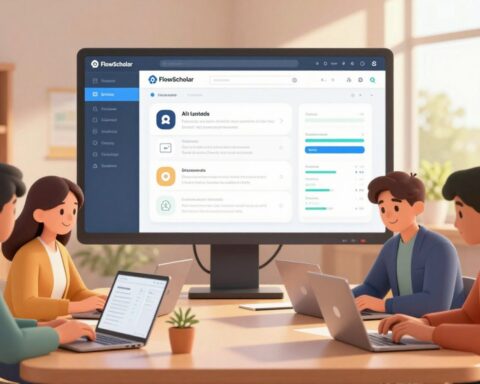
There is a quiet relief when a student finds an answer at midnight and can breathe again.
The shift in higher education toward 24/7 digital support reflects that moment: institutions need scalable tools to meet rising demand while preserving care. Today’s chatbots combine natural language processing and machine learning to understand intent, route students to resources, and hand off complex issues to staff.
Colleges deploy these systems across admissions, financial aid, advising, tutoring, campus life, and mental health. The result: faster answers, consistent messaging, and more time for advisors to focus on urgent cases.
This guide frames practical steps for leaders: definitions, benefits, integrations, ethical guardrails, and measurement. It shows a clear way forward—grounded in data and real services—so campuses can scale support without sacrificing equity or privacy.
Key Takeaways
- Modern chatbots use NLP and machine learning to deliver 24/7 student support and route complex issues to humans.
- They free staff from routine tasks, letting advisors focus on high-value work.
- Successful deployment emphasizes transparency, FERPA compliance, and equity-by-design.
- Billions of monthly visits show students are comfortable engaging when privacy is respected.
- This guide offers practical steps and examples to implement tools responsibly in U.S. colleges.
Why Student-Support Chatbots Matter in Higher Education Today
Campuses face rising expectations for instant, helpful answers as students move through enrollment and campus life.
With smaller teams and tight budgets, institutions must deliver consumer-grade responsiveness for questions about financial aid, advising, and mental health. Reliable digital tools provide 24/7 coverage, reducing wait times and letting staff use their time where judgment matters most.
These systems absorb routine inquiries at scale—freeing frontline services and improving the overall student experience. Multilingual and accessible design expands reach to first-generation, international, and remote learners, making equity a practical outcome.
Campus deployments already include tutoring and academic guidance, extending learning outside office hours. Early data also show proactive risk detection and lighter workloads for advisors.
Leaders can pilot incrementally: start with high-volume questions, measure conversational data to spot trends, then expand. Quick wins validate value while protecting privacy and ensuring proper escalation to counselors.
- Benefit: Faster answers and more equitable accessibility.
- Strategy: Pilot, measure, iterate.
What Student-Support Chatbots Are and How They Work
Today’s campus conversational systems turn asked questions into actions: they confirm deadlines, route forms, and schedule appointments so students complete tasks faster.
From FAQs to intent-driven help: static pages list frequently asked questions. Conversational systems interpret intent, clarify follow-ups, and provide precise next steps instead of generic content pages.
Natural language processing and language processing pipelines map user text to intents and entities. That mapping connects queries to knowledge sources and live systems, improving accuracy for course, enrollment, and financial queries.
Machine learning supports classification, retrieval-augmented responses, and continuous improvement. The machine refines patterns over time so coverage grows and answers become more reliable.
Accessibility and multilingual support are foundational: plain-language modes, screen-reader compatibility, and mobile-first interfaces make these tools usable by more learners.
- Orchestration: confirm program requirements, check holds, and route to the right office.
- Guardrails: chatbots may decline out-of-scope queries, cite sources, and hand off high-risk issues to staff.
- Practical prompting: provide context, specify role and output style, then iterate—an approach recommended by leading universities.
Education teams should tune intents around top student journeys to realize value quickly and responsibly.
Benefits That Improve Student Success and Experience
When institutions deliver quick, consistent replies, students complete tasks with less stress.
Faster answers reduce waits across admissions, advising, and financial aid. That speed raises satisfaction — a key driver of student success and retention in higher education.
Faster Answers, Lower Wait Times, Higher Satisfaction
24/7 multilingual coverage cuts first-response time and shrinks ticket backlogs. Immediate confirmations and deadline reminders help students follow through on tasks.
Equitable, Accessible Support for Diverse Learners
Accessibility and plain-language design expand reach to first-generation and international students. Consistent messaging avoids confusion and clears barriers to services.
Freeing Staff Time for High-Value Human Assistance
Automating routine queries reduces repetitive work. Advisors and counselors then focus on complex cases and relationship-building.
Data-Driven Insights to Enhance Outcomes
Conversation data reveals friction points — forms, policies, or deadlines — so teams can streamline processes. Timely nudges and reminders also help to enhance learning by lowering cognitive load and improving follow-through.
“Institutions reported lighter workloads, earlier warnings for students at risk, and clearer pathways to support.”
| Metric | Reported Impact | Benefit to Students |
|---|---|---|
| 24/7 Multilingual Support | Higher engagement across time zones | More equitable access to help |
| Reduced Wait Times | Shorter first-response time | Faster resolution of tasks |
| Conversation Data | Identifies recurring friction | Improved policies and outcomes |
Responsible routing for mental health concerns combines supportive language with rapid handoff to counselors when needed. For implementation details and best practices, see chatbots in higher ed.
Proven Use Cases Across the Student Journey
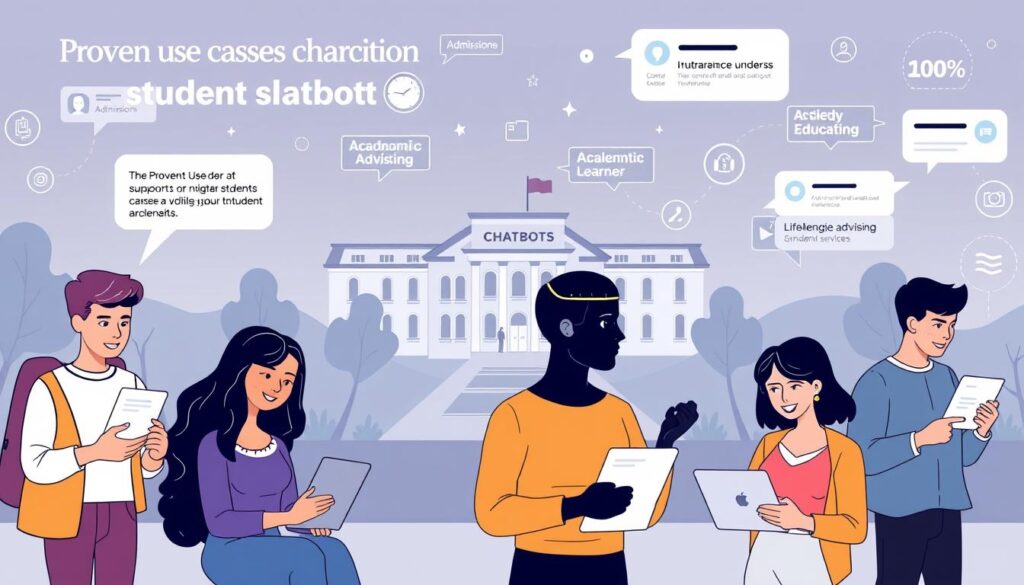
Practical deployments show how conversational systems guide students through key milestones, from application to graduation. Below are concrete ways universities apply these tools to reduce friction and elevate outcomes.
Enrollment and Admissions
First-generation and international applicants benefit when systems clarify deadlines, document needs, and status checks. Clear steps reduce anxiety and help students finish applications on time.
Financial Aid and Scholarships
Systems answer questions about FAFSA, deadlines, and scholarship eligibility. They triage complex cases to financial aid offices, lowering phone and email queues.
Advising, Course Planning, and Degree Tracking
Tools surface course options, prerequisites, and degree progress. They connect students to advisors for nuanced planning decisions and escalation when needed.
Tutoring and Learning Support
Proactive recommendations route learners to tutoring, writing centers, and study groups. Conversational data shows where tutoring accelerates mastery.
Mental Health Support and Human Handoff
Systems offer immediate, empathetic guidance and clear paths to health support. For safety, they implement auditable handoffs to counselors and campus services.
- Outcome focus: conversational analytics reveal where students stall—admissions forms, course registration, or aid verification—and guide targeted fixes.
How to Implement Student-Support Chatbots: A Step-by-Step Guide
Implementation succeeds when teams map problems to measurable outcomes before building any conversational flow.
Map student pain points and prioritize high-impact tasks
Start by analyzing ticket logs and conversation data to find high-volume questions. Prioritize tasks with clear policies and fast wins.
Start with one focused use case and pilot for feedback
Select a single workflow—admissions or advising—and pilot with a representative student cohort and front-line staff.
Collect qualitative feedback and measure time saved, deflection rates, and satisfaction.
Choose an education-first vendor and plan integrations
Pick tools that support FERPA, role-based access, and SIS/CRM integration. Plan APIs, error handling, and rate limits early so services stay reliable.
Co-design conversations with staff and students
Work with advisors and counselors to craft tone and prompts. Ensure cultural responsiveness and clear instructions that help learning and action.
Build clear escalation paths to human services
Define SLAs and handoff rules so context transfers save time for both student and staff. Log interactions for auditability and faster resolution.
Maintain, retrain, and iterate over time
Assign content owners, schedule reviews, and use feedback to refine intents. Institutions must set milestones and training so teams scale with confidence.
- Quick checklist: map pain points, pilot small, integrate securely, co-design flows, set escalation SLAs, iterate with feedback.
AI Use Case – Student-Support Chatbots: Responsible and Ethical Deployment
Ethical design centers on transparency, governance, and the safety nets that protect students.
Commit to clear disclosures: what data is collected, why it is used, retention periods, and student rights. Align policies with FERPA and relevant privacy frameworks; where applicable, consider GDPR principles for international learners. For governance models and ethics guidance see responsible governance.
Mitigating bias to promote equity
Evaluate training sources and test responses for disparate impact. Include diverse student voices in pilot testing to surface blind spots.
Boundaries to avoid overreliance
Set clear limits: chatbots may decline uncertain answers and route high-stakes queries to staff. Encourage students to build self-advocacy through coaching-style replies.
Sensitivity and safety for mental health
Define real-time risk signals, localized crisis resources, and warm transfers to counseling with full context. Document SLAs and audit trails so the university can review incidents quickly.
“Transparent governance and routine ethics reviews keep support safe, fair, and trustworthy.”
| Area | Minimum Requirement | Operational Step | Benefit |
|---|---|---|---|
| Privacy | FERPA-aligned policies | Retention schedule, consent logs | Clear legal compliance |
| Equity | Bias audits | Diverse testing panels | Fairer outcomes |
| Safety | Mental health protocols | Risk triggers, warm transfers | Faster human response |
| Governance | Approval workflows | Audit trails, incident playbooks | Operational accountability |
For clinical and ethical research on human-centered design and privacy in education contexts, consult this review: privacy and policy literature.
Integrations, Tools, and Technical Considerations
Connecting conversational platforms to live systems turns occasional guidance into authoritative, real-time support.
Connecting to Real-Time Data Systems and Student Services
Effective solutions link SIS/CRM, LMS, ticketing, and knowledge bases so answers reflect current records and policy. Map each integration to ensure data freshness and clear ownership.
Engineer reliability with caching, graceful fallbacks, and monitoring to handle registration spikes. Communicate maintenance windows and change logs to campus teams.
Selecting Models and Platforms for Natural Language Processing
Choose platforms that let teams test multiple models and compare performance on real intents—benchmarks such as Stanford’s AI Playground (Oct 2024) can help.
Secure machine-to-machine authentication, enforce least-privilege access, and encrypt data in transit and at rest. Plan mental health routing with consented handoffs to counseling systems.
- Practical points: consider accessibility and multilingual language rendering, vet adjacent tools like Grammarly or Turnitin for governance, and align logging with IT incident response.
“Well-designed integrations turn automation into dependable campus support.”
Measuring Impact and Optimizing Over Time
Measuring impact starts with clear goals that tie conversations to real outcomes. Metrics must move past clicks and focus on whether tools improve the student journey.
Define Outcomes and KPIs Beyond Click Rates
Track first-response time, resolution time, CSAT, and deflection rate. Include equitable access measures across student segments.
Tie metrics to learning and student success by monitoring completed tutoring referrals, advising appointments scheduled, and financial aid forms submitted on time.
Leverage Feedback Loops from Students and Staff
Collect structured feedback to refine intents, tone, and factual accuracy. Short surveys after key interactions give rapid insight.
Feedback from staff highlights where conversations stall and which knowledge articles need revision. Stanford-style iterative prompting and review improves performance over months.
Use Predictive Analytics for Early Interventions
Combine conversation data with academic records to surface early risk signals. Predictive models can flag students for outreach before disengagement grows.
Run A/B tests on different flows, copy, and escalation paths to validate what best enhances learning and throughput. Schedule quarterly reviews to maintain governance, model updates, and knowledge hygiene.
“Measure what matters: link metrics to student success and refine continuously through feedback.”
- Compare cohorts by course milestones and persistence to see if nudges improve outcomes.
- Instrument performance analytics to find friction and prioritize fixes.
- Share wins with stakeholders to sustain investment and momentum.
Next Steps for U.S. Institutions to Support Students with AI
Begin with a narrow, high-impact workflow that students hit most often and measure results quickly. Pick admissions FAQs, registration holds, or aid deadlines so outcomes are visible.
Stand up a limited pilot and collect transcripts and survey feedback. Iterate fast: fix content gaps, tune escalation rules, and document what helps students most.
Prepare integrations early so services deliver authoritative answers. Align IT and functional owners on roles, tasks, and maintenance windows.
Publish clear handoff routes to humans, including operating hours and explicit mental health protocols. Train staff and student ambassadors on what the tool can and cannot do.
- Keep governance: update policies, archive stale resources, and retrain models on fresh data.
- Expand gradually: add intents based on measured impact and student feedback.
- Use institutional sandboxes (for example, Stanford’s platform) to compare models safely before wide rollout.
“Choose a small, measurable start—then scale with governance and human-centered protocols.”
| Step | Action | Owner | Success Metric |
|---|---|---|---|
| Pilot | Launch focused workflow (admissions/registration) | Functional team + IT | Reduction in tickets, CSAT |
| Integration | Connect SIS/CRM and knowledge base | IT | Answer accuracy, uptime |
| Escalation | Publish handoff rules and hours | Advising & Counseling | Faster human response, safety logs |
| Governance | Schedule reviews, archive old resources | Content owners | Knowledge freshness, equity audits |
Conclusion
Conclusion
Well-designed conversational tools remove small barriers so students can focus on learning and community. When routine questions are answered fast, the learning experience improves and students learn with less friction.
Benefits education are clear: faster assistance, more equitable access, and measurable outcomes in satisfaction and throughput. Responsible design—privacy, accessibility, and humane escalation—must guide every deployment.
Leaders should assemble a cross-functional team, pilot a focused workflow, and track performance. For an evidence review of campus results and outcomes, see this evidence review.
These systems amplify advisors and counselors; they do not replace human relationships. Iterate on performance and style so students continue to learn and the learning experience keeps improving.
FAQ
What are student-support chatbots and how do they work?
Student-support chatbots are conversational tools that use natural language processing and machine learning to interpret questions and deliver relevant answers. They connect to knowledge bases, enrollment systems, and calendars to give timely guidance on admissions, financial aid, course planning, tutoring, and campus services. When a question requires human expertise—such as complex advising or mental health concerns—the system routes the student to staff or schedules a handoff.
Why do institutions implement chatbots for student support?
Institutions deploy chatbots to reduce wait times, provide 24/7 multilingual help, and scale routine services without adding staff. This frees counselors and advisors to focus on high-value work, improves satisfaction, and produces data that reveals common pain points to guide improvements in programs and outreach.
What are the most effective use cases across the student journey?
Proven use cases include enrollment and admissions guidance for first-generation and international students, support with financial aid forms and scholarship queries, academic advising and degree tracking, on-demand tutoring and study resources, plus initial mental health triage with clear escalation to licensed professionals. Each use case targets predictable, frequent tasks that benefit from quick, consistent responses.
How do chatbots support accessibility and equity?
Chatbots can deliver multilingual responses, accessible interfaces (screen-reader compatibility, text size options), and consistent information that reduces disparities for students who face barriers to in-person services. When designed with inclusive datasets and human oversight, they help extend support to underserved populations while flagging cases needing personalized intervention.
What privacy and compliance considerations should institutions address?
Responsible deployment requires FERPA-aware data handling, transparent privacy notices, minimal data retention for conversational logs, and secure integrations with student information systems. Institutions should document data flows, obtain necessary consents, and implement role-based access to protect sensitive student records.
How can institutions mitigate bias in conversational models?
Mitigation begins with diverse training data, regular audits for disparate outcomes, and human-in-the-loop review of edge cases. Co-designing dialogues with students and staff helps surface biased assumptions. Policies must be in place to monitor model behavior and retrain systems when biases are detected.
What does a phased implementation roadmap look like?
Start by mapping student pain points and selecting a single, high-impact use case to pilot. Choose an education-focused vendor, plan integrations with real-time systems, and co-design conversation flows with frontline staff. Define escalation paths, monitor KPIs, collect feedback, and iterate—retraining models and expanding scope over time.
Which metrics matter when measuring impact?
Focus on outcomes that reflect student success: resolution rate, time-to-resolution, student satisfaction, reduction in advisor caseloads, and downstream effects like retention or timely registration. Supplement quantitative KPIs with qualitative feedback loops from students and staff to guide improvements.
How should institutions handle mental health inquiries via chat?
Chatbots should provide validated self-help resources, safety prompts, and immediate escalation protocols when risk is detected. Systems must include direct links to campus counseling, crisis hotlines, and procedures for urgent human intervention. Sensitivity and privacy should guide every interaction.
What integrations and technical choices are essential?
Essential integrations include student information systems, learning management systems, scheduling tools, and knowledge bases. Choose models and platforms optimized for natural language understanding in education contexts, and ensure APIs support real-time lookups while maintaining secure authentication and data governance.
How can predictive analytics be used responsibly to support students?
Predictive analytics can flag students at risk of falling behind by combining engagement signals, grades, and service interactions. Responsible use requires transparency, consent, and human review before intervening. When used ethically, early alerts enable targeted advising and timely outreach to improve outcomes.