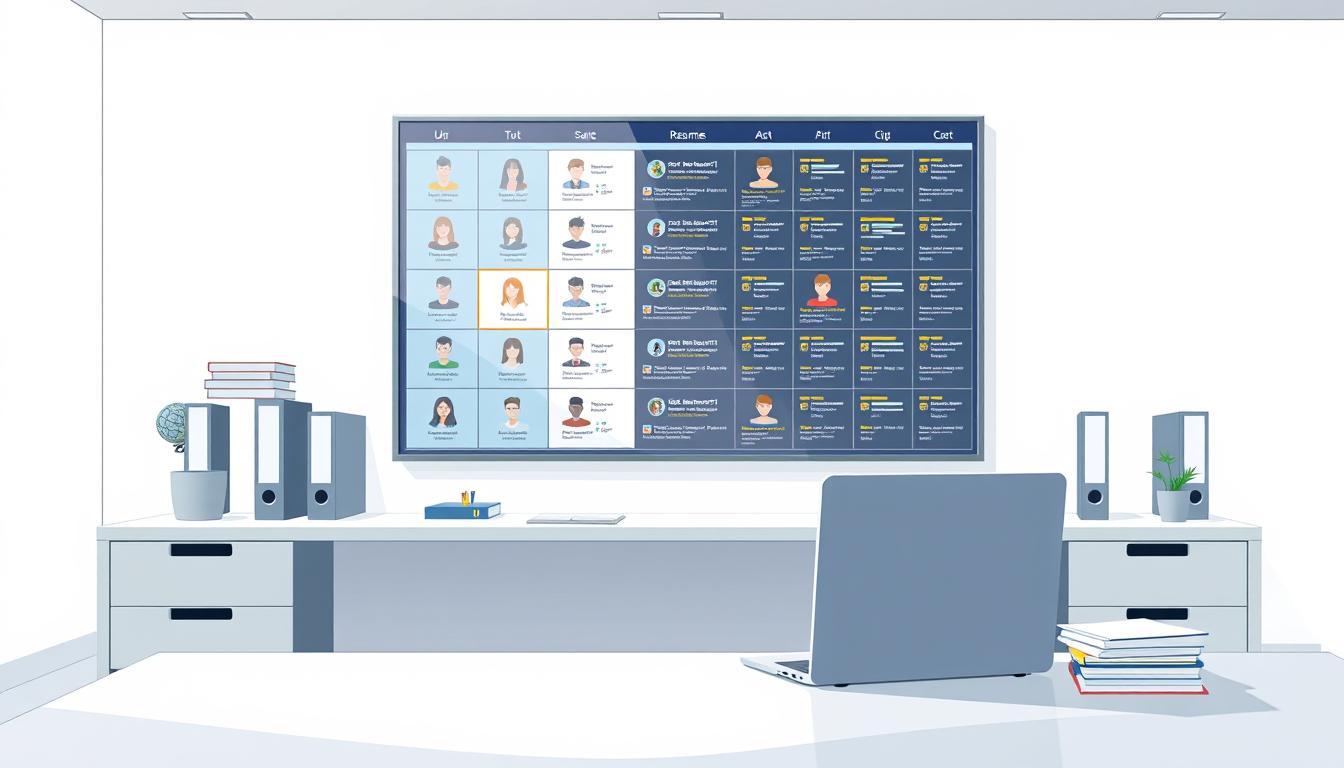
There is a quiet tension when a pile of applications sits unread on a desk. Recruiters feel the pressure: great hires are won or lost at this first gate. The task seems simple, yet inconsistent formats, high volumes, and scarce time make the process fragile.
The guide that follows frames a practical roadmap. It shows how an intelligent screening flow can balance speed with fairness while keeping human judgment central. Readers will gain a clear workflow, smart tools to evaluate resumes, and a framework to shortlist candidates with confidence.
NLP-driven tools extract skills and context from diverse resumes. That reduces bias from titles or schooling and turns fragmented data into consistent signals. The end-to-end process—from parsing to ranking—brings visibility, fewer errors, and faster hiring cycles.
We acknowledge realities: limited recruiter bandwidth, large applicant pools, and the need for compliance. This section sets expectations and invites leaders to reshape the first gate into an advantage.
Key Takeaways
- Screening is the pivotal step that shapes hiring outcomes.
- Structured processes reduce errors and speed up time-to-hire.
- Modern tools extract skills and context beyond keyword matches.
- Balancing automation with human review preserves fairness.
- The guide provides a clear workflow, toolset, and evaluation framework.
What This How-To Guide Covers and Who It’s For
Here is a concise playbook to align job needs, tools, and daily work for better hiring. The guide focuses on practical steps to improve the screening process, from intake to shortlist. It explains what to set up now and how to measure early wins.
Search intent and outcomes you’ll achieve today:
- Align job requirements with clear evaluation criteria.
- Configure core tools and launch an initial candidate screening workflow.
- Turn profiles into structured scorecards to speed decision-making.
Who benefits most:
- Talent acquisition teams that need scalable systems for high-volume hiring.
- Hiring managers who want clarity on role fit and faster shortlists.
- Recruiters who need to save time on admin and improve the candidate experience.
“Automation handles routine scoring and scheduling so teams can focus on evaluation.”
Why Resume Screening Decides Great Hires
Early screening steers every hire; a small shift at the front door changes outcomes weeks later.
Resume screening sets the hiring trajectory. Clear criteria early prevents wasted interviews and slow cycles. When teams agree on non-negotiables, the shortlist usually contains more qualified candidates.
Common bottlenecks are simple: high volume, mixed formats, and seven-second scans. A 2024 Novorésumé survey found hiring managers average seven seconds per resume, which makes high-volume triage error-prone.
Common bottlenecks: volume, formatting, and seven-second scans
Hundreds of applications in one job inflate risk. Inconsistent resumes hide skills. Quick scans favor neat layouts—not aptitude.
From job description to job requirements: aligning must-haves vs nice-to-haves
Translate a job description into measurable requirements. Define must-haves (certifications, core skills) and nice-to-haves (preferred sectors or tools). A shared rubric keeps review focused and reduces bias under time pressure.
- Focus on skills, outcomes, and role-fit over job titles.
- Align stakeholders before posting the job to avoid rewrites.
- Keep a living rubric and refine it with hiring data.
| Challenge | Impact | Practical fix |
|---|---|---|
| High volume of applications | Missed qualified candidates | Set clear must-haves and use structured scorecards |
| Inconsistent resume formats | Hidden skills and slower review | Extract skills and standardize fields for comparison |
| Seven-second human scans | Superficial filtering and bias | Use short rubrics and a two-pass review to reduce error |
“Switch emphasis from pedigree to demonstrated skills and potential to improve quality of hire.”
For practical setup and deeper guidance, see resume screening insights.
Manual Screening vs Automated Screening: How They Differ
The method for reviewing resumes changes speed, cost, and quality.
Manual review captures nuance. Recruiters spot context, rare skills, and cultural fit. This approach works well for niche roles or small applicant pools. It consumes recruiter hours and slows hiring when applications grow.
Automated systems scan resumes in minutes. Applicant tracking platforms and modern screening tools parse criteria at scale. They speed first-pass filtering and free time for deeper evaluation. However, misconfigured rules can reinforce systemic bias; oversight is essential.
Speed, accuracy, scalability, and cost trade-offs
- Manual: high context, low speed, higher per-hire cost.
- Automated: high speed, consistent output, lower marginal cost at scale.
- Best practice: hybrid workflows—automate first-pass; human review for borderline profiles and interviews.
“Combine explainable logs with human review to keep trust and auditability.”
| Aspect | Manual | Automated |
|---|---|---|
| Speed | Slow; hours per job | Fast; hundreds in minutes |
| Accuracy | Context-rich but inconsistent | Consistent when configured; needs checks |
| Cost | Recruiter hours | Upfront license; lower per-application |
| Best fit | Niche roles, small pools | High-volume hiring, triage |
How AI Screening and Candidate Matching Actually Work
A structured pipeline converts diverse inputs—text, audio, video—into comparable candidate records. Natural language models read resumes, cover notes, transcripts, and profiles to extract roles, dates, and skills. That moves review from keyword hits to contextual signals about experience and potential.
Parsing breaks unstructured files into fields: work history, education, tools, and measurable outcomes. Profile matching then compares those fields to the job rubric. Scores reflect alignment to must-haves and preferred skills.
Ranking elevates profiles that map to critical role outcomes. Shortlisting applies thresholds—certifications, location, or minimum years—to keep quality high while cutting review time.
Systems learn over time. When hiring outcomes feed back into the model, recommendations grow more relevant. Explainable scoring and regular audits help surface bias and let teams adjust criteria.

“Explainable scores let recruiters defend shortlists and propose focused interview questions.”
- Transforms raw data into structured signals.
- Scores and ranks by role-fit and critical skills.
- Refines recommendations as outcomes accumulate.
AI Use Case – Resume Screening and Candidate Matching
A clear pipeline turns raw applications into ready-to-review shortlists in minutes.
Start with a single intake point inside the applicant tracking system to collect job descriptions, attachments, and baseline fields. Parsing standardizes resumes into structured records so profiles can be compared fairly.
Next, profile matching scores candidates against must-haves and preferred skills. Scores rank profiles for recruiter review, and automated shortlists surface the best fit for each role.
Candidate outreach channels: chatbots, messaging apps, phone, and video
Conversational bots handle FAQs and quick screens. Messaging platforms—WhatsApp and LinkedIn—work well for short checks. Real‑time phone screens and structured video let teams assess tone and clarity at scale.
“Timely, respectful automation improves the candidate experience while keeping humans in control.”
Using performance and cultural fit signals to find the best fit
Prioritize outcome-based signals: measurable achievements, tenure on impact projects, and role-specific metrics. Soft indicators—communication style, learning agility, and values alignment—add context to scores.
Tagging profiles with behavioral notes and performance markers helps future reactivation. Centralized data in the applicant tracking system preserves context and reduces duplication.
When to hand off to humans for interviews and hiring decisions
Hand off when nuance, judgment, or high-stakes hiring is required: deep dives on soft skills, ambiguous experience, or final offers. Use structured interview guides based on the job description so interviews remain objective.
| Channel | Typical use | Benefit | Handoff trigger |
|---|---|---|---|
| Chatbot | Initial FAQs, quick screens | Scales outreach; immediate engagement | Ambiguous responses or high-potential leads |
| Messaging apps (WhatsApp, LinkedIn) | Short clarifying questions | Higher response rates; personal touch | No reply or complex queries |
| Phone | Real-time structured screens | Assess communication and availability | Further assessment of soft skills needed |
| Video | Asynchronous or live interviews | Observe presentation and problem solving | Final shortlist or role fit uncertainty |
For an implementation checklist and practical tips on scoring and workflow setup, see resume screening guidance.
Step-by-Step: Implementing AI in Your Screening Process
Start small and iterate: a focused pilot reveals real-world gaps fast.
Define criteria and clean data to reduce human bias
Translate the role into clear must-haves, preferred skills, and weightings. Keep criteria measurable so automated scoring focuses on performance, not pedigree.
Anonymize names, locations, and demographic fields during testing to reduce human bias. Remove proxies—like broad degree filters—unless they directly predict on-the-job success.
Configure your applicant tracking system and integrate tools
Set the applicant tracking system as the single source of truth. Map fields from parsing tools to unified records so no resumes slip through gaps.
Integrate screening tools so scores, notes, and assessment results flow into one profile for recruiters to review.
Automate scoring, shortlisting, and interviews
Mirror your rubric in automated scoring and shortlist rules. Add structured interview guides that follow those same criteria to keep evaluations objective.
Validate skills with assessments
Include skills-based tests to confirm hard and soft skills rather than relying solely on resumes. Assessments reduce false positives and improve quality of hire.
Measure, pilot, and refine
Track time-to-hire, quality-of-hire, and diversity metrics on dashboards. Pilot the workflow on one or two roles, tune thresholds, then scale.
Train recruiters and hiring managers to read outputs, override when needed, and escalate cases that require human judgment. For a practical rollout checklist, see this implementation guide.
Tools and Features to Prioritize in Your Tech Stack
Choose platforms that convert messy applicant records into clear, actionable data. A focused stack reduces manual triage and surfaces high-fit profiles faster. Start by mapping what must flow into a single source of truth.
ATS integration and unified candidate records
Prioritize tight applicant tracking integration. Every interaction, score, and note should live in one profile so recruiters see the full history at a glance.
Look for vendors that sync parsing, assessments, and interview notes into a unified record. That reduces duplicate work and speeds review time.
Explainable scoring, auditability, and compliance readiness
Require explainable scores and auditable logs. Transparent scoring supports compliance and helps teams defend shortlists.
“Explainable logs make it possible to run bias audits and tune thresholds over time.”
Scalability for high-volume hiring and real-time analytics
Choose platforms that scale with applications and deliver real-time funnel analytics. Dashboards should show diversity metrics, time-to-hire, and shortlist precision by role.
Video screening and conversational tools for candidate experience
Evaluate vendors that support pre-recorded video Q&A and conversational flows to assess soft skills at scale. Integrations with the tracking system keep those assets attached to each applicant record.
- Ensure tools handle unstructured resumes and unify data across channels.
- Demand dashboards for funnel analytics and performance correlations.
- Validate vendor claims with pilots—measure time saved and shortlist precision.
Ethics, Compliance, and Candidate Experience in the United States
A defensible screening process starts with clear rules and regular audits. Teams should document anonymization steps, scoring rubrics, and who reviews exceptions. These basics reduce both human bias and systemic errors.
Reduce bias with process and proof. Practical mitigations include blind screening, standardized criteria, diverse training data, and scheduled audits. Audit logs let recruiters trace why a profile was advanced or declined.
Transparency and local regulations
U.S. compliance requires explainability. New York City’s Local Law 144 demands annual bias audits and public disclosure for automated employment tools. Teams must prepare reports and remediation plans.
Designing respectful communications
Timely, specific messages improve candidate experience and brand perception. Tell applicants next steps, expected timelines, and how decisions are made. Offer mobile-friendly flows and alternative formats for accessibility.
“The goal is to elevate qualified candidates consistently while upholding trust and legal standards.”
- Run candidate surveys and manager feedback loops to refine fairness.
- Hold recruiters accountable to review outputs and override where context demands.
- Keep explainable records so hiring decisions remain defensible.
For a deeper look at ethics in practice, see why ethics could save your career.
Conclusion
Be sure to insert a strong, aligned plan: map the job description to clear job requirements, set a single tracking system, and pick screening methods that standardize applicant fields. Natural language parsing turns messy resumes into searchable skills, so teams can sort applications quickly without losing context.
Operate in a hybrid mode: use rapid resume screening to filter noise, then validate with skills-based assessments and structured interviews. This approach helps hiring teams find best talent, save time, and reach a quality hire more consistently.
Measure performance on dashboards, keep explainable tools for audits to manage bias, and train recruiters to finalize hiring decisions with judgment. With this blueprint, talent acquisition can scale the process while improving candidate experience and securing the best fit.
FAQ
What does this how-to guide cover and who should read it?
This guide explains an end-to-end approach to applicant tracking, screening methods, and talent acquisition workflows. It’s for hiring managers, recruiters, and talent acquisition teams who want to improve hiring decisions, save time, and find quality hires through better job requirements, structured interviews, and data-driven shortlisting.
What outcomes will readers achieve by following the guide?
Readers will learn to reduce time-to-hire, increase the quality-of-hire, and improve candidate experience. The guide shows how to align job descriptions with must-haves, configure screening tools, track diversity metrics, and use performance signals to find top talent.
What common bottlenecks does screening solve?
Screening addresses high application volume, inconsistent resume formatting, and seven-second scans that miss fit. It introduces parsing, structured scoring, and shortlisting to surface candidates who meet core criteria and to reduce manual review workload.
How should teams distinguish must-haves from nice-to-haves in job requirements?
Start by defining role-critical competencies and outcomes; list nonnegotiable skills, certifications, and experience first. Then mark transferable skills and preferences as nice-to-haves. This clarity improves applicant tracking accuracy and reduces bias during screening.
How do manual and automated screening differ in practice?
Manual screening offers human judgment and context but is slow and inconsistent. Automated screening scales, speeds up shortlisting, and provides audit trails, yet it requires careful configuration to avoid false negatives and maintain candidate fairness.
What human bias concerns arise with each approach?
Manual reviews can reflect unconscious bias in selection and phrasing. Automated systems risk encoding biased patterns from historical data. Combining blind screening, standardized rubrics, and regular audits helps mitigate both sources of bias.
How do natural language techniques improve candidate evaluation?
Natural language processing on unstructured data moves beyond simple keyword matching to understand context, job titles, and accomplishments. This enables better parsing of experience, extraction of skills, and more accurate profile matching.
What are the core technical steps in parsing and matching?
Key steps include parsing resumes into structured fields, mapping skills to job requirements, scoring candidates against role criteria, ranking results, and generating shortlists for interviews. Continuous learning refines these models over time.
When should teams hand off from automated screening to human review?
Hand off when candidates reach a defined score threshold, when role nuance requires judgment, or before final interviews. Humans should validate shortlisted profiles, assess cultural fit, and conduct structured interviews informed by screening data.
What practical workflow moves a candidate from ATS parsing to shortlist?
Typical workflow: ingest application into applicant tracking system, parse content, run profile matching and scoring, apply filters for must-haves, produce shortlist, then trigger outreach via messaging or phone to schedule structured interviews.
Which outreach channels work best for candidate engagement?
Use a mix: email and SMS for scheduling, chatbots for initial FAQs, and phone or video for richer screening. Combining channels improves response rates and candidate experience while keeping communications respectful and timely.
How can teams validate soft skills and technical ability during screening?
Add skills-based assessments, structured interview guides, and work-sample tests. These tools complement parsing and scoring by measuring real performance and behavioral indicators that predict on-the-job success.
What metrics should organizations track for continuous improvement?
Track time-to-hire, quality-of-hire, offer acceptance, candidate experience scores, and diversity metrics. Analyze funnel conversion rates from application to offer to identify bottlenecks and optimize screening criteria.
What features should hiring teams prioritize in their tech stack?
Prioritize ATS integration with unified candidate records, explainable scoring and audit logs, scalability for high-volume hiring, real-time analytics, and video screening tools to enhance candidate experience and recruiter efficiency.
How can explainable scoring and auditability support compliance?
Explainable scoring documents why a candidate received a particular score, enabling audits and regulatory compliance. Maintain logs, version control on scoring rules, and clear documentation to respond to inquiries and legal requirements.
What steps reduce algorithmic and human bias in the United States?
Use blind screening, remove demographic fields during initial review, run bias audits on models, and set diverse panels for human evaluation. Follow local regulations, such as New York City Local Law 144, and implement transparent practices.
How should teams design communications to respect candidates and save time?
Use clear, concise messages that set expectations for next steps and timelines. Offer self-service scheduling, transparent feedback where feasible, and keep touchpoints timely—this improves candidate experience and employer brand.
What compliance risks should talent acquisition teams monitor?
Monitor data privacy, anti-discrimination laws, record-keeping requirements, and local regulations on automated decision-making. Ensure vendor contracts, data handling, and audit trails meet legal and organizational policies.
How do continuous learning and data-driven recommendations improve hiring?
Continuous learning refines scoring models with new hire outcomes and assessment results. Over time, recommendations become more predictive of quality-of-hire and cultural fit, helping teams make better, faster decisions.
What signals indicate a candidate is the best fit beyond technical skills?
Look for cultural fit indicators, behavioral interview outcomes, performance on work samples, and patterns in collaboration or leadership shown in past roles. Combine these with technical assessments to identify top talent.