There are moments when a single line of text changes everything. A classroom, a town hall, a breaking news stream—sudden clarity can turn confusion into connection.
The modern era uses artificial intelligence to render speech into clear on-screen text. This evolution moves transcription from slow manual work to fast, scalable service for media and enterprise.
Today, deep learning and natural language tools improve recognition of accents, homophones, and domain terms. The result is accurate captions and subtitles that keep people aligned with the video moment and boost accessibility across platforms.
Teams can adopt cloud platforms to cut time and cost while meeting ADA and WCAG 2.1 AA expectations. For a practical roadmap, see our detailed guide.
Key Takeaways
- Modern intelligence transforms speech into reliable on-screen text.
- Captions and subtitles improve accessibility and audience reach.
- Cloud delivery ensures low time latency for live video.
- Models now handle accents, homophones, and domain-specific terms.
- Adoption helps organizations meet ADA and WCAG 2.1 AA standards.
Why Real-Time Captioning and Subtitling Matter Today
Making speech visible changes who can follow a message—and how well they retain it. Captions and subtitles lift comprehension across video and audio media, helping viewers stay longer and recall more.
Accessibility is at stake: on-screen text lets people who are deaf or hard of hearing participate in live events, classrooms, and briefings. It also aids non-native speakers, learners, and those with cognitive challenges.
Live subtitles reduce language barriers for global audiences. They let international viewers access announcements and training without waiting for edits.
Organizations face legal and ethical pressure to meet ADA and WCAG 2.1 AA standards. Real-time solutions make compliance scalable and reliable, while boosting engagement and trust.
- Inclusivity in action: captions help in noisy places, silent mode on mobile, or shared workspaces.
- Business impact: when an audience can read along, content value rises for marketing, learning, and internal comms.
- Measure to prove ROI: track retention, completion rates, and behavior before and after captions are added.
Benefits and Business Impact of AI Captioning and Subtitling
Clear, synced on-screen text turns a short video into a measurable business asset. Organizations capture value through better reach, faster workflows, and simpler compliance.
Accessibility and compliance gains help diverse audiences participate. Captioning supports people who are deaf or hard of hearing and reduces legal risk under ADA and WCAG 2.1 AA.
Engagement, comprehension, and retention
Captions and subtitles lift engagement: users watch longer and viewers retain more of the content. Measured KPIs—watch time, completion, and quiz scores—often improve after captions are added.
Cost efficiency and scalability
Automated transcription and translation lower labor costs versus manual services while preserving accuracy through trained models. Teams scale captions across training, media, and enterprise libraries without duplicating production.
- Quantify value: faster turnaround and lower cost per minute while keeping accuracy high.
- Operational fit: integrate services with LMS and media platforms to centralize workflows.
- Governance: keep human review for high-risk content and use customization—dictionaries, speaker ID—to boost domain accuracy.
By combining accurate transcription and translation, organizations reach new audiences, remove language barriers, and improve the overall viewer experience.
Core Technologies Behind Real-Time Captioning
Modern systems blend multiple layers of computation to turn spoken words into precise captions. The stack begins with audio capture and ends with readable on-screen text. Each layer adds context, speed, and resilience.
Speech recognition and modern NLP for context-aware accuracy
First, speech recognition converts raw audio into a rough transcript. Then modern NLP adds grammar, resolves homophones, and improves sentence flow for readable output.
Deep learning models, cloud processing, and low-latency delivery
Deep learning models trained on vast datasets learn accents, dialects, and emotional tone. Cloud platforms scale processing elastically to keep latency low and deliver captions at speed for global audiences.
Speaker identification and domain-specific language models
Speaker ID separates voices in multi-presenter events. Domain models and custom vocabularies reduce jargon errors and lift recognition in technical fields.
Accuracy depends on microphones, acoustic models, and contextual vocabularies. Robust pipelines handle noisy environments and variable networks to keep captions synced.
| Layer | Role | Benefit |
|---|---|---|
| Capture | High-quality audio input | Reduces transcription errors |
| Recognition | Speech recognition models | Fast, baseline transcripts |
| Context | NLP and language models | Improves readability and accuracy |
| Delivery | Cloud & CDN | Low latency, global reach |
Translation services can run in parallel, turning recognized text into multiple languages and keeping content aligned across audiences. Versioned models and monitoring tools let teams roll updates without disrupting live workflows.
How to Implement Real-Time Captioning for Live Events
A practical rollout begins with audio you can trust and a platform that reduces surprises. Start with a short checklist and treat captions as part of broadcast infrastructure.
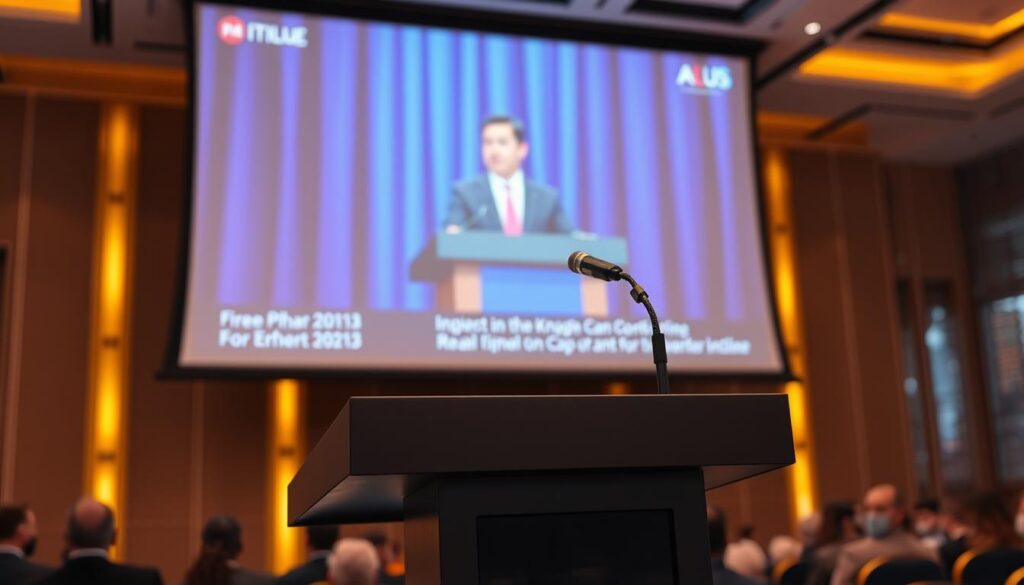
Prepare the audio pipeline for clarity
Clean sound is the single biggest factor for accuracy. Use directional microphones, proper gain staging, and basic acoustic treatment. Monitor levels and keep backup feeds for panel discussions.
Select a platform with CDN, player, and analytics
Pick solutions that bundle CDN, player, and analytics. Integrated platforms simplify setup, reduce latency, and surface metrics that guide post-event improvements.
Configure languages, translation targets, and stream details
Before going live, define the primary captioning language and any translation paths. Set ingest names, bitrate, and redundancy so streams stay stable under load.
Embed captions and validate in time
Decouple caption display from the player if you need flexible placement on the page. Test alignment under realistic network conditions and monitor accuracy and delay as the event runs.
- Plan for scale: ensure services handle spikes without degrading media quality.
- Operationalize QA: publish a runbook for audio faults, retries, and audience issues.
- Iterate after the event: review analytics for latency, error rates, and viewer engagement.
AI Use Case – Real-Time Captioning and Subtitling with AI: Step-by-Step Best Practices
Practical best practices close the gap between raw transcripts and polished on-screen text. Teams should combine customized vocabularies, human review, and display tuning to protect quality during live events.
Custom dictionaries and pronunciation tuning
Prepare dictionaries that include product names, acronyms, and technical terms to reduce misrecognitions. Add phonetic hints for difficult names so the system renders spoken words as correct text during fast exchanges.
Human-in-the-loop review
Assign reviewers for regulatory or executive sessions. Spot checks catch risks early and provide escalation paths when errors could harm compliance or reputation.
Readability and display optimization
Standardize capitalization, punctuation, and line-break rules to keep captions readable. Test font size, contrast, and placement across phones and desktop to improve the user experience without blocking important visuals.
- Document runbooks so support teams know how services recover from faults in real time.
- Audit outputs regularly to measure accuracy against human transcripts and refine glossaries.
- Train presenters on mic technique and pacing to maximize clarity, especially during rapid Q&A.
| Practice | Action | Benefit |
|---|---|---|
| Custom dictionary | Load product names and acronyms before go-live | Fewer misrecognitions; higher initial accuracy |
| Pronunciation tuning | Add phonetic entries for names and brands | Correct rendering during rapid speech |
| Human review | Assign spot-checkers and escalation roles | Risk mitigation for sensitive content |
| Display optimization | Test fonts, contrast, and placement across devices | Better reading experience for users |
Multilingual Subtitles: Translation and Localization with AI
When translation runs alongside transcription, events reach new language markets instantly. The pipeline ingests live transcripts and emits synchronized subtitles in multiple target languages. This expands reach and lowers access barriers for global audiences.
Context-aware machine translation for live transcripts
Modern translation evaluates sentence-level meaning to preserve tone and intent. That reduces literal errors and keeps phrasing natural for viewers.
Localization for idioms, cultural references, and tone
Localization adapts idioms, formality, and references so the content reads like native material. Glossaries and style guides keep brand voice consistent across languages.
When to add human QA for technical or sensitive topics
Introduce human review for legal, technical, or sensitive sessions. Reviewers catch nuance that automated translation might miss and protect reputation.
| Step | Action | Benefit |
|---|---|---|
| Ingest | Live transcription feed | Fast, accurate source text |
| Translate | Context-aware MT | Preserves tone and meaning |
| Localize | Apply glossaries and style | Audience-appropriate phrasing |
Integration, Compliance, and Measurement in the United States
Compliance, integration, and measurable metrics form the backbone of scalable caption workflows in the U.S.
Organizations that plan for policy, platform, and performance avoid surprises during high-stakes events.
Aligning with ADA and WCAG 2.1 AA requirements
Map captions and subtitles to ADA and WCAG 2.1 AA checkpoints before publishing public-facing or internal media.
Anchor compliance by documenting where captions appear, who reviews them, and which thresholds meet legal tests.
Integrate services into LMS, conferencing tools, and video players so captions enable access by default for live and recorded events.
“Accessibility is not an add-on; it is a measurable part of content delivery.”
Analytics to track accuracy, latency, and audience engagement
Measure the essentials: monitor accuracy, latency (speed/time), and engagement to validate user experience.
Choose platforms that bundle player, CDN, and analytics — or offer APIs to automate multi-event orchestration at scale.
| Metric | Why it matters | Target |
|---|---|---|
| Accuracy | Quality of transcript and translation across languages | >95% for standard content |
| Latency | Delay between speech and visible captions | <2 seconds for live events |
| Engagement | Viewer behavior and experience with captions | Lift in watch time and retention |
- Standardize operations: set SLAs, roles, and governance for captioning across departments.
- Track per-language metrics: identify where tuning or human review is needed.
- Close the loop: collect user feedback to improve readability, contrast, and display settings.
Challenges, Limitations, and What’s Next
Live events expose the toughest limits of speech systems: crowds, crosstalk, and jargon. These factors cut accuracy and increase error rates in fast exchanges.
Audio matters first. Directional microphones, gain control, and noise suppression raise the baseline. Coaching presenters to pace speech and avoid overlap also reduces errors.
Handling accents, noisy environments, and domain jargon
Crowded rooms, overlapping speakers, and specialized vocabulary are the hard parts. Custom dictionaries and pronunciation entries lower domain errors. Continuous learning from feedback closes gaps over time.
API-based automation, multi-language streams, and continuous model improvement
APIs let teams enable captions across many streams with presets for bitrate and language packs. Multi-language translation runs in parallel while balancing latency and quality. Roadmaps favor tighter system integration and richer analytics to guide model updates.
| Issue | Action | Benefit |
|---|---|---|
| Crowded rooms | Directional mics, noise filters | Improved recognition accuracy |
| Domain jargon | Custom dictionaries, glossaries | Fewer misrenders in content |
| Scaling languages | API presets, language packs | Consistent translation quality |
| Operational drift | Monitor errors, runbook updates | Faster corrective learning |
- Standardize tools: event templates cut setup time.
- Monitor continuously: track errors by segment and update vocabularies.
- Look forward: expect richer analytics and tighter platform ties to improve outcomes.
Conclusion
A well-designed caption pipeline converts speech into clear on-screen text that supports every viewer. It ties transcription to display, lowers delay, and raises the overall impact of video and audio content.
Adopting these systems brings measurable benefits: greater inclusivity, higher engagement, and lower production cost. Teams get support from integrated stacks that combine player, CDN, and analytics while keeping captions readable and synced.
Translation and multi-language workflows extend reach for live events and on-demand media. Subtitles and subtitle tracks preserve tone across regions; a pilot will validate latency, accuracy, and user response.
Start small, measure accuracy and latency, then scale. For a practical comparison of services and expected performance, see comparing live captioning services. Good governance, custom dictionaries, and human review keep captioning reliable and compliant — a lasting business advantage.
FAQ
What is real-time captioning and subtitling for live events?
Real-time captioning and subtitling convert spoken words into time-synced text during live broadcasts, meetings, or streamed events. These services capture speech, apply speech-recognition and language models, and display readable captions or translated subtitles so viewers follow dialogue as it happens.
Why does real-time text for audio matter now?
Live text removes access barriers for people who are deaf or hard of hearing, supports multilingual audiences, and boosts comprehension for noisy environments. It also helps organizations meet legal obligations and improves retention and engagement across education, media, and corporate settings.
What business benefits can organizations expect from implementing captioning and subtitles?
Benefits include stronger accessibility and compliance with regulations, higher viewer engagement and information retention, and lower long‑term costs by scaling automated workflows across many events and languages.
Which core technologies enable low-latency captions?
Modern deployments rely on speech recognition, natural language processing for context, deep learning models hosted in the cloud, and optimized delivery networks to minimize latency and ensure accurate, synchronized text.
How important is speaker identification and domain language tuning?
Very important. Speaker labeling improves readability for multi‑speaker events, while custom dictionaries and domain-specific models reduce errors for technical terms, brand names, and jargon.
What should event producers do to prepare audio for live transcription?
Prioritize clear microphone placement, use noise reduction and mixing best practices, and route a clean program feed to the captioning service. Clear audio is the single biggest factor in transcription accuracy.
How do you choose a platform for live captions?
Select a provider that offers low-latency CDN delivery, player integration, analytics, and support for multiple languages and translation targets. Check for features like speaker diarization, custom vocabularies, and human review options.
Can captions be embedded into a video player or shown as overlays on a webpage?
Yes. Most solutions support embedded captions through standard formats (CEA-608/708, WebVTT) or overlays that can be styled for readability and accessibility across devices.
What steps ensure smooth go-live and ongoing accuracy?
Validate end-to-end latency before broadcast, run dress rehearsals with representative audio, monitor live metrics for errors, and enable human-in-the-loop correction for high-stakes content.
What are best practices for improving transcription quality?
Use pronunciation tuning, custom terminology packs, noise gating, and speaker isolation. Combine automated transcription with human QA where precision matters, and optimize display settings for readability.
How does multilingual subtitling work for live streams?
Systems transcribe the source language, run context-aware machine translation, and then format subtitles for target languages. Localization adjusts idioms and tone, and human QA is advised for culturally sensitive or technical material.
When should human review be added to the workflow?
Add human review for legal testimony, medical briefings, financial disclosures, or any content where errors carry high risk. Hybrid workflows balance speed with accuracy by routing critical segments to editors in near real time.
How do captioning services align with US accessibility standards?
Services should meet ADA expectations and implement WCAG 2.1 AA guidelines for text contrast, timing, and readability. Providers often supply compliance reports and accessibility tools for audits.
Which metrics matter for evaluating captioning performance?
Key metrics include word accuracy rate, end‑to‑end latency, caption completeness, and audience engagement signals. Analytics that surface error types and noisy segments help prioritize improvements.
What common limitations should organizations anticipate?
Expect challenges with heavy accents, overlapping speech, and poor audio quality. Domain jargon may still produce errors without custom models. Continuous model training and human review mitigate these issues.
How do APIs and automation improve captioning workflows?
APIs enable integration with streaming platforms for automated caption delivery, multi-language streams, and real-time analytics. Automation reduces manual steps and speeds up deployment for frequent events.
What future trends will shape live captioning and subtitle services?
Trends include better accent robustness, lower latency through edge processing, improved multilingual context handling, and tighter integration of human editors for rapid corrections and legal compliance.