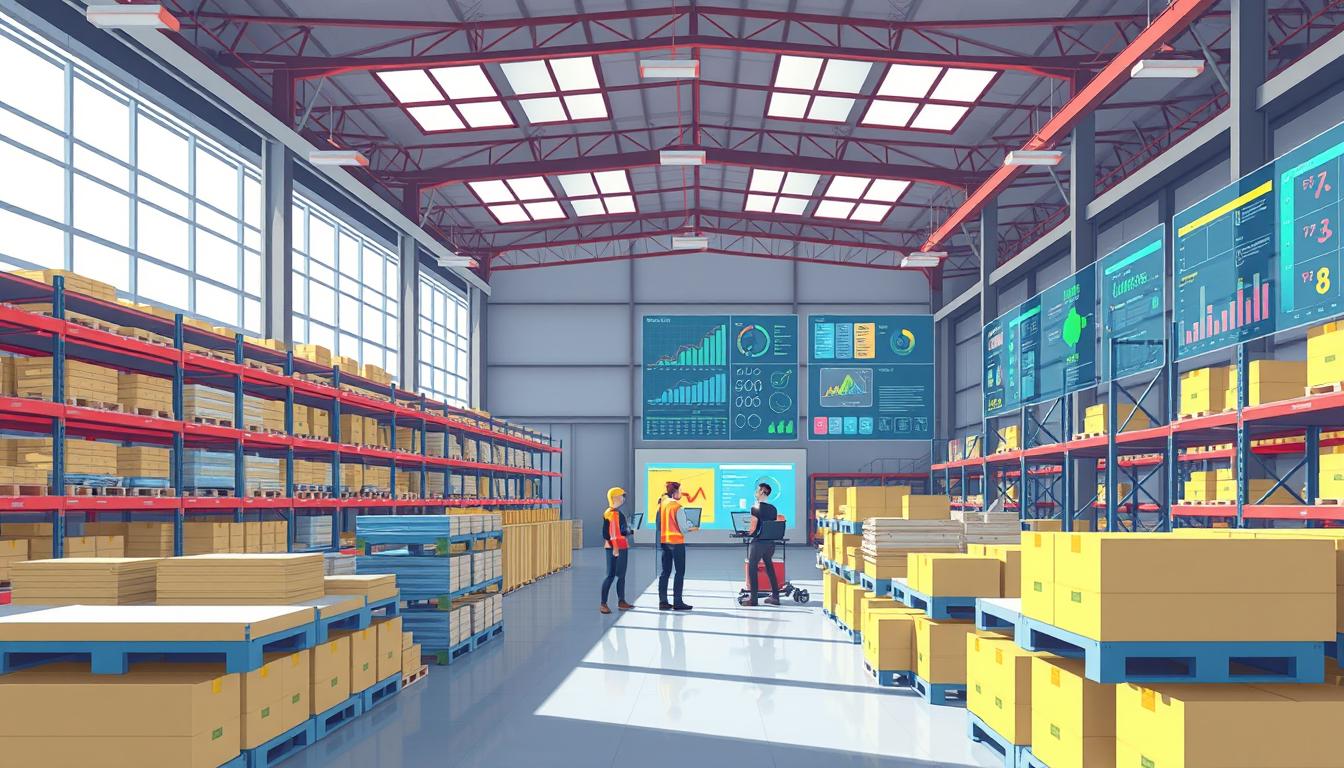
Missing a shipment or a sudden demand spike can be tough. A mid-sized retailer learned this the hard way during the holidays. Empty shelves lost customer trust, and long waits hurt profits.
They decided to make forecasting a key part of their strategy. Now, leaders at Amazon and Unilever use AI for better forecasting. This tech combines past sales, current data, and outside factors like weather.
It helps reduce costs and avoid stockouts. McKinsey and IBM found that using AI early can improve service and lower inventory. Idaho Forest Group, for example, cut their forecasting time from over 80 hours to under 15.
This AI use case is both practical and big. It’s about using AI to guide buying, pricing, and making decisions. It aims to show quick, measurable results, not just in years.
Key Takeaways
- Demand forecasting AI technology turns fragmented data into actionable demand signals.
- Early adopters report higher service levels, lower inventory, and reduced logistics costs.
- AI-driven inventory optimization shortens forecasting cycles and improves accuracy.
- Combining ML models with real-time inputs enables faster response to supply disruptions.
- Clear alignment of AI with operational problems drives rapid, measurable ROI.
Understanding Demand Forecasting
Demand forecasting helps companies plan by predicting what customers will buy. It uses tools to see trends and changes. This helps plan what to make and when to sell it.
What is Demand Forecasting?
Demand forecasting guesses what will be sold in the future. It looks at past sales and outside factors. Companies like Walmart use this to plan for busy times.
Using AI makes forecasting better. It learns from data and changes with trends.
Importance of Accurate Demand Predictions
Good forecasts help avoid too much or too little stock. Too much stock costs money. Too little means lost sales.
Companies like General Motors use forecasts to order parts on time. AI helps match supply with demand, improving service.
Methods of Demand Forecasting
Old methods like ARIMA and exponential smoothing are good starting points. They are easy to understand and work well for big numbers.
Newer methods like decision trees and XGBoost use more data. They handle changes in prices and trends. AI models like LSTM and RNN predict sales for specific items.
Choosing the right method is key. It depends on the data and goals. A mix of old and new methods works best.
| Method | Strength | Typical Use Case |
|---|---|---|
| ARIMA / Exponential Smoothing | Transparent, low compute | Monthly regional forecasts; baseline comparisons |
| Decision Trees / XGBoost | Handles mixed features; fast training | Promotional impact and cross-sku effects |
| LSTM / RNN | Captures temporal patterns | SKU-level time-series with seasonality |
| Transformer Models | Scales to large, complex datasets | Enterprise-wide forecasts across thousands of SKUs |
| Hybrid (Baseline + AI) | Practical, measurable uplift | Phased adoption to validate AI in demand forecasting |
The Role of AI in Demand Forecasting
AI adds depth to demand planning by mixing old stats with new learning. It helps firms add outside info like weather and social trends to sales data. This way, they catch trends that old methods miss.
This change makes planning faster and finds risks early.
How AI Enhances Traditional Methods
AI does tasks like making orders and figuring out safety stock. This lets planners work on big ideas. Systems check for oddities and look at supplier risks.
Companies using AI for forecasting save time and get more accurate. They go from weeks to days for forecasts and cut down on mistakes. They can also try out different scenarios and change inventory fast.
Machine Learning Algorithms for Forecasting
There are many models for different needs. XGBoost and trees are good with simple data. LSTM and RNN work with time series. And transformers handle big, complex data.
Ensembles mix these strengths for better results.
Computer vision and NLP help too. Vision checks products and quality. NLP reads emails and social posts. The right choice depends on the data and how fast it needs to be.
Teams start with simple learning and move to more complex as data grows. Experts say using many AI models together improves accuracy. They also suggest using good historical data as a base.
For a guide and stats on AI’s impact, check out IBM.
Key Benefits of AI in Inventory Optimization
AI helps inventory and supply chain teams a lot. Companies using AI for inventory see better service and less stock. This is because AI gives clear views, makes quick decisions, and cuts down on mistakes.
Reduced Stockouts and Overstocks
AI uses data to set the right amount of stock. McKinsey found AI can cut inventory by over a third. It also makes service better.
AI sends alerts to buy more before stock runs out. It also stops buying too much when demand drops.
Improved Customer Satisfaction
AI helps predict what customers will buy. This means less stock left over and less stock running out. Companies like Walmart use AI to guess sales better.
This makes customers happier because they find what they want. It also makes them more likely to come back.
Warehouse Efficiency Gains
AI makes picking and storing items better. It frees up people to do more important work. AI also helps with planning routes and using space better.
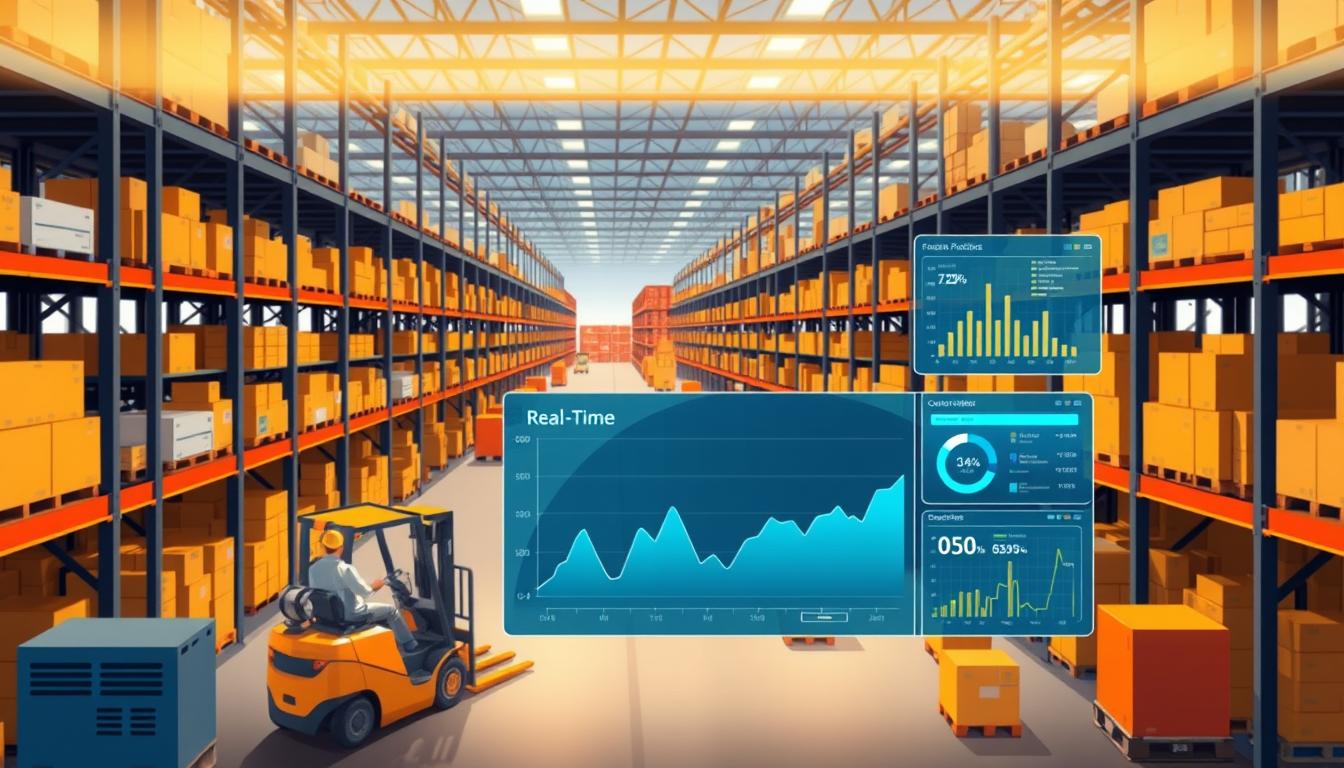
Studies show AI can make logistics cheaper while keeping things moving fast. It uses real-time data and cameras to keep stock accurate.
| Benefit | Primary Mechanism | Typical Impact |
|---|---|---|
| Lower inventory levels | Dynamic safety stock, demand sensing | Reduction of 20–35% in on-hand stock |
| Faster replenishment | Automated PO triggers, supplier performance scoring | Fewer emergency purchases; improved lead-time adherence |
| Higher fulfillment accuracy | Computer vision, IoT tracking, robotics | Fewer discrepancies; higher on-time delivery |
| Better customer experience | Improved forecast precision and local demand signals | Reduced stockouts; stronger repeat purchase rates |
| Lower logistics costs | Route planning, storage optimization | Cost reductions of 5–20% in distribution |
Using AI for inventory needs good data and clear goals. With these, AI helps teams plan ahead. This leads to better service and lower costs.
Challenges in Implementing AI for Forecasting
Using AI for forecasting is promising but comes with challenges. Teams face data gaps, system issues, and human factors. Taking practical steps can help overcome these hurdles.
Data Quality and Availability
Poor data quality is a big problem. Issues like missing sales history and wrong SKU codes hurt forecasts. Data from outside sources can also be unreliable.
IBM suggests checking data carefully and investing in cleaning tools. It’s also important to track how well forecasts are doing.
Integration with Existing Systems
Many companies use old ERP systems that are hard to connect to AI. This makes it tough to share important data with suppliers. Keeping data safe is a big challenge.
Using special tools can help connect systems. Starting small and growing slowly makes it easier to use AI for inventory.
Change Management and Training Needs
Planners might not trust AI if it’s not clear how it works. This lack of trust can slow down adoption. Getting users involved in the design can help.
It’s important to educate and train people. Starting small and keeping planners involved helps build trust in AI.
- Run a baseline data audit and fix the most harmful gaps.
- Choose vendors with ERP connectors and strong security frameworks.
- Design pilots with clear metrics, human override, and a rollout roadmap.
- Invest in training and explainable models to win planner trust.
Industries Benefiting from AI Demand Forecasting
AI helps many sectors with demand forecasting. Each one uses different data. This data includes weather, promotions, and rules.
Retail Sector Applications
Retailers use AI to manage stock levels. They match stock with online and in-store demand. This prevents running out of items.
AI looks at trends and seasons for each item. Fashion stores use this to decide when to lower prices. Grocery stores plan for sales and stock up on fresh items.
AI helps retailers avoid losing sales. It also helps them not to have too much stock. This saves money and keeps shelves full.
Manufacturing and Supply Chain Impact
Manufacturers use AI to plan production. They match demand with what they make. This helps them use materials better.
Logistics teams use AI to plan routes. Energy companies forecast needs based on weather. Restaurants plan for busy times.
Hospitals and drug distributors use AI for planning. Novolex, a packaging company, cut inventory costs with AI.
AI connects sales data with action. It helps reduce waste and improve service. This makes businesses more efficient.
Case Studies of Successful AI Implementations
Real-world examples show how AI helps in managing inventory. Big retailers and manufacturers see better service levels and faster planning. They use AI tools to make these improvements.

Retail: A Major E-commerce Player
Big retailers use online data, store sales, and weather to predict demand. Walmart is a great example. It uses local data to avoid stockouts.
Studies say using AI can improve service levels by 65%. It can also cut inventory by 35% and logistics costs by 15%. Space-O saw a 21% better forecast accuracy.
Food and Beverage Industry Example
Food makers and restaurants deal with demand peaks during holidays and events. AI helps reduce waste and improve availability. Idaho Forest Group cut forecast time from 80 hours to 15.
Novolex cut excess inventory by 16% and planning time from weeks to days. These examples show AI’s benefits in making quicker decisions and reducing waste.
In all sectors, AI helps when paired with good data and changes. It speeds up planning and gives clearer demand signals. This helps match supply with customer needs better.
Technologies Driving AI Demand Forecasting
Today’s demand forecasting uses many technologies. These help teams move from guessing to knowing. Cloud platforms grow and connect to many tools.
This makes it easier to update and use Demand forecasting AI technology everywhere.
Cloud Computing and AI
Cloud services from AWS, Microsoft Azure, and Google Cloud help train big models. They also track experiments and show important numbers in real-time. This way, AI gets better without needing a lot of money.
It’s important to connect these systems. They work with inventory and sales data. This makes it easier to get good results fast.
Big Data Analytics for Improved Insights
Big data brings together lots of information. This includes sales, web data, and weather. It makes AI better at planning inventory.
With real-time analytics, teams can act fast. They can change stock or prices right away. For more on how models work, check out this paper: forecasting model benchmarks.
- IoT and edge computing make quick decisions. Smart shelves and edge AI are fast.
- Computer vision checks stock and quality. It makes counting and checking faster.
- NLP reads emails and invoices. It gives models better data.
Good systems use different methods together. This makes them work well for many things. AI can handle changes and new trends.
Research shows new things coming. Quantum optimization and generative AI will be big. Companies that use AI now are ready for these changes.
Best Practices for AI Integration in Inventory Management
Starting with AI in inventory management means doing your data work well. Clean and check sales and stock data for 24 months. Make sure product codes and locations match up right.
Set clear goals like better accuracy and cost savings before you start. This helps plan your first steps.
Ensuring Data Accuracy and Integrity
Start with easy, common items to show AI’s value fast. Roll out AI in phases: test small, then grow. Make sure to follow rules on data privacy and fairness.
Check your data for missing bits and wrong formats. Use AI to make data look the same, but keep a human to check it. This way, you can trust the AI but also make changes when needed.
Use AI’s predictions in real-life tasks like making more products. For tips and examples, check out AI inventory management guidance.
Continuous Monitoring and Adjustment
Watch how well AI is doing with the right numbers. Keep an eye on how data changes over time. Update AI models when data changes, not just on a schedule.
Try AI alongside old ways to see if it’s better. Set up alerts for strange demand patterns. This way, you can fix things fast and keep improving AI over time.
Only grow your AI use if it really helps your business. Watch how it changes service levels and saves money. This will help you use AI more widely.
| Practice | Action | Expected Outcome |
|---|---|---|
| Data Audit | Clean 24 months of historical data; standardize SKUs and locations | Fewer input errors; higher model accuracy |
| Phased Rollout | Pilot on predictable, high-volume SKUs; run AI in parallel with legacy forecasts | Lower risk; measurable proof points |
| Governance | Define privacy, bias checks, KPI ownership, and override rules | Trustworthy, compliant deployments |
| Monitoring | Track MAPE/WAPE, data drift; automate anomaly alerts | Faster detection of model degradation |
| Feedback Loop | Use operational results to refine features and retrain models | Continuous improvement in Inventory forecasting using AI |
| Training | Educate technical and business users; maintain human-in-the-loop | Higher adoption and better decision quality |
| Vendor Selection | Choose providers aligned to business objectives and scale needs | Smoother integration of AI solutions for inventory management |
Future Trends in AI and Demand Forecasting
The future of AI in demand forecasting will be exciting. Edge AI will make decisions in warehouses. Generative models will help planners quickly test scenarios.
Natural language processing will let systems read emails and reports. This will help spot supply and demand changes fast. Teams will use AI to ask questions and test ideas without spreadsheets.
IoT will give us real-time data from smart shelves and tags. This data will help AI make better forecasts. This means fewer stockouts and less waste in warehouses.
Computer vision, robotics, and IoT will work together. They will make inventory systems smarter. Robotics will move items, vision will check counts, and IoT will report on conditions.
AI will also think about the environment. It will balance costs, service, and emissions. Quantum and large-scale optimization will solve complex problems. Companies will become more resilient and competitive.
For more on how to improve efficiency with AI, check out Miloriano. They have research and examples on how AI can help.
Advancements in Natural Language Processing
NLP will change how we get data. Systems will turn text into demand signals. This will make planning faster and easier.
Generative assistants will let planners talk about scenarios. This will make using AI analytics more common across teams.
Influence of IoT on Inventory Strategies
IoT will give us real-time data. This will help reduce extra inventory and improve fill rates. AI models will use this data to make better forecasts.
Edge inference will let us make changes right away. This will help us stay strong during problems. It will also save money by making logistics smarter.
Conclusion: Embracing AI for Competitive Advantage
Start by getting your data ready. Set clear goals and test AI in small steps. This way, you can see how AI helps with planning.
Companies that do this see big improvements. They get better service, cut down on inventory, and save on shipping costs. This shows how important AI is for planning.
First, figure out what you need. Then, pick the right AI tools. Make sure your data is good too.
Work with your team and keep improving your AI. Watch how it does and make changes. This helps you make better choices and please your customers.
Use AI in a way that works with your team. Make sure everyone knows how it works and keeps things private. This way, AI helps you stay ahead of the game.
FAQ
What is demand forecasting and why does it matter for inventory optimization?
Demand forecasting predicts what customers will buy in the future. It helps businesses plan better. This way, they avoid having too much or too little stock.
AI helps make these forecasts by looking at past sales and other trends. It uses data like weather and social media to guess what people will want.
How does AI enhance traditional forecasting methods?
AI makes forecasts better by using more data and finding hidden patterns. It looks at sales, promotions, and even what people say online. This helps businesses plan more accurately.
AI also automates some tasks, like figuring out when to order more. This makes planning faster and more efficient.
Which machine learning algorithms are commonly used for demand forecasting?
Some common algorithms include XGBoost, LSTM, and transformers. These help find patterns in data. They make forecasts more accurate.
AI also uses computer vision and NLP to get more information. This helps businesses make better plans.
What measurable benefits can companies expect from AI-enabled forecasting?
Companies can see big improvements with AI. They might sell more, waste less, and save money. Some have even cut their forecasting errors by half.
AI also helps businesses plan faster and more accurately. This leads to better results and more money saved.
How does AI reduce stockouts and overstocks in practice?
AI looks at real-time sales and trends to predict demand. It figures out the best time to order more. This helps avoid having too much or too little stock.
AI also adjusts safety stock levels based on how long it takes to get items. This helps businesses avoid buying too much.
In what ways does AI improve customer satisfaction?
AI helps businesses keep more items in stock. This means customers are happier and buy more. It also helps businesses plan better for promotions.
This leads to more sales and happier customers. It’s a win-win for everyone.
What warehouse efficiency gains come from AI-driven inventory management?
AI makes picking and packing faster and more accurate. It uses robots and computer vision to count items. This saves time and reduces mistakes.
AI also helps plan the best routes for delivery. This makes getting items to customers faster and more efficient.
What are the primary data challenges when implementing AI for forecasting?
Poor data quality is a big problem. It can make AI forecasts not very good. Businesses need clean, accurate data to get the most out of AI.
They also need to make sure their data is consistent. This helps AI make better predictions.
How difficult is integration with existing ERP and supply chain systems?
Integrating AI with existing systems can be tough. But, it’s doable with the right approach. Cloud-based AI platforms often have easy connections to other systems.
Start small and test the integration on a few items. This helps make sure everything works smoothly.
What change-management and training considerations should organizations plan for?
Getting everyone on board with AI is important. Involve the team during the planning phase. This helps them understand and support the change.
Provide training for both technical and business teams. This ensures everyone knows how to use AI. Set clear goals and keep human oversight to build trust.
Which industries benefit most from AI demand forecasting?
Retail and e-commerce see big benefits from AI. It helps them plan better for online and in-store sales. AI also helps manufacturers and the automotive industry plan better.
Food and beverage, restaurants, healthcare, and pharma use AI for specific needs. Even financial services use AI for forecasting.
Can you provide examples of successful AI implementations?
Yes, many companies have seen great results from AI. Retailers have improved their forecasts by up to 65%. Manufacturers have cut excess inventory by 16%.
These success stories show how AI can make a big difference. They highlight the benefits of better forecasts and more efficient planning.
What technologies support AI-driven demand forecasting?
Cloud computing and big data analytics are key. They help AI learn and make predictions. IoT and edge computing provide real-time data for better forecasts.
Computer vision and NLP help AI understand more data. This leads to more accurate forecasts and better planning.
What are best practices for starting an AI inventory optimization program?
Start with a data audit and clean history. Standardize data and set clear goals. Pilot on high-volume items to test the system.
Use phased rollouts and keep human oversight. Monitor data changes and update models as needed. This ensures the system works well over time.
How should companies monitor and maintain forecasting models?
Track how accurate the forecasts are. Use data-drift detection to update models. Run AI forecasts alongside old ones during pilots.
Build feedback loops to improve the system. This ensures the forecasts stay accurate and useful over time.
What future trends will shape AI demand forecasting?
Expect more use of IoT, computer vision, and robotics. Edge AI will make decisions faster. NLP will help understand more data.
AI will also consider environmental impact. This will help businesses save money and be more sustainable.
What common pitfalls and how can they be mitigated?
Avoiding black-box models is important. They can make planners skeptical. Start small and test the system.
Make sure data is clean and consistent. Budget for change management and keep human oversight. This ensures the system works well and is trusted.
What ROI can companies realistically expect from AI in forecasting?
AI can bring big returns when used right. Businesses have seen up to 300% ROI in 18 months. AI improves forecasts, reduces waste, and saves money.
It makes planning faster and more accurate. This leads to better results and more savings.
How do external signals like weather and social sentiment improve forecasts?
Weather and social media trends help predict demand. AI uses this data to make forecasts more accurate. This helps businesses plan better.
AI can spot trends that humans might miss. This leads to better planning and more sales.
Is AI effective at SKU-level forecasting or should companies aggregate to regions?
It depends on the data and resources. SKU-level forecasts are more detailed but need a lot of data. Regional forecasts are simpler but less detailed.
Start with a small test to see what works best. Then, expand based on results and data quality.
How should companies choose vendors or partners for AI forecasting?
Look for vendors that match your business goals. Make sure they integrate well with your systems. Check their track record and support for AI.
Choose partners that offer cloud solutions and easy connections. They should also provide tools to understand AI decisions.
Can AI forecasting handle extreme disruptions like pandemics or natural disasters?
AI helps but has limits. It’s best for predicting usual trends. For big surprises, AI needs human input.
AI can simulate scenarios and adjust plans. But, it’s important to have a plan B for extreme events.
How does IoT and edge computing change inventory strategies?
IoT and edge computing provide real-time data. This helps businesses manage stock better. It reduces waste and improves planning.
Edge computing makes decisions faster. This helps businesses respond quickly to changes in demand.
What governance and privacy concerns arise with supply-chain AI?
AI deals with sensitive data. Businesses need strong data protection. This includes access controls and privacy rules.
Use secure connections and limit data retention. This helps protect data while allowing AI to work.