Missing a shipment or running out of stock can be stressful. It might mean a call from a worried client or a stop in production. These moments make us look for better ways to plan.
For many, AI is now a real solution. It helps reduce uncertainty and brings back confidence. This is thanks to tools that use machine learning and predictive analytics.
This AI Use Case focuses on improving inventory and planning. It uses machine learning and predictive analytics. The goal is to cut down on mistakes and make things faster.
AI is changing how we manage supply chains in many fields. Walmart uses AI to keep stock levels right. Novolex has less extra stock and plans faster. Even healthcare and energy use AI for important resources.
Using AI means we must protect data and follow rules. We aim to help leaders use AI wisely. This means giving them the tools and knowledge they need.
Key Takeaways
- AI-driven demand forecasting for industrial supply chain reduces forecasting errors and speeds planning cycles.
- Industrial supply chain management with AI uses machine learning, predictive analytics, and automation to cut excess inventory and stockouts.
- Cross-industry examples—from retail to healthcare—demonstrate measurable operational gains.
- Successful adoption requires strong governance: data security, privacy, and bias mitigation.
- Practical resources and case studies help leaders translate AI Use Case – Industrial Supply-Chain Demand Forecasting into real business outcomes; see this overview from IBM for more context: AI demand forecasting insights.
Introduction to AI in Industrial Supply Chains
The industrial supply chain is getting more complex. This is due to global sourcing, demand changes, and products lasting less time. AI helps by moving from guessing to making smart plans.
Overview of AI Technology
AI uses old and new methods to forecast. Statistical models are the base for steady trends. But, machine learning and neural networks find hidden patterns that old methods miss.
Generative AI and large language models understand natural language. They make sense of notes, messages, and reports. AI agents then use this info to make decisions and take actions.
Things like Hadoop and Spark help with data. Digital twins and platforms show real-time data. RAG and Model Context Protocol connect AI to company data and actions.
But, AI has limits. It can make mistakes if it doesn’t have good data. It also has limits on how much data it can use. Good results need clean data and rules.
Importance of Accurate Demand Forecasting
Wrong forecasts cost a lot. They lead to too much inventory and high storage costs. They also cause missed sales and lost customer trust.
Companies that use AI early see big benefits. They save on logistics, use inventory better, and improve service. Studies show savings of 15% on logistics, 35% on inventory, and 65% on service.
AI helps with many things like managing inventory and planning production. It also helps with pricing, promotions, choosing suppliers, and planning for emergencies. It makes it easier to test scenarios and adjust plans quickly.
AI helps teams plan ahead instead of just fixing problems. It lets planners test different scenarios and make smart decisions. This is what AI does best: turning data into quick actions.
| Capability | Core Benefit | Example Use |
|---|---|---|
| Statistical Models | Stable baseline forecasts | Monthly demand planning for mature SKUs |
| Machine Learning & Neural Nets | Detect nonlinear drivers and seasonality shifts | Predicting sales spikes from weather or events |
| Generative AI & LLMs | Extract signals from unstructured text | Parsing supplier updates and market reports |
| AI Agents & RAG | Automated decision workflows | Triggering replenishment or reroute actions |
| Digital Twins & Data Pipelines | End-to-end visibility and scenario testing | Simulating factory constraints and lead-time shifts |
The Role of Data in Forecasting
Data is key for good forecasting today. When using AI for supply chain forecasting, treat data as a treasure. It needs to be captured well, integrated smartly, and checked often to be useful.
Types of Data Used
Structured data is the base for models. It includes past sales, inventory, and ERP/WMS data. These help predict trends and analyze products and locations.
External data adds more context. It includes economic news, weather, and shipping updates. Mixing internal and external data makes forecasting better.
Unstructured data brings more detail. It’s from reviews, social media, and news. AI can understand these messy data types. IoT sensors also provide real-time data for better planning.
Collection Methods
Internal data comes from APIs connecting different systems. This makes data entry easier and speeds up insights. External data comes from third-party sources for a complete view.
AI helps make documents useful by extracting data. Streaming data allows models to update fast. This keeps forecasts accurate.
Data Quality and Integrity
Good data is essential. Bad data can mess up forecasts. Cleaning data is important to keep it accurate.
Good data governance is also key. It ensures data is safe and shared right. AI needs to be fair to avoid bias.
People should check data too. This keeps forecasts reliable. It’s important to update models when data changes.
| Data Category | Examples | Collection Method | Role in Forecasting |
|---|---|---|---|
| Internal Structured | Sales history, inventory levels, ERP/WMS records | API integrations, batch ETL | Baseline trends, seasonality, SKU-level demand |
| External Structured | Economic indicators, weather, shipping status | Third-party feeds, APIs | Contextual drivers, risk signals, demand shifts |
| Unstructured | Reviews, social posts, news, contracts | OCR, NLP pipelines, RAG indexing | Sentiment signals, promo impact, supplier terms |
| Sensor / Real-Time | IoT telemetry from plants, warehouses, vehicles | Streaming platforms (Kafka, cloud streams) | Demand sensing, inventory movement, lead-time alerts |
| Quality & Governance | Data lineage, master data, privacy rules | Provenance tracking, access controls | Trust, compliance, model reliability |
Machine Learning Techniques for Demand Forecasting
Choosing the right technique is key to making good forecasts. This section talks about how to use AI for better supply chain planning. It also shows when to use each method and gives examples of their strengths and weaknesses.
Regression models are a good starting point. They help us see how demand changes with things like price and season. Companies like General Motors and Caterpillar use them to understand their data better.
Regression is great for steady patterns. But, it can struggle with complex patterns unless we add special features. That’s why combining methods can lead to better results.
Regression Analysis
Linear regression makes it easy to see how different things affect demand. Multivariate regression can handle lots of variables. These models help us test ideas and set limits for more complex systems.
Regression and time series forecasting work well together. Regression explains the drivers, and time series catches the patterns. This combo helps us understand and react to changes.
Time Series Analysis
Time series models like ARIMA and exponential smoothing break down trends and seasons. Supply planners at Siemens and Honeywell use them for short-term forecasts.
Time series models are good at catching seasonal patterns. But, they might not handle sudden changes well. Adding external data can help them adapt faster.
Neural Networks
Recurrent networks like LSTM and GRU are great for patterns in data. Convolutional and transformer models can handle complex interactions. Amazon and UPS use these for combining different data sources.
Neural networks are good at finding complex relationships. They’re also useful for forecasting new products. They can handle lots of different types of data, like text and images.
It’s important to keep models up to date. Retraining on new data helps keep forecasts accurate. MLOps practices from Microsoft and Google Cloud show how to do this while keeping track of changes.
Using a mix of techniques can lead to better forecasts. It’s important to balance how well we can understand the model. This way, we can trust the results and make good decisions.
| Technique | Strengths | Limitations | Best Use Case |
|---|---|---|---|
| Linear / Multivariate Regression | Clear interpretation; fast; baseline for feature testing | Poor with nonlinearity; needs feature engineering | Explainable baseline and driver analysis |
| ARIMA / SARIMA / Exponential Smoothing | Strong at seasonality and short-term trends; low data prep | Limited shock response; less effective with many exogenous variables | Demand-sensing and short-horizon replenishment |
| LSTM / GRU / Transformers | Captures complex nonlinear and multivariate patterns; handles heterogeneous inputs | Computationally intensive; reduced transparency | New-product forecasting and fusion of sensor, text, and image data |
| Ensembles (Hybrid) | Higher accuracy; balances explainability and responsiveness | Complex pipelines; needs strong MLOps | Robust production systems for industrial supply chains |
Benefits of Implementing AI in Supply Chains
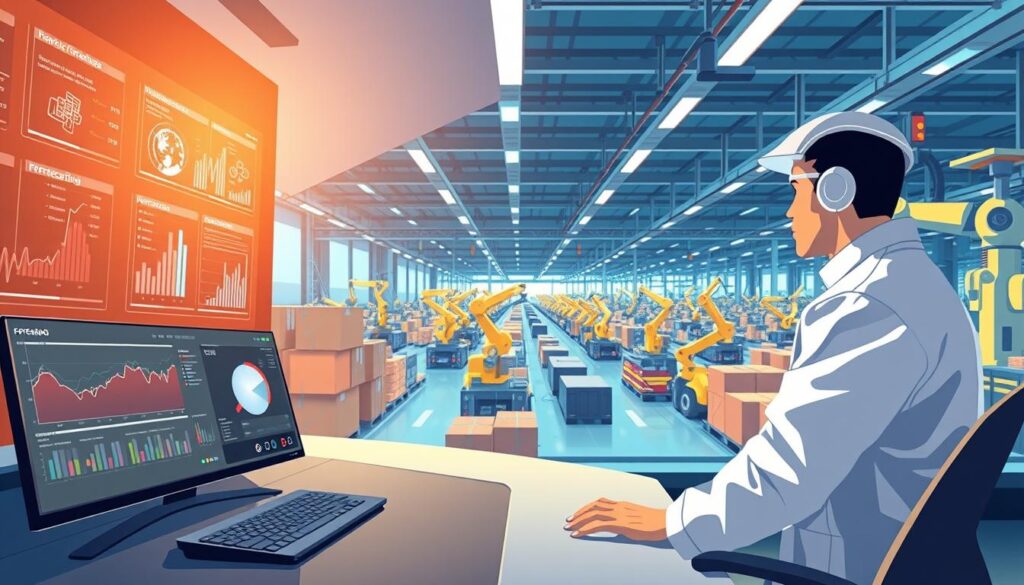
AI helps a lot in planning, operations, and finance. Companies using AI can plan better and make smart choices. This makes them less surprised and more in control.
Improved Accuracy
AI uses many things like sales history and weather to find new patterns. Walmart uses AI to guess sales better by looking at local events and weather. Novolex makes fewer mistakes and plans faster with AI.
AI keeps learning from new data. Idaho Forest Group made planning much faster by using AI. This helps make forecasts more accurate and reliable.
Cost Reduction
AI helps guess sales better, which means less extra stuff to store. McKinsey says companies using AI spend less on shipping and keep more items moving. AI also makes planning faster and cuts down on rush orders.
AI helps avoid running out of stock and makes buying smarter. Companies using AI save money on storage, shipping, and cash flow.
Enhanced Decision-Making
AI gives clear plans and options. It helps figure out prices, schedules, and backup plans. AI can also summarize big data and suggest quick actions.
AI helps everyone agree on plans faster. It turns data into useful information. This lets teams work together smoothly and quickly.
Challenges in AI Implementation
Using AI in supply chains is hard. Leaders face many challenges. They need to manage change and data well. This makes AI work better in forecasting.
Many projects fail because of missing data. New products and limited data make models weak. But, using AI in new ways can help.
Data Scarcity
Supply partners often don’t give enough data. This makes predictions less accurate. Teams should find the most important data and use different types of data together.
Using outside data like sales trends helps. This makes models better when there’s not much data. Testing AI in small ways shows it can work well.
Integration with Existing Systems
Old systems like ERP and TMS are common. Connecting them to AI is hard. It needs good APIs and pipelines.
Adding AI to systems is complex. Teams should plan well and use secure ways to connect. It’s also important to control data and follow rules.
Resistance to Change
Teams might not trust AI or worry about losing their jobs. This makes it hard to use AI. It’s important to be open and show how AI helps.
Start by using AI to help, not replace, teams. Teach people about AI and use clear goals. This builds trust and keeps knowledge in the team.
| Challenge | Root Cause | Practical Mitigation | Expected Outcome |
|---|---|---|---|
| Data Scarcity | New SKUs, sparse partner feeds, short histories | Transfer learning, synthetic data, external signals | Improved model robustness and scenario coverage |
| System Integration | Legacy ERP/WMS/TMS, siloed data | APIs, ETL pipelines, middleware, modular design | Smoother deployments and faster time to value |
| Security & Vendor Risk | Third‑party AI providers and data sharing | Strict access controls, audit trails, vendor SLAs | Compliance and reduced exposure |
| Organizational Resistance | Distrust of black-box models, fear of displacement | Pilot programs, co-pilot tools, training, governance | Higher adoption rates and sustained performance gains |
| Model Maintenance | Data drift, seasonal shifts, vendor updates | Monitoring, retraining schedules, validation pipelines | Consistent accuracy and reliable forecasts |
Working on these challenges helps AI make a big difference. Using AI wisely and planning for change can make a company better.
Case Studies of Successful AI Deployments
Real-world examples show how AI helps in forecasting. We’ll look at two companies that made big changes. They show us how to use AI in different ways.
Company A wanted to make forecasting faster. Idaho Forest Group used new methods to do this. They went from 80 hours to 15 hours.
This change helped them try more ideas. They could quickly adjust to changes in the market. They had clean data, kept improving their models, and got everyone on board.
Company B aimed to use less inventory and save money. Novolex used AI to predict sales and stock needs. They cut down on extra stock by 16% and made planning faster.
They saved money and kept customers happy. They chose the right tools, had good data, and made sure everyone agreed on what to do.
Big companies like Walmart use AI too. They adjust stock based on weather and sales. Healthcare and energy also use AI to plan for big needs.
These stories show AI’s power in different fields. They teach us to match technology with clear goals, use good data, and keep people involved.
| Company | Primary Goal | Approach | Measured Outcome | Key Lesson |
|---|---|---|---|---|
| Idaho Forest Group | Faster, scalable forecasting | Automated data aggregation and model orchestration | Forecast time cut from 80+ hrs to under 15 hrs | Clean historical data and iterative refinement |
| Novolex | Reduce excess inventory | Hybrid models using sales, supply indicators, external data | 16% reduction in excess inventory; shorter planning cycles | Robust data pipelines and model governance |
| Walmart (retail example) | Dynamic inventory adjustment | Demand sensing with local signals and weather | Improved inventory responsiveness and service levels | Real-time signals improve short-term accuracy |
| Healthcare & Energy | Critical resource forecasting | Combined market, weather, and public-health signals | More accurate PPE and energy demand estimates in crises | Cross-source signals strengthen predictive power |
These stories show us how AI can help. Teams that use technology well and have clear goals do great things. We can learn from these examples to use AI in our own ways.
Tools and Software for AI Demand Forecasting
Choosing the right tools makes AI useful for planners and supply-chain leaders. This guide lists top tools, highlights key features, and offers advice. It helps teams start pilots with clear goals.
Overview of Popular Software
Big planning suites like IBM Planning Analytics, SAP Integrated Business Planning, and Oracle Cloud SCM do forecasting and planning together. IBM Planning Analytics has AI helpers for quick scenario making. Cloud ML platforms like AWS SageMaker, Google Vertex AI, and Azure Machine Learning help make custom models and use data in real-time.
Specialist vendors focus on demand sensing and easy connections to ERP, POS, WMS, and TMS systems. Startups offer easy workflows that automate model runs and update forecasts. Open frameworks and libraries like LangChain and RAG patterns with OpenAI or Anthropic models help make flexible pipelines.
Key Features to Look For
Look for tools that can connect to ERP, POS, WMS/TMS systems easily. They should also handle streaming data to reduce forecast delay.
Check if the tools can use different models, explain forecasts, and update models automatically. These features help forecasts keep up with changing demand.
Make sure the tools can use RAG and LLM to understand contracts and documents. This helps planners understand exceptions and supplier issues.
AI agents that can start models, update forecasts, and check with humans are useful. They make the process faster and reduce manual steps.
Good tools have strong security and governance. They should have access controls, audit trails, and encryption to protect data and meet rules.
Tools should be easy to use. Natural-language interfaces and co-pilots help planners without needing to code.
When choosing tools, match them with your business needs. Start with small pilots to check KPIs like forecast accuracy and planning speed. Work with proven vendors or consultants to set up tools and follow rules. For custom work, cloud ML platforms are best because they support Advanced analytics for supply chain demand forecasting.
| Category | Representative Vendors | Strengths | When to Choose |
|---|---|---|---|
| Enterprise Planning Suites | IBM Planning Analytics, SAP IBP, Oracle Cloud SCM | Integrated planning, embedded AI assistants, end-to-end workflows | Large organizations needing unified planning and governance |
| Cloud ML Platforms | AWS SageMaker, Google Vertex AI, Azure ML | Scalable training, model hosting, streaming data support | Teams building custom models and advanced pipelines |
| Specialist Forecasting Vendors | Demand-sensing providers and supply-chain AI firms | Pre-built demand models, fast ERP/WMS/TMS integration | Companies wanting rapid accuracy gains with minimal custom work |
| Frameworks & Libraries | LangChain, RAG stacks with OpenAI/Anthropic, MCP orchestration | Flexible RAG implementations, agent orchestration standards | Organizations needing tailored retrieval, LLM summarization, or agentic workflows |
| Startups with Agentic Workflows | Domain-focused supply-chain startups | Automated forecast generation, human-in-loop verification | Teams piloting modern UX and automation for planners |
For buying, make a checklist that links vendor features to KPIs. Check how AI solutions handle data, retraining, and explain forecasts to users. Choose tools that support Advanced analytics for supply chain demand forecasting, but also focus on governance and usability.
Future Trends in AI and Demand Forecasting
The next big thing in predicting demand is coming. Leaders at Amazon and McKinsey say it will be faster and more useful. This change will link models, data, and business plans better.
Predictive Analytics Innovations
New models will mix old stats with AI to give clear advice. This will help systems make decisions and explain them to people.
Big AI updates will make forecasts better by using more data. This is good for planning supply chains.
AI will also guess better about new products. Companies that use both old and new methods will do well. For more on this, check out this guide on AI in demand.
Real-Time Data Utilization
AI will soon use IoT to catch changes in what people want right away. This is great for fast-changing items like clothes and gadgets.
Other data like social media and local events will also help. Systems will give tips that people can check and change.
Keeping data safe and true will be key. Rules and checks will help make sure AI is trusted.
The table below shows what’s new, how it works, and what it means for businesses.
| Capability | Practical Use Case | Strategic Impact |
|---|---|---|
| Agentic Forecasting | Auto-run scenario tests and update purchase suggestions | Faster decisions; fewer manual errors |
| Large Context LLMs | Richer RAG-enabled forecasts using full product docs | Improved accuracy for complex SKUs |
| IoT & Streaming Data | Real-time demand sensing in stores and warehouses | Reduced stockouts; better promotions timing |
| Domain-Specific Models | New-product and cross-market forecasting | Faster ramp-up for launches; less forecast bias |
| Alternative Signal Integration | Social trends and shipment disruptions feeding forecasts | More responsive planning; resilient operations |
| Governance & Human-in-Loop | Review gates for agent actions and KPIs | Trustworthy scale and risk control |
Best Practices for AI Adoption in Supply Chains
Using AI in supply chains needs a careful plan. Start with a simple, important task and grow as you learn. This guide helps leaders work with teams, keep models up-to-date, and learn new skills.
Stakeholder Engagement
Get everyone involved early to avoid problems and speed up adoption. Form teams that include planners, IT, and suppliers. They will help set goals and check progress.
Try small tests with clear goals to show how AI helps. Being open about how AI works helps everyone trust it. This is true when using tools from companies like IBM or Microsoft.
Make rules for who does what and how data is shared. This keeps everyone on the same page and protects privacy. Clear agreements and checks help keep things running smoothly.
Continuous Improvement
Keep models updated and watch for changes. Use different methods to get more accurate results. This way, you avoid relying on just one method.
Let people review AI decisions. This helps catch any mistakes. Use tests and checks to see if AI is really helping.
Add more data slowly but surely. Use tools to make sure everything runs smoothly. Work with experts to make sure your systems are reliable.
Training and Development
Teach everyone about AI, not just data experts. Planners need to understand AI results. IT teams must handle the tech side.
Make guides and rules for using AI. Hands-on training helps people feel more confident. This reduces worries about AI.
Encourage trying new things. Small tests help teams learn without big risks. Share what works well so everyone can use it.
- Start small: pick short-horizon demand sensing or high-value SKUs as pilot candidates.
- Measure outcomes: use forecast accuracy, inventory days, and cycle time as core KPIs.
- Secure systems: enforce vendor data contracts, encryption, provenance, and audit trails before broad rollout.
- Partner wisely: work with experienced vendors or integrators for data pipelines and agent implementations during early stages of Implementing AI in industrial supply chain forecasting.
Follow these tips to adopt AI well in supply chains. Good planning, constant checking, and training are key. This way, you build a strong AI system that keeps improving.
Conclusion: The Future of Supply Chain Forecasting
AI is now a key part of supply chain planning. It uses machine learning and deep learning to predict better than old methods. Companies like Walmart and Novolex have seen big improvements.
They have less waste and better service. This is because AI makes planning faster and more accurate.
To succeed, you need good data and systems that work well together. It’s also important to have people checking the AI’s work. This keeps everything running smoothly.
But, there are challenges like finding enough data and making sure systems talk to each other. It’s also important to keep data safe. Start small and check things work before you do more.
For those who like tech, AI is getting better at working with IoT and big data. This makes predictions even more accurate.
People who want to use AI should start with important areas. Work with experts and make sure your data is clean. Test it out first and then grow it.
For more info, check out this article on AI in demand forecasting: AI demand forecasting insights.
AI is not a magic fix. But with the right plan and data, it can make supply chains better. It helps them be more ready for changes and work more efficiently.
FAQ
What is the primary use case for AI in industrial supply-chain demand forecasting?
AI helps manage inventory and plan production better. It makes forecasts more accurate and faster. This reduces errors and improves customer service.
Which core AI technologies are most relevant to demand forecasting?
Key technologies include machine learning and deep learning. Also, generative AI and large language models are important. These work together to improve forecasts.
What business outcomes can companies expect from implementing AI forecasting?
Companies see better forecasts and lower costs. They also have less inventory and better customer service. Early adopters have seen big improvements.
What types of data are used to train AI demand-forecasting models?
Data includes sales history and external sources like weather. It also includes sensor data for real-time insights. This helps make better forecasts.
How should organizations collect and integrate the required data?
Use APIs and external feeds for data. Also, integrate with systems like ERP and WMS. Make sure data is reliable and complete.
What data-quality practices are essential for reliable forecasts?
Keep historical data clean and accurate. Use checks and validation to ensure quality. This helps maintain forecast reliability.
When should teams use regression analysis versus other techniques?
Use regression for simple models. But, for complex data, try machine learning or deep learning. They handle complex patterns better.
How do time-series models fit into forecasting strategies?
Time-series models are great for short-term forecasts. They handle seasonality well. Combine them with other models for better results.
What advantages do neural networks offer for demand forecasting?
Neural networks handle complex data well. They learn from data and improve over time. This makes them useful for new products.
Should organizations use ensembles or single-model approaches?
Ensembles are usually better for accuracy. They combine different models for a more complete view. But, they need careful management.
How much can AI improve forecast accuracy in practice?
AI can cut errors by up to 50%. It works best with diverse data and complex models. This leads to more accurate forecasts.
What cost benefits arise from AI-driven forecasting?
AI reduces inventory and planning costs. It also lowers shipping and labor costs. This saves money and improves efficiency.
How does generative AI and LLM capability add value?
Generative AI and LLMs help with unstructured data. They provide insights and recommendations. This makes planning easier and more accurate.
What are common data scarcity challenges and remedies?
Limited data is a big challenge. Use transfer learning and synthetic data to help. Also, combine structured and unstructured data for better insights.
How difficult is integration with legacy enterprise systems?
Integrating with old systems can be hard. Use APIs and ETL tools for better integration. This makes data sharing easier and more secure.
What governance and security considerations must be addressed?
Data privacy and security are key. Use encryption and secure data sharing. This protects against data breaches and misuse.
How should organizations manage resistance to AI-driven change?
Build trust through education and small tests. Start with simple changes and involve everyone. This makes AI adoption smoother.
What real-world examples demonstrate AI benefits in supply chains?
Idaho Forest Group and Novolex have seen big improvements. Walmart uses AI for better demand planning. AI helps in many industries.
What software and platforms support AI demand forecasting?
Many tools are available, like IBM Planning Analytics and AWS SageMaker. Choose based on your needs and data.
Which features should buyers prioritize when selecting forecasting tools?
Look for good data connections and model support. Also, check for explainability and automatic updates. These features are important.
What are near-term innovations and trends to watch?
Watch for more advanced AI tools and better data use. IoT and streaming data will improve forecasting. These changes will make AI more useful.
How should companies start an AI demand-forecasting program?
Start with small pilots and clear goals. Use experienced vendors for data and AI. Make sure to keep data safe and secure.
What operational practices sustain long-term model performance?
Keep models updated and monitor them closely. Use human checks and continuous improvement. This keeps forecasts accurate over time.
What training investments improve adoption among planners?
Train planners on AI tools and workflows. Give them hands-on experience and encourage experimentation. This helps them adapt to AI.
How should organizations balance automation with human oversight?
Start with AI suggestions and involve planners. Define clear goals and escalation paths. This ensures AI works well with human judgment.
What KPIs should leaders track to measure AI forecasting success?
Track accuracy, inventory, and service levels. Also, monitor planning time and costs. This helps evaluate AI’s impact.
Are there regulatory or ethical risks when deploying forecasting AI?
Yes, there are risks like data breaches and biased forecasts. Use privacy controls and audits to mitigate these risks.
How can firms scale successful AI forecasting pilots?
Document lessons and standardize processes. Expand training and use AI agents for better management. This helps grow AI use.
What final advice should supply-chain leaders keep in mind?
View AI as a tool, not a replacement. Focus on clean data and clear goals. Use AI wisely to gain a competitive edge.