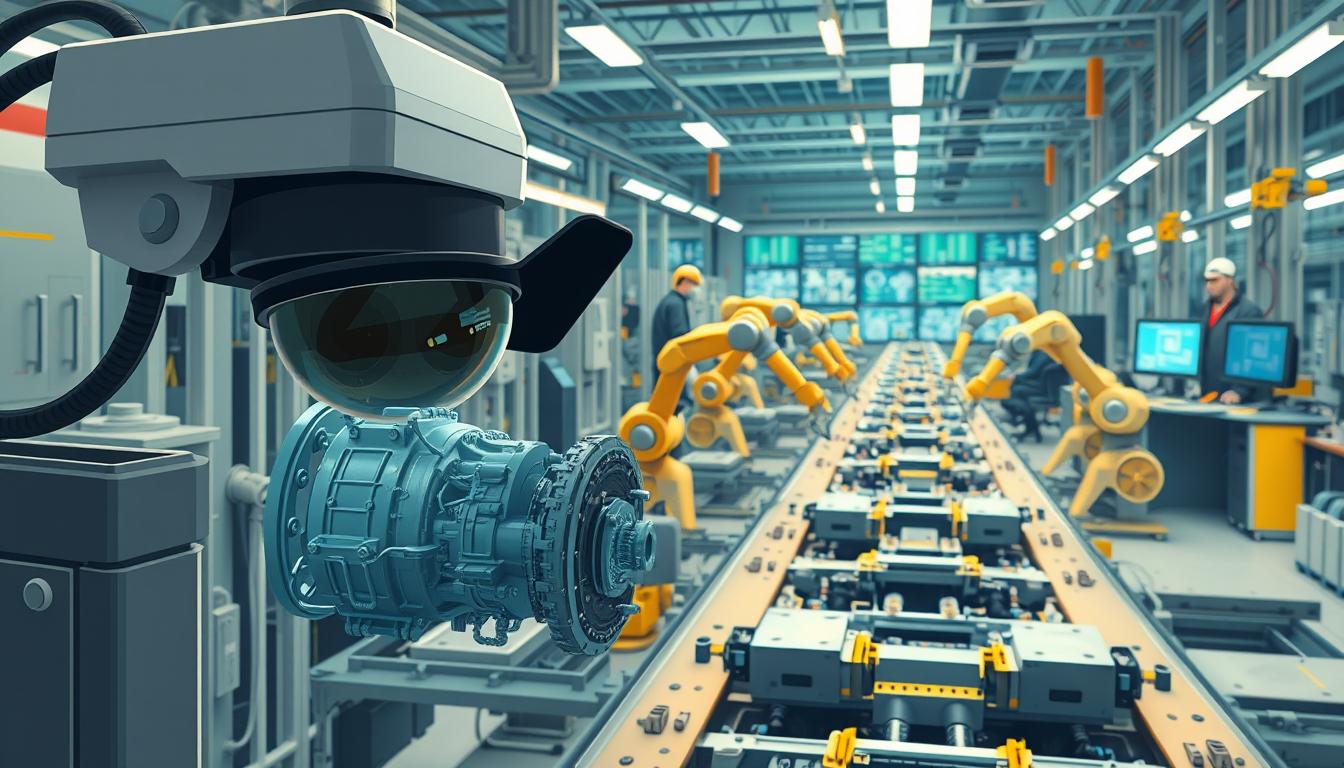
On the factory floor, a single missed defect can cause big problems. It might delay a shipment, lead to a recall, or make a team work late. Many in manufacturing know the feeling of worry when a human eye gets tired and mistakes happen.
This article talks about a big solution to this worry. AI Use Case studies show how Computer Vision makes Quality Inspection on Assembly Lines better. It finds flaws fast, much faster than humans can.
Machine Vision systems check things like solder joints and packaging. They do it over and over again without getting tired. This makes life easier for workers and lowers the chance of mistakes later on.
Using AI in Manufacturing means we can prevent problems instead of just fixing them. Automated Inspection makes finding defects much better. It goes from about 80% accuracy to over 99%.
It also cuts down on mistakes that are not really mistakes. This means less waste and fewer things to do over. Real examples from places like electronics and cars show how it works. They have faster work, less redoing, and make money back quickly.
Key Takeaways
- Computer Vision enables rapid, consistent Quality Inspection on Assembly Lines.
- AI in Manufacturing can boost defect detection accuracy to over 99%.
- Automated Inspection reduces false rejections and lowers scrap and rework costs.
- Machine Vision shortens inspection time to under one second per part, speeding cycles.
- Deployments often yield fast payback and significant labor reductions—see practical solutions from providers like Tupl.
Introduction to AI and Computer Vision
AI in Manufacturing makes checks faster and more accurate. It uses Machine Vision to scan parts and find defects. This way, it spots errors with great detail.
These systems work all the time. They help avoid mistakes that humans might make after a while.
Definition of AI and Computer Vision
Artificial intelligence uses algorithms and data to do tasks that humans used to do. Computer Vision is about how machines understand images and videos. It includes tasks like classification and detection.
Deep learning models learn from examples. They don’t just follow rules. This makes them very good at finding defects.
Machine Vision uses cameras and special hardware to analyze images quickly. It works fast, even without sending images to the cloud.
Importance in Modern Manufacturing
AI visual inspection makes things better in factories. It makes sure products are consistent and made faster. In places like electronics and cars, AI is better than old systems.
AI finds problems that others miss. It’s very good at spotting small issues.
To start using AI, you need to know what you want to check. Then, you need to get and prepare images. After that, pick the right model for your needs.
Make sure the system works well and meets rules. For more info, check out this guide: AI visual inspection basics.
The Role of Quality Inspection in Manufacturing
Quality inspection is key to making products right. It keeps products good, cuts down on waste, and saves money. Companies that focus on Quality Control get fewer returns and gain customer trust.
Why Quality Matters in Assembly Lines
Quality on assembly lines is vital for smooth production and a good brand image. Small mistakes can lead to big problems like recalls and fines. Checking products at key points helps make sure only good ones are sold.
Manual checks can be hit-or-miss, depending on who’s doing them. In making electronics, this can lead to high costs. Using machines to inspect helps avoid mistakes, makes decisions faster, and keeps standards the same.
Common Quality Issues in Production
Manufacturers often see problems like scratches, dents, and wrong sizes. They also see issues with color, stains, missing parts, and bad packaging. These problems can mess up shipments and force extra work.
Electronics makers face special issues like bad solder joints and missing parts. Machines must be good at finding real problems but not too strict. This is because machines can sometimes say there’s a problem when there isn’t.
Creating the right inspection plan helps avoid delays. Mixing visual checks with numbers helps teams fix problems early. This reduces waste and makes the whole production process better.
How Computer Vision Enhances Quality Control
Computer vision turns camera feeds into useful information. It watches assembly lines in real-time, finding problems early. This helps improve models constantly.
This method works for both immediate checks and later reviews. It depends on how fast things move and how careful you need to be.
Real-time Monitoring Techniques
Fast industrial cameras, LED lights, and special lenses take the same pictures over and over. Computers with GPUs or FPGAs quickly process these pictures. This way, decisions are made right away.
Designers pick between making decisions on the spot or sending pictures to a central computer. This choice depends on how fast things need to move and how safe it needs to be.
Real-time watching helps with regular checks. When combined with finding defects automatically, it cuts down on manual checks. This makes fixing problems faster.
Identifying Defects with Precision
Choosing the right way to find defects is key. There are methods for single items, multiple objects, and detailed pixel maps. Each method has its own speed, detail, and complexity.
For printed circuit boards, AI helps with 3D imaging. It checks paste height and volume. After heating, it looks at solder shape and where it’s placed. Using 3D and X-ray with AI makes finding defects and measuring very accurate.
Finding defects gets better with a layered approach. First, obvious mistakes are caught. Then, special models look at tricky cases. Humans check anything unclear. This whole process makes products better and saves time fixing mistakes later.
Companies wanting to improve can look at examples and data at how AI and computer vision change quality control. The report shows how these tools make inspections better and cut down on waste.
Benefits of AI-Powered Quality Inspection
AI visual inspection makes assembly lines better. Teams see faster work and less mistakes. This section talks about the good things and how it helps operations.
Increased Efficiency and Productivity
Using computer-vision systems makes checks 10–50 times faster than humans. This means more work gets done and skilled workers are used better. Faster finding of defects and better first-time quality are big wins.
Cost Reduction through Waste Minimization
AI finds fewer mistakes, so less work is wasted. In PCBA lines, mistakes drop from over 30% to under 8%. This means less waste and less work to redo.
Improved Product Consistency
AI makes decisions the same everywhere. This makes products better and fewer complaints. It also helps meet rules and keeps quality records.
Measuring Automated Inspection ROI
AI brings big savings and returns. Payback in 12–18 months and 300–500% ROI in three years. These numbers show AI’s value to managers and CFOs.
| Key Benefit | Typical Impact | Metric |
|---|---|---|
| Inspection Speed | Faster cycle times and throughput | 10–50x increase |
| Detection Accuracy | Fewer escapes and missed defects | Up to 99.9% accuracy |
| Waste Reduction | Lower scrappage and rework | Significant material and labor savings |
| Labor Efficiency | Reduced manual review and redeployment | ~$100,000 saved per line annually |
| Return on Investment | Fast payback and high multi-year ROI | 12–18 month payback; 300–500% ROI in 3 years |
Key Technologies in Computer Vision
Computer vision systems use many technologies. They turn pixels into useful information on the assembly line. This section talks about the main parts — from capturing images to making decisions at the edge. These parts help with accurate checks and better manufacturing.
Image Recognition and Analysis
Getting good images is the first step. This includes using special lenses and lights to reduce bad effects. Then, images are labeled and made better for training.
Image recognition does many things. It can tell what’s in a picture, find objects, and even check each pixel. This helps spot problems like cracks or missing parts.
Machine Learning Algorithms
Convolutional neural networks (CNN) are key for inspection. They’re good at finding patterns in images. Deep Learning helps by using less data and learning faster.
By constantly learning from new data, models stay good at finding problems. This makes them better over time.
Integration with IoT Devices
IoT connects vision systems to other important systems. This lets us see problems in real time and fix them right away. Edge AI devices make quick decisions without needing the internet.
Using GPUs and FPGAs for training makes models better. This helps with keeping things running smoothly and improving over time.
- Capture: industrial cameras, special lenses, sensors that see in different ways
- Processing: getting images ready, labeling, and organizing data
- Modeling: using CNNs, Deep Learning, and updating models
- Deployment: making decisions at the edge, training in the cloud, and connecting to other systems
Using these technologies together makes things better. It helps find problems faster and makes manufacturing smoother. Companies that use good data and the right tools see big improvements.
Workflow of Computer-Vision Quality Inspection
The process of computer-vision quality inspection starts with capturing images. It then moves to using these images in real-time. Each step is important to ensure quality and confidence.
First, we collect data. Then, we prepare it for use. Next, we train models to recognize defects. We check these models carefully to make sure they work well.
After that, we deploy the models in real-world settings. This process helps us improve our AI systems as we go along.
Data Collection and Preprocessing
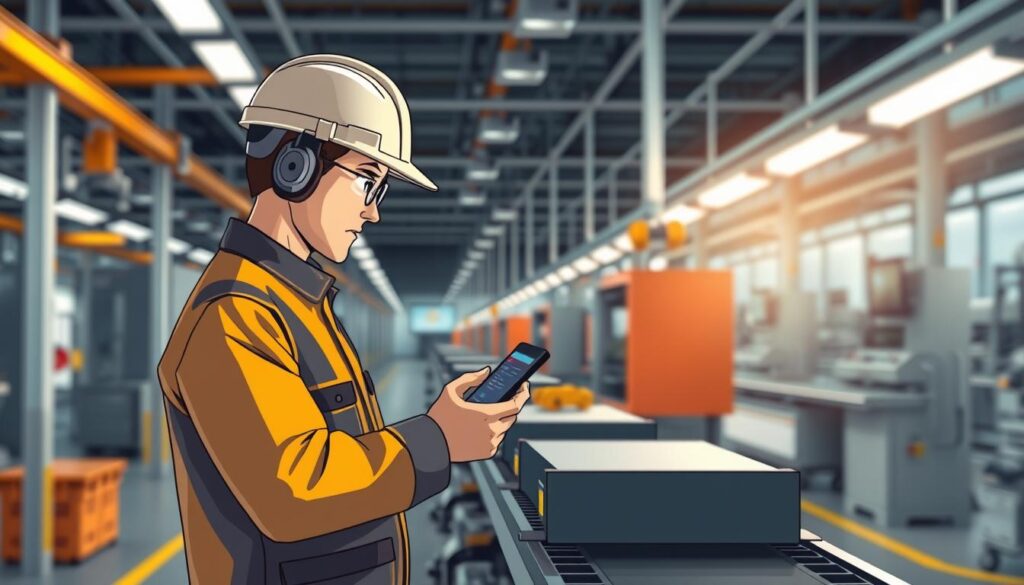
We start by taking pictures and videos from real assembly lines. We make sure the lighting and angles are right. This helps our models learn from real-life examples.
We label these images carefully. This depends on what we want to check for. We also check the data to make sure it’s balanced and correct.
To get the best results, we clean and prepare the data. This makes sure our models learn from good information, not bad.
Model Training and Validation
We divide our data into different groups for training and testing. This helps us see how well our models really work. We choose the right models based on what we need.
We watch how our models perform closely. If they don’t do well, we make changes. For rare defects, we use special techniques to help our models learn.
We keep track of our models and update them as needed. This ensures they stay accurate and reliable.
Real-world Deployment
When we deploy our models, we choose the right hardware and software. This makes sure they work fast and efficiently. We pick cameras and storage based on how much data we need to handle.
We test our models in a safe way before using them for real. This lets us see how they compare to human inspectors. We keep improving our models based on feedback and new data.
Case Studies of Successful Implementations
Real-world examples show how computer-vision inspection works. They move from idea to real results. This section talks about successes in making things and how different methods work in big production.
Automotive industry examples
A big car maker saw a huge drop in paint mistakes. They used AI cameras on the final assembly line. This cut down paint defects by 95%.
They used special cameras and NVIDIA GPUs. This made checking images fast, in about 0.05 seconds. It helped spot problems right away.
This also led to fewer mistakes in putting parts together. And, customers were happier, with 70% fewer complaints.
AI was great for checking sizes where old tools failed. It learned fast, even with few examples. This made it very good at finding problems.
Consumer electronics success stories
In making printed circuit boards, AI cut down on mistakes. It went from 40-70% false positives to under 10%. This made production smoother.
For checking PCBs, AI found surface defects with 98% accuracy. This shows how well AI works in finding problems.
Using 3D and X-ray images, AI found almost all defects in BGAs. This was about 99.2% accurate. It shows how advanced tools can be very precise.
- Performance metrics: Paint, assembly and dimensional accuracy improvements in automotive quality inspection; AOI false-positive reduction and solder-joint accuracy in PCB inspection.
- Hardware & software: High-resolution cameras, NVIDIA GPUs, and efficient neural networks for sub-0.1s inference.
- Training methods: Few-shot learning and GAN augmentation to reduce sample requirements and speed deployment on SMT lines.
These examples show how AI works well in making things. They use precise tools, fast computers, and smart learning. They give a clear guide for using AI in making cars and electronics.
Challenges in Implementing Computer Vision Systems
Using computer vision on assembly lines has big benefits and big challenges. Teams face problems with data, hardware, and people. A good plan helps make pilots work well in production.
Technical limits for model performance
Having enough good data is a big problem. Making labeled datasets for high-yield electronics is very expensive. This means models need to be retrained often when new parts come in.
Things like changing lights, vibrations, and camera angles can make models less accurate. Also, not enough network bandwidth and edge-compute can slow down real-time work. To fix these issues, we need to make strong pipelines and choose the right sensors for the shop floor.
Practical integration with legacy equipment
Many plants use old PLCs and vision-unfriendly conveyors. Adding modern AI needs special tools or hardware changes. This makes pilot projects take longer and cost more.
Using the same data format helps scale systems faster. Companies like Rockwell Automation or Siemens offer good connectors. But, sometimes custom work is needed. Clear interface specs help avoid mistakes during deployment.
Workforce adaptation and training needs
Operators and maintenance teams need to learn new ways of working. Training should include hands-on practice and guides. Help from vendors and local experts can reduce mistakes and downtime.
Getting everyone on board is key. Support from leaders, clear benefits, and small pilots help. Keeping training budgets up ensures skills stay current with model updates and product changes.
| Challenge | Root Cause | Practical Mitigation |
|---|---|---|
| Data scarcity | Rare defects; high yield production | Synthetic data, targeted labelling, cross-plant data sharing |
| Hardware mismatch | Legacy equipment; limited I/O | Protocol converters, gateway devices, phased retrofits |
| Environmental noise | Lighting swings, vibrations | Robust camera mounts, controlled illumination, image augmentation |
| Network and compute limits | Insufficient edge or bandwidth | Hybrid edge-cloud design, model compression |
| Organizational resistance | Lack of buy-in; unclear ROI | Pilot wins, executive sponsorship, transparent metrics |
| Skill gaps | Need for domain knowledge plus ML skills | Targeted training, vendor support, hire blended talent |
| Regulatory validation | Industry compliance and traceability | Documented validation plans, audit-ready logs |
Future Trends in AI and Quality Inspection
The next big thing in making things is how machines see and do things. Makers will use new data to make things better, faster, and more accurate. This means fixing problems before they get worse.
Advances in Deep Learning
Deep learning is getting better at finding rare problems. It uses new ways to learn from data. This makes machines smarter and faster at spotting issues.
New tools like hyperspectral and X-ray cameras give machines more information. They can now see things that were hidden before. This makes it easier to find problems.
Predictive Maintenance Applications
Vision data is now used to predict when machines might break. This helps plan when to fix things. It also helps decide what parts are needed.
Edge AI makes machines work faster and saves data. 5G helps teams work together from far away. This makes fixing problems more efficient.
The table below shows how these new things help.
| Capability | What It Enables | Operational Impact |
|---|---|---|
| Foundation models & segment-anything | Faster labeling, adaptable segmentation across products | Reduced annotation cost; quicker model iterations |
| Generative AI for synthetic data | Augmented rare-defect examples for training | Improved recall on uncommon faults; fewer field misses |
| Advanced imaging (hyperspectral, X-ray, 3D) | Access to subsurface and spectral signatures | Detection of hidden defects; higher first-pass yield |
| Edge AI with 5G | Low-latency inference and secure on-site processing | Real-time rejection, reduced network load, resilient ops |
| Multimodal AI integration | Combines vision, sound, and sensor telemetry | Richer context for diagnosis; better predictive maintenance |
To use these new things, you need to keep learning and using good data. This makes making things faster, better, and cheaper. The future looks bright for making things.
Best Practices for Implementation
Every good plan starts with a clear goal. First, do a business analysis. This helps decide what defects to find, where to inspect, and how often. It also looks at how to connect with MES and ERP, set up alerts, and use data.
Designing a system means choosing the right hardware and software. Make sure there’s good lighting and the right camera setup. Pick cameras and lenses that work well for your needs. Also, decide if you’ll use edge or server processing.
Good data is key for a model to work well. Collect real images from production. Make sure your data is balanced and labeled right. Use synthetic data for rare defects. This helps your model learn and improve.
When choosing a partner, look at their experience and how well they integrate. Check if they know about electronics, cars, or other goods. They should have shown success in lowering false alarms and improving speed. Make sure they offer good support after you start using their system.
Start small and grow as you go. Do pilot projects that are like your real production. Use clear goals like how accurate you are and how fast you can alert. Get support from leaders before you roll it out everywhere.
Being ready to operate is as important as having a good model. Train your team and set up regular updates. Make sure you have a plan for keeping things running smoothly.
The table below shows important steps to follow when choosing and starting a new system.
| Focus Area | Key Actions | Success Metrics |
|---|---|---|
| Business Analysis | Define defects, inspection cadence, integration points, reporting needs | Clear scope, measurable KPIs, stakeholder alignment |
| Hardware & System Design | Specify lighting, camera type, lenses, edge vs. server inference | Target cycle time met, image quality consistent, low latency |
| Data Strategy | Collect real images, label datasets, augment rare defects, run EDA | Balanced dataset, reduced bias, reliable model validation |
| Vendor Selection | Evaluate domain expertise, integration ability, post-deploy support | Proven case studies, reference metrics, clear SLAs |
| Pilot Projects | Run controlled pilots, validate KPIs, capture integration issues | Accuracy targets met, minimal production disruption, stakeholder buy-in |
| Solution Customization | Tune models, adjust hardware, create retraining schedules | Lower false positives, stable long-term performance, scalable design |
Conclusion: The Future of Quality Inspection
AI is changing how we inspect things. Factories are getting better at finding problems fast. They also make less waste and follow rules better.
Using AI for checking things works well. It finds problems almost perfectly in tests. It also finds fewer false alarms in electronics checks. And it helps save money by predicting problems.
When experts in making things and data science work together, things get even better. This makes the AI work well for different products.
Connecting AI to machines makes things even better. It helps fix problems faster and makes things move smoother. Choosing the right tasks to improve first helps save money fast.
Call to action for industry adoption
Start a small test: pick one important task, get good pictures, and make sure the pictures are labeled well. Work with AI experts and update things little by little. Watch how well it works by looking at how many problems it finds, how accurate it is, how fast it works, and how much it costs to fix problems.
| Action | Goal | Short-term Metric | Scaling Signal |
|---|---|---|---|
| Pilot highest-cost defect | Prove ROI quickly | Reduction in scrap (%) | Consistent error drop over 3 runs |
| Invest in labeled datasets | Improve model accuracy | Validation accuracy (%) | Stable performance across product variants |
| Integrate with MES/PLC | Enable closed-loop control | Automated corrective actions per hour | Decrease in manual interventions |
| Partner with vendor | Accelerate deployment | Time to first working model (weeks) | Vendor support for edge updates |
| Commit to iterative improvement | Sustain Quality transformation | Monthly improvement rate (%) | Ongoing reduction in warranty claims |
Resources for Further Learning
Learning resources help teams go from theory to real use. Start with a machine vision reading list. It should cover data strategies, deep learning model choice, and deployment in areas like cars, gadgets, and drugs. For a quick guide, check out Labellerr on automated assembly-line inspection.
Recommended books and articles cover CNN architectures, explainable AI, and edge computing studies. Look for white papers on ROI and hyperspectral imaging. They compare SPI and AOI and show AI’s benefits.
For learning, take computer vision and deep learning courses on Coursera, Udacity, or edX. Also, get machine-vision certifications from industry groups. Mix online classes with hands-on workshops on PCB or SMT and GAN-based methods.
Lastly, check out Allied Vision, NVIDIA, and AAEON for hardware and software tips. These guides and resources help you learn, practice, and improve quality on the line.
FAQ
What is AI-based visual inspection and how does it differ from traditional manual inspection?
AI-based visual inspection uses computer vision and deep learning. It analyzes images or video from industrial cameras and sensors. This is different from manual inspection, which relies on human eyes and judgment.
AI systems learn from labeled examples to detect subtle defects. They classify faults and segment damage at pixel level. They work consistently 24/7, with sub-millimeter accuracy and less variability.
What primary use cases does computer-vision quality inspection cover on assembly lines?
It covers defect detection, assembly verification, and solder inspection. It also includes dimensional measurement, packaging checks, and safety monitoring. Predictive maintenance is another use case.
These applications are found in industries like automotive, electronics, aerospace, pharmaceuticals, and consumer goods.
How much can AI vision improve defect detection and what ROI should manufacturers expect?
AI vision can improve defect detection from 80% to 99.9%. It can make inspections 10–50x faster. It also improves first-pass yield by 15–25%.
Manufacturers can save on labor and rework. Payback can happen in 12–18 months, with a 300–500% ROI in three years.
How does AI compare to traditional AOI (Automated Optical Inspection) for PCBs?
AI replaces rigid AOI rules with learning from data. This reduces false positives. AOI can have false-positive rates of 40–70%.
AI systems lower this to below 10%. AI also supports complex tasks like 3D imaging and X-ray-assisted BGA analysis.
What core technologies are required for reliable computer-vision inspection?
Reliable systems need high-resolution cameras and controlled lighting. They also need image acquisition hardware and compute for inference. This includes GPUs, FPGAs, or embedded vision processors.
On the software side, convolutional neural networks and detection/segmentation models are essential. Data-augmentation, few-shot learning, and tools for labeling and model management are also important.
What inspection approaches (classification, detection, segmentation) should be chosen for different defects?
The choice depends on the task. Classification is for single-object frames. Detection handles multiple objects or component presence.
Segmentation gives pixel-level defect maps. Small, subtle defects and measurement tasks often require higher resolution and dedicated lighting.
How should manufacturers collect and prepare data for training models?
Gather representative production images under real-line conditions. Build balanced datasets with both defect and non-defect examples. Label according to the chosen approach.
Use exploratory data analysis to remove bias/outliers. When defects are rare, use few-shot learning or synthetic data generation to increase sample diversity.
Should inference run at the edge or in the cloud?
Real-time, low-latency needs benefit from edge inference. This is located on the line. Cloud or server inference works for heavy-model training and historical analysis.
Many deployments use hybrid architectures. Edge inference for millisecond decisions and cloud servers for model retraining and analytics.
What measurable benefits do AI inspection systems deliver on assembly lines?
AI systems raise defect detection accuracy to 99.9% in some cases. They improve inspection speed by 10–50x. They also reduce false positives.
AOI false-positive rates can be as high as 40–70%. AI systems lower this to below 10%.
How can vision inspection data support closed-loop manufacturing and IIoT?
Inspection outputs can feed MES/ERP and IIoT platforms. This enables closed-loop control. For example, SPI results adjust solder paste parameters upstream.
Integrating vision insights with digital twins and analytics helps reduce failures. It also shortens mean time to repair.
What are common implementation challenges and how can they be mitigated?
Challenges include insufficient labeled defect data and variable lighting. Legacy equipment integration and network gaps are also issues. Organizational resistance is another challenge.
Mitigation strategies include running pilot projects and collecting production-specific datasets. Use transfer learning and synthetic augmentation for rare defects. Standardize lighting and fixtures, secure executive sponsorship, and invest in operator training and vendor support.
How important is lighting and optics to system accuracy?
Lighting and optics are extremely important. Controlled lighting and telecentric lenses are foundational. Poor lighting and optics undermine even the best models.
System design should prioritize these elements before model tuning.
What hardware choices are typical for PCB and electronics inspection?
Common hardware includes high-resolution industrial cameras and 3D imaging heads. X-ray/CT is used for hidden joints. Telecentric lenses and inference hardware like NVIDIA Tesla T4 servers are also used.
Gateways and industrial PCs from vendors like AAEON are often used for ruggedized deployments.
How do organizations validate performance before scaling up?
Validate with pilots that define KPIs. Run A/B testing against existing AOI or manual inspection. Log audit trails and involve cross-functional stakeholders.
Confirm payback with defined ROI metrics and a retraining plan before wider roll-out.
What workforce changes are needed to adopt AI inspection?
Staff need training on system operation and basic model behavior. Roles shift from repetitive inspection to exception handling and system supervision.
Partner support for onboarding, clear SOPs, and ongoing education help bridge the skills gap.
Which industries benefit most from AI vision inspection?
High-volume, high-precision industries see the largest gains. Electronics and PCBA/SMT lines, automotive assembly, aerospace components, pharmaceutical packaging, and consumer goods production benefit.
Any sector where defects cause significant downstream cost or regulatory risk will benefit.
How does continuous improvement and retraining work post-deployment?
Systems log flagged images and operator decisions to create new labeled data. Periodic retraining with fresh production samples addresses concept drift and new defect modes.
Techniques like transfer learning and few-shot learning accelerate updates. A governance process tracks model metrics to ensure ongoing accuracy and reduce false positives over time.
What emerging trends will shape the future of quality inspection?
Advances in deep learning, multimodal inspection, explainable AI, and edge computing will reduce deployment time. They will also improve rare-defect detection.
Integration with predictive maintenance, digital twins, and 5G-enabled remote processing will push manufacturing toward proactive, closed-loop quality control.
How should a manufacturer start a computer-vision quality-inspection project?
Start with a business analysis to identify highest-cost defects or heaviest false-positive burdens. Run a focused pilot and collect representative production images.
Choose a partner with domain expertise and define KPIs and ROI expectations. Prioritize data quality and plan for operator training and retraining cycles.
What vendor capabilities should manufacturers evaluate when selecting a partner?
Evaluate a vendor’s industry domain experience and track record reducing false positives and improving throughput. Check their integration skills with MES/ERP and hardware partners.
Look for measurable case studies—electronics SPI/AOI improvements or automotive paint and assembly results—instead of generic claims.
Are there recommended learning resources for teams implementing AI vision inspection?
Recommended paths include hands-on computer vision courses from Coursera and Udacity. Industry machine-vision workshops and vendor technical materials are also helpful.
White papers on AOI vs. AI inspection and SPI/3D/X-ray methods are recommended. Specialized certifications and practical projects accelerate readiness.