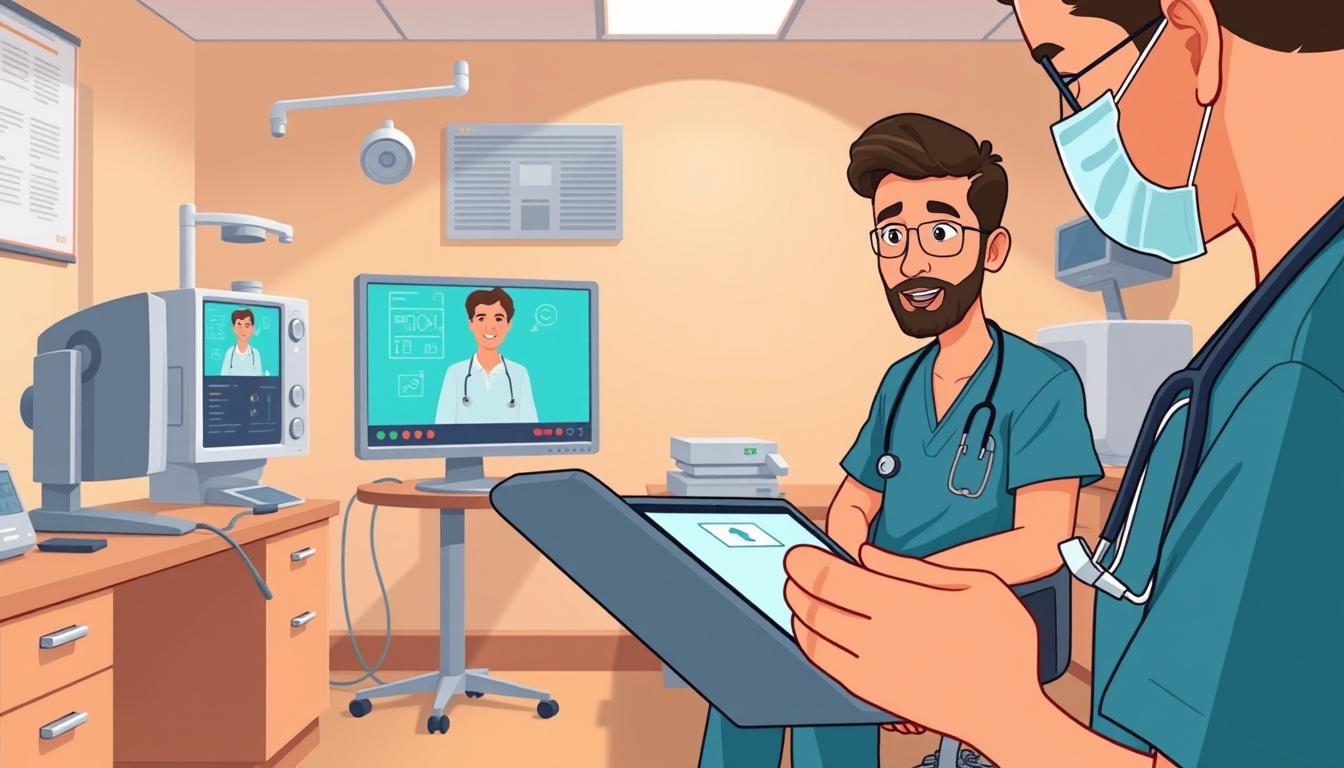
Waiting for a diagnosis can feel like lost time. It’s time with family, time to treat, and time to act. Artificial intelligence in telehealth diagnostics changes this. It makes care timely and choices clear.
Telemedicine AI solutions are changing how doctors work. They help with symptoms, medical images, and patient monitoring from afar. The market is growing fast, with big investments in healthcare AI.
AI in telehealth uses machine learning and more. It helps with patient monitoring and making decisions. This makes care better and more efficient.
COVID-19 made AI in telehealth more important. It helped with diagnosing pneumonia and strokes. It showed how AI can make a big difference.
Key Takeaways
- AI in telehealth diagnostics speeds access to care and reduces diagnostic delays.
- Artificial intelligence applications in telehealth diagnostics combine ML, NLP, and computer vision for practical clinical tasks.
- Telemedicine AI solutions are attracting major players and rapid market growth across regions.
- Healthcare AI technology supports remote monitoring, triage, and image analysis to improve patient outcomes.
- Early adoption during the pandemic demonstrated real-world diagnostic benefits and operational gains.
- Readers can explore clinical evidence and implementation details, including epidemiologic and telehealth studies, via authoritative sources like this study and industry analysis.
For more on AI in telehealth, see this summary. It talks about how AI helps with monitoring and triage. Also, check out the industry overview on AI in healthcare diagnostics for more info.
Introduction to Artificial Intelligence in Telehealth
Telehealth uses digital tech to give care from far away. It includes video chats, messaging, and tracking health. It’s used in many ways, like apps and big hospital systems.
Definition of Telehealth
Telehealth lets doctors help patients without seeing them. It helps with ongoing care and urgent needs. It also makes care easier with tools like scheduling and messaging.
More people used telehealth during the COVID-19 pandemic. Kids had more video visits in 2022 than in 2019. Changes in rules and extra money helped keep it popular. Now, more places offer telehealth to meet demand.
Overview of AI in Healthcare
AI works with big data like health records and images. It helps doctors and makes tasks like billing easier.
AI uses many ways to help, like learning from data and understanding language. It’s used in things like finding strokes and checking heart rhythms. Companies like Viz.ai and AliveCor show how AI helps in real life.
AI is changing how we get care. It makes finding problems faster and more accurate. Most of the time, AI is used in the cloud. Hospitals and care companies use it the most.
| Area | AI Application | Clinical Benefit |
|---|---|---|
| Imaging | Computer vision for mammograms, CT, X-ray | Improved sensitivity and faster reads |
| Cardiology | Mobile ECG analysis and arrhythmia detection | Early detection and remote triage |
| Remote Monitoring | Predictive analytics for RPM data | Earlier intervention for deterioration |
| Patient Communication | NLP chatbots and virtual assistants | Streamlined intake and symptom triage |
| Administration | Automated scheduling and billing workflows | Reduced clinician burden and operational cost |
The Role of AI in Telehealth Diagnostics
Artificial intelligence changes how we diagnose in telemedicine. It makes things faster and more accurate. Doctors use images, wearables, labs, and patient histories to get a clear picture.
This new way uses special software and algorithms. They find patterns that humans might miss.
Enhancing Diagnostic Accuracy
AI looks at X-rays, CT scans, and MRIs for signs of disease. Companies like Viz.ai and Lunit help doctors by checking these images. This can reduce mistakes and avoid extra tests.
When AI looks at images and patient notes together, it gets better. It can spot things that one look alone might miss.
AI uses data from patients and wearables too. It makes decisions based on what patients say and their health data. This way, AI can guess what’s wrong faster and more accurately.
Reducing Time to Diagnosis
For urgent cases, time is very important. AI can quickly check CT scans for strokes. This means doctors can act fast.
Tools like those from Nuance and Microsoft help doctors write notes faster. This lets them focus on treating patients sooner.
AI can also guess what’s wrong after just a few questions. This means patients don’t have to wait as long. It helps doctors too, by making their work easier and less stressful.
Machine Learning Techniques in Telehealth
Machine learning makes remote care better. Doctors and engineers use it to make sense of health data. This helps in many ways, from finding new treatments to improving patient care.
Supervised learning uses labeled data to predict what will happen next. For example, it helps doctors find problems in X-rays. It also spots heart issues from ECGs, just like a doctor would.
Unsupervised learning finds patterns in data without labels. It groups patients by how they use telehealth services. This helps doctors know who needs more help.
Time-series learning watches health data from wearables. It spots sudden changes, like a heart rate spike. This alerts doctors quickly.
Getting machine learning to work takes a lot of work. It needs good data, careful setup, and constant checks. This ensures the tech works well and is fair.
| Technique | Typical Use Case | Algorithms / Tools | Key Metrics |
|---|---|---|---|
| Supervised Learning | Image diagnosis, ECG classification, outcome prediction | Logistic regression, Random Forest, Gradient Boosting, CNNs; scikit-learn, TensorFlow, PyTorch | AUC-ROC, F1, Precision, Recall |
| Unsupervised Learning | Patient segmentation, usage pattern discovery | K-means, PCA, Hierarchical Clustering; time-series clustering toolkits | Silhouette score, Davies–Bouldin, cluster stability |
| Time-Series & Streaming | Wearable monitoring, adoption forecasting, anomaly detection | ARIMA, change-point detection, online learning, Kafka/stream pipelines | Latency, detection rate, MAE for forecasting |
| Explainability & Fairness | Clinician trust, bias mitigation | SHAP, LIME, fairness-aware training libraries | Feature importance clarity, fairness metrics, audit logs |
Natural Language Processing in Patient Communication
NLP in telehealth changes how patients and doctors talk. It uses chatbots for intake and follow-ups. This helps patients who can’t move easily or live far away.
Telehealth uses AI for better conversations. Tools like Ada Health and Babylon AI help by asking questions and giving advice. They use 10–20 questions to help decide what to do next.
AI makes telehealth faster and more efficient. Chatbots help doctors by handling simple tasks. They also make sure doctors have time for harder cases.
AI also helps with writing down what happened during visits. Tools like Nuance Dragon Ambient eXperience write down what was said. This makes writing reports faster and easier for doctors.
NLP looks at what patients say to find out how they feel. Most patients are happy, but some have problems with technology. This helps make things better for everyone.
Getting AI to work right takes special models and careful handling of data. It’s important to make sure AI is fair and works for everyone. This includes making sure it understands different languages.
| Use Case | Example Vendors | Primary Benefit | Key Considerations |
|---|---|---|---|
| Symptom Triage Chatbots | Ada Health, Infermedica, Buoy Health | Scalable intake; faster triage | Clinical accuracy; regulatory alignment |
| Ambient Clinical Documentation | Nuance DAX, Augmedix | Reduced clinician documentation time | EHR integration; privacy safeguards |
| Sentiment & Feedback Analysis | Custom NLP pipelines | Actionable product and policy insights | Representative data; noise reduction |
| Multilingual Support & Simplification | Translation modules, simplified language models | Improved access and comprehension | Accurate medical translation; cultural context |
Image Recognition Technology in Telehealth
Image recognition is key in remote care. Doctors use computer vision to understand scans and photos. This helps them make quick decisions and give clear second opinions.
AI-Powered Medical Imaging
AI helps with X-rays, CTs, MRIs, and skin photos. Viz.ai speeds up stroke detection. Qure.ai checks for lung disease. SkinVision spots skin cancer risk. Lunit helps with cancer diagnosis.
These tools show doctors where to focus first. They use heatmaps and flags. This makes it easier to find the most urgent cases.
Most images are stored in the cloud. This is because the cloud can handle lots of data. It also makes updates quick and easy to track.
Some devices can do image analysis on their own. This makes things faster and keeps data safe.
Benefits of Image Analysis for Remote Consultations
Telemedicine software offers reliable image analysis. Even doctors who aren’t experts can get second opinions. Patients can send photos or scans for quick checks.
This makes it faster to treat serious conditions. Some systems can read mammograms and CT scans very quickly. This helps doctors make quick decisions during virtual visits.
Getting approval and proving it works is important. Viz.ai and Lunit followed FDA rules and did studies. They showed their technology is safe and effective.
Keeping data safe is a big deal. Systems must follow HIPAA rules and use strong encryption. This way, doctors can easily access images during virtual visits.
Choosing where to store images depends on the task. Cloud for updates and edge for quick, private checks. Both help doctors and patients in remote care.
Predictive Analytics in Telehealth Solutions
Predictive analytics in telehealth helps doctors act fast. It uses machine learning to look at patient data from many sources. This way, doctors can stop problems before they start and use resources wisely.

Identifying patient risks
Telehealth models find patients at high risk by watching their health closely. For example, AI can spot heart rate issues or blood sugar changes. This lets doctors help patients early, which can prevent serious problems.
These models also help plan how to use resources better. They help decide who to see first and when. This makes sure patients get the care they need when they need it.
Forecasting disease progression
Telehealth models predict how diseases will change over time. They use information like how often patients see doctors and their medical history. This helps doctors plan the best care for each patient.
These predictions also help doctors choose the right treatments. This makes care more personal and effective. It helps patients get better faster.
Extending into genomics and therapeutics
AI helps find new treatments by looking at genes and molecules. This leads to more precise care plans. When AI looks at genes and monitors patients, doctors can plan care even better.
Operational metrics and ROI
Predictive analytics in telehealth saves money and time. It leads to fewer hospital stays and less chance of getting sick again. It makes sure doctors use their time well and helps the whole system work better.
- Reduction in acute visits through early alerts
- Improved clinician efficiency via prioritized workflows
- Enhanced patient engagement with personalized care paths
Case Studies of AI in Telehealth Diagnostics
Real-world examples show how AI changes clinical care. This section looks at key deployments. It shows how AI impacts different areas like radiology and cardiology.
Successful Implementations
Viz.ai uses AI to quickly spot big problems in CT scans. It alerts stroke teams fast. This helps hospitals with stroke programs work better together.
Qure.ai and Infervision made tools for quick chest CT and X-ray checks during COVID-19. These tools help doctors sort out urgent studies fast. They keep quality high even when there’s a lot to do.
AliveCor’s KardiaMobile uses AI to find heart rhythm problems. It sends alerts to doctors and patients. This helps catch problems sooner and keeps hearts healthy.
Ada Health, Buoy Health, and Infermedica created chatbots for symptom checks. They help doctors decide what to do next. This makes it easier for people to get help when they need it.
Studies show telehealth works as well as face-to-face care for kids with depression. It’s even better for anxiety in some cases. Places that pay for telehealth see more use and better results.
Lessons Learned from Real-World Applications
Quality and bias are big challenges. Models need diverse training data to work well for everyone. Teams use special tools to check models and build trust.
Getting AI to work with doctors’ systems is key. Making it easy to use and store data helps doctors accept it. This makes care better and more efficient.
How well a place pays for telehealth affects how much it’s used. Clear rules and safe systems are needed for AI to become part of regular care. Good payment plans help keep it going.
| Domain | Vendor / Example | Primary Benefit | Key Implementation Insight |
|---|---|---|---|
| Stroke Radiology | Viz.ai | Faster triage; reduced door-to-treatment times | Real-time alerts require tight EHR and pager integration |
| Chest Imaging | Qure.ai, Infervision | Rapid COVID-19 triage; workload management | Performance maintained under surge when models trained on diverse imaging |
| Cardiology | AliveCor KardiaMobile | Home ECG screening for atrial fibrillation | Patient engagement and clear alert pathways improve follow-up |
| Symptom Triage | Ada Health, Buoy Health, Infermedica | Automated intake; reduced admin load | Clinician oversight and UX design are critical for trust |
| Mental Health | Telehealth programs using SAMHSA/NSDUH analyses | Comparable or improved outcomes for youth anxiety/depression | Reimbursement and access policies drive utilization |
Regulatory Landscape for AI in Telehealth
The rules for telehealth and AI are changing fast. Everyone involved must follow federal and state laws. They must also keep patient safety and data privacy first.
Regulators want to know how AI algorithms are made and tested. They look for proof that AI works well in real life. They also want plans for checking AI after it’s used.
FDA Guidance on AI-Medical Devices
The FDA sees many AI tools as Software as a Medical Device. Makers often get approval through 510(k) clearance or De Novo authorization.
The FDA says AI tools must be clear, show how well they work, and have plans for updates. Companies like Viz.ai and Lunit got approval by showing strong evidence and testing.
Developers need to have technical info, what the tool is for, and plans for watching it after it’s used. This helps speed up reviews and makes things clearer for using AI in telehealth.
HIPAA Compliance in Telehealth
HIPAA rules for telehealth mean data must be sent safely, stored securely, and access is strict. Health systems need to use agreements with cloud companies when health info is shared.
It’s key to make data anonymous when training AI models. Teams must choose between keeping data local or using the cloud. The cloud is great for big data but needs strong security and agreements.
State laws on licenses and payments also affect how AI is used. Some states make it easier to use telehealth and pay for AI tools, helping them become part of regular care.
| Regulatory Area | Key Requirements | Practical Steps |
|---|---|---|
| FDA Review | Risk-based pathway; validation; transparency; post-market monitoring | Prepare 510(k)/De Novo submissions, include real-world performance plans, document model updates |
| HIPAA | Secure transmission; access controls; BAAs; de-identification for research | Encrypt data, sign BAAs with cloud vendors, establish role-based access and audit trails |
| State Policy | Licensure rules; reimbursement parity; telehealth coverage variations | Track state rules, adapt billing workflows, obtain necessary licenses for clinicians |
| Ethics & Liability | Explainability; informed consent; clinician oversight; shared liability concerns | Document AI use in the medical record, disclose AI role to patients, maintain clinician final decision authority |
Challenges in Implementing AI for Diagnostics
Using AI in health care is exciting but also faces many challenges. Teams must keep patient data safe while making tools easy to use. This section talks about the main risks and how to overcome them for safe AI use in health care.
Data Privacy and Security Concerns
Health care systems collect lots of data like health records and images. This data is at risk from cyber attacks. To keep it safe, strong encryption and strict access controls are needed.
Methods like de-identification help protect data during training. Regular checks and plans for when things go wrong are also key. It’s important to stay up to date with new threats.
For more on the ethics and security of medical AI, check out this analysis on challenges and ethics in medical. It talks about breach trends and how to keep patients’ trust.
Integration with Existing Systems
Health IT systems are complex, with many parts like EHRs and telehealth portals. To work well, AI needs to fit with these systems. Standards like FHIR and DICOM help.
Cloud-based systems can make AI faster, but they need to be balanced with cost and speed. Clear plans and small tests can help find problems early.
Training and changing how things work are key to using AI. Doctors need to understand how AI works and see how it does on different groups. Places that teach and check AI’s performance get more trust from doctors.
| Challenge | Impact | Mitigation |
|---|---|---|
| Data breaches and third-party risk | Loss of patient trust; regulatory fines | Encryption, BAAs, regular audits |
| Biased training data | Poor outcomes for underserved groups | Diverse datasets, fairness-aware ML, subgroup reporting |
| Interoperability gaps | Workflow disruption; low adoption | FHIR/DICOM standards, API-first design |
| Technical skill gaps | Implementation delays; misuse | Training programs, clinician engagement |
| Cost and unclear reimbursement | Slow scaling; limited pilots | ROI studies, policy engagement, phased rollout |
Leaders should see these challenges as problems to solve. With careful planning for data safety and AI integration, health care can use AI safely. This way, they keep the benefits of AI while protecting everyone involved.
The Future of AI in Telehealth
The next decade will change how we get care. New tools will use big language models and mix images with text and sensor data. They will also keep our health info safe.
New AI trends will use special learning methods. These methods let groups work together without sharing sensitive health info. This makes it easier for hospitals, payers, and startups to improve models together.
AI will help care become more proactive. It will use genetic data, wearables, and health records to predict problems early. This way, health systems can prevent more hospital visits and create better prevention plans.
AI will also make doctors’ work easier. Tools like voice assistants and real-time notes will help doctors focus on patients. Soon, AI will handle tasks like scheduling and follow-ups, freeing up doctors to care for patients.
There are different ways AI will be used in telehealth. Some companies will offer complete solutions with analytics. Others will provide parts that fit into existing systems. Both ways will create chances for new businesses and old ones to grow.
More people will use telehealth because of market growth. There will be more chances for startups and big companies to come up with new ideas. But, making sure everyone has access to these benefits is important.
Rules and fairness will guide how AI is used. Laws that are clear but flexible will help things move faster. It’s also key to make sure AI treats everyone fairly, no matter their age, race, or where they live.
Leaders should start by testing new AI methods and working with AI companies. They should also check how AI changes access to care and outcomes. Using AI wisely will make things more efficient while keeping doctors and patients safe.
Ethical Considerations in AI Diagnostics
Using AI in remote care has its ups and downs. Doctors and health systems need to handle these issues carefully. They must have clear rules for data use, how things work, and who can access them.
Bias and fairness in clinical models
AI can make health problems worse if it’s not fair. This happens when it’s trained on data that doesn’t include everyone. Places like Mayo Clinic check for fairness in their models.
To fix this, they use special tests and keep working on it. They also make sure the AI works the same for everyone.
Informed consent and transparent communication
Patients need to know when AI helps make their diagnosis. Doctors should tell them how AI is used and what data is kept. This helps build trust and lets patients make choices.
Doctors can use a special form to explain how AI works. This follows what experts say and helps patients understand AI in telehealth. You can find more about telehealth here.
Explainability and clinician oversight
Tools like SHAP and LIME help doctors explain AI to patients. They don’t replace doctors’ decisions but help them. Doctors are always in charge to avoid mistakes.
Doctors need training to understand AI explanations. They should question strange results and write down their reasons.
Data governance, privacy, and secondary use
Handling data the right way is key. This includes how it’s collected, stored, and used later. Doctors need permission to use data for research or training AI.
Having clear rules helps patients feel safe and keeps doctors out of trouble. It’s important for everyone.
Equity in access and digital divides
Not everyone has the same access to the internet or technology. Making telehealth easier to use can help. Programs can help get better internet to more places.
Teams should check who can use telehealth and if it’s fair. Making telehealth fair helps more people get help.
Ongoing monitoring and governance
Keeping an eye on AI after it’s used is important. This includes checking for problems and making sure it’s safe. Rules from review boards and regulators help keep AI safe.
Plans for watching AI should include checking it often, reporting problems, and being able to stop it if needed. This keeps AI safe and trusted by everyone.
| Ethical Area | Practical Steps | Expected Outcome |
|---|---|---|
| Bias detection | Stratified validation, subgroup metrics, synthetic augmentation | Reduced disparities in model performance |
| Patient consent | Clear disclosures, opt-out options, documented AI involvement | Improved trust and informed decision-making |
| Explainability | Use SHAP/LIME, clinician training, human-in-loop review | Better clinician acceptance and safer decisions |
| Data governance | De-identification, access controls, consent for secondary use | Stronger privacy protection and lawful reuse |
| Access equity | Low-bandwidth tools, policy advocacy, device programs | Greater reach for underserved populations |
| Monitoring | Post-market surveillance, revalidation, rollback plans | Early detection of harm and adaptive safeguards |
Conclusion
AI is changing telehealth diagnostics in big ways. It uses image recognition, natural language processing, and more. This makes diagnosis faster and more accurate.
Companies like Viz.ai and AliveCor are leading the way. They show AI’s power in real life. For a quick look at AI in telehealth, check out this summary article.
Summary of Insights
AI helps doctors make better diagnoses faster. It’s good for many areas, like skin checks and imaging. It also helps with mental health in young people.
Businesses are moving to cloud services and talking agents. But, they need to follow rules and get approvals. This makes sure AI works well and safely.
Future Directions in AI and Telehealth
AI will get even better, with new ways to keep data safe. We’ll see smarter AI helpers and better tools for tracking health. States that support AI are already seeing good results.
Business leaders should focus on working with doctors and following rules. This way, AI can help more people and make healthcare better. It’s all about making sure AI works well and helps everyone.
FAQ
What is telehealth and which services does it include?
Telehealth uses digital tech for remote healthcare. It includes video visits and messaging. It also has remote monitoring and virtual consults.
How is artificial intelligence defined within telehealth diagnostics?
AI in telehealth uses machine learning and natural language processing. It also uses computer vision and predictive analytics. These tools help with virtual assistants and symptom triage.
How does AI enhance diagnostic accuracy in remote care?
AI analyzes data to find patterns humans miss. It uses CNNs for radiology and algorithms for stroke detection. This helps doctors make better decisions.
Can AI shorten time to diagnosis for urgent conditions?
Yes. AI can quickly flag critical cases. It helps doctors make faster decisions. This is important for conditions like stroke.
Which machine learning techniques are most used in telehealth?
Telehealth uses supervised learning for predictions. It also uses unsupervised methods for patient grouping. Time-series models help with remote monitoring.
How is unsupervised learning applied to remote patient monitoring?
Unsupervised learning groups patients and finds anomalies. It helps doctors target interventions. This makes care more personalized.
What role does NLP play in telehealth communication?
NLP powers chatbots for symptom triage. It helps with intake and follow-up. It also improves clinical documentation.
Are symptom-checker chatbots clinically useful?
Yes. Chatbots like Ada Health and Buoy Health help with symptom triage. They guide patients to the right care.
How accurate are automated transcription and ambient documentation tools?
Tools like Nuance Dragon Ambient eXperience are very accurate. They reduce documentation time. But, they need EHR integration and privacy safeguards.
How does computer vision support telehealth imaging workflows?
Computer vision analyzes images for conditions like stroke. It helps doctors make quick decisions. This improves patient care.
What operational benefits do image-analysis tools bring to remote consultations?
Image tools reduce interpretation time and prioritize urgent cases. They help doctors make faster decisions. This improves patient outcomes.
How do predictive analytics models identify patient risks in telehealth?
Predictive models use data to flag risks. They look at vitals and EHRs. This helps doctors take proactive steps.
Can AI forecast disease progression for chronic conditions?
Yes. AI models track chronic diseases. They help doctors plan care and monitor patients closely.
Which real-world examples show AI’s value in telehealth diagnostics?
Viz.ai and Qure.ai are examples of AI in telehealth. They help with quick diagnosis and improve care.
What lessons have deployments revealed about successful AI integration?
Success needs good data and validation. It also requires integration with EHRs and workflows. Explainability and clinician training are key.
What FDA pathways apply to AI-driven telehealth tools?
AI tools may follow 510(k) or De Novo pathways. The FDA looks for transparency and validation. This ensures safety and effectiveness.
How must telehealth AI solutions comply with HIPAA?
Solutions must protect PHI and use access controls. They should use BAAs with cloud vendors. Edge inference can also protect data.
What are the main privacy and security risks for telehealth AI?
Risks include cloud misconfigurations and unauthorized access. Strong encryption and secure development practices help mitigate these risks.
How does AI risk amplifying bias in telehealth diagnostics?
Bias occurs when data lacks diversity. This affects performance for certain groups. Fairness testing and diverse datasets help reduce bias.
What integration challenges exist between AI tools and existing clinical systems?
Challenges include data standards and interoperability. Using standards and robust middleware helps. Cross-functional planning is also important.
What workforce and training needs accompany AI adoption?
Adoption requires clinician education and IT staff. Explainability and clear governance are essential. This builds trust in AI.
What are typical cost and ROI considerations for telehealth AI?
Costs include data curation and model development. ROI comes from reduced admissions and improved efficiency. Favorable policies help adoption.
Which deployment models are commonly used for telehealth AI?
Cloud-based platforms are common. They offer scalability and monitoring. Edge or on-device inference is used for privacy.
What emerging technologies will shape the future of AI in telehealth?
Trends include multimodal models and federated learning. These technologies will make telehealth more personalized and proactive.
How will AI affect overall healthcare delivery through telehealth?
AI will expand access and improve accuracy. It will reduce clinician burden and support preventive care. Policy and reimbursement are key.
What ethical obligations accompany AI use in diagnostics?
Ethical duties include fairness and transparency. Providers must respect patient autonomy and privacy. Continuous monitoring is also important.
How should providers obtain patient consent for AI-involved care?
Providers should disclose AI use and explain its limitations. They should offer opt-out choices. This ensures transparency and compliance.
What governance and monitoring practices are recommended after deployment?
Governance should include monitoring for drift and bias audits. It should also involve incident reporting and subgroup tracking. This ensures ongoing safety and fairness.
How large is the AI in telehealth market and what is its growth trajectory?
The market was valued at about US.89 billion in 2024. It is expected to grow to US.31 billion by 2034. North America led in 2024, while Asia Pacific is growing fastest.
Which market segments are dominant and which are growing fastest?
NLP and conversational agents dominated in 2024. Predictive analytics and RPM are growing fastest. Cloud-based platforms are the most common deployment.
Who are leading vendors in telehealth AI and what capabilities do they offer?
Key vendors include Teladoc Health and Amwell. They offer chatbots, imaging AI, and RPM analytics. These tools improve telehealth services.
What regulatory and reimbursement factors most affect adoption?
FDA guidance and state policies impact adoption. HIPAA compliance and Medicare flexibilities are also important. Favorable policies increase adoption and improve outcomes.
What practical steps should organizations follow when implementing telehealth AI?
Prioritize representative data and fairness testing. Use standards and choose compliant hosting. Validate clinically and follow FDA pathways. Invest in training and continuous monitoring.
How can startups and entrepreneurs best position themselves in this market?
Focus on cloud-native platforms that solve clinical problems. Emphasize regulatory strategy and HIPAA compliance. Build partnerships with health systems to demonstrate value.