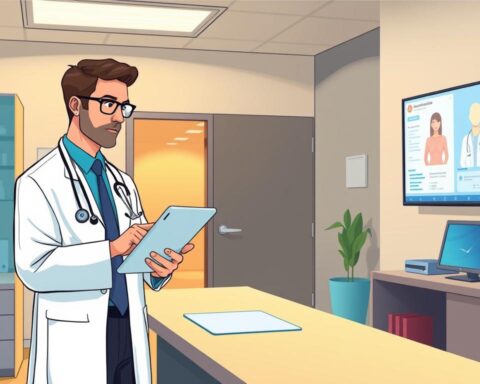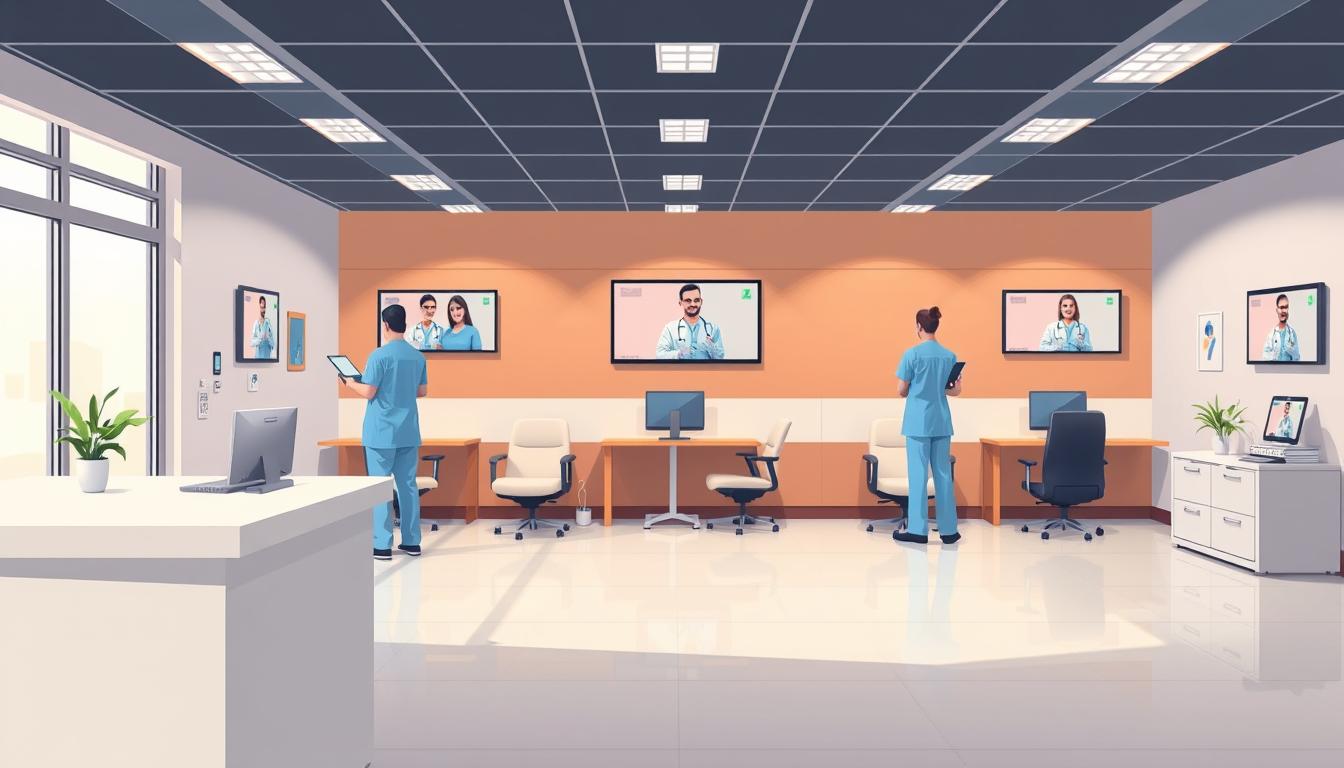
Ever felt worried about a late-night cough or a sudden rash? Waiting for care can be hard, even more so in rural areas. This article talks about how technology is changing that.
AI in telemedicine is changing how doctors work. It helps them find diseases, sort patients, and follow up. AI looks at images, talks to patients, and predicts risks. It makes doctors better at their jobs.
AI does a lot in telemedicine. It looks at images, watches patients, and talks to them. It also predicts and helps doctors make decisions. This makes care faster and better.
Studies show AI is making a big difference. It’s better at finding eye problems and predicting strokes. But, there are challenges like data quality and following rules.
This article will guide you on using AI in healthcare. It talks about how AI fits into doctor’s work, what data it needs, and the rules it must follow. For more info, check out PMC.
Key Takeaways
- AI algorithms in telemedicine diagnostics enhance accuracy across specialties by analyzing imaging and real-time data.
- Artificial intelligence in healthcare technology enables faster triage, 24/7 diagnostic support, and reduced in-person testing.
- Telehealth AI solutions span imaging, NLP triage, remote monitoring, predictive analytics, and CDSS integration.
- Successful adoption depends on high-quality data, privacy safeguards, bias mitigation, and EHR interoperability.
- Evidence shows promise in ophthalmology, radiology, and chronic disease prediction—but regulatory and reimbursement clarity remains critical.
Introduction to Telemedicine and AI Algorithms
Remote care has grown a lot. It’s now more than just phone calls. We have video visits, monitoring, and more.
This growth helps people in hard-to-reach areas. It cuts down on travel and keeps care going smoothly. The COVID-19 pandemic made it even more popular.
Now, systems can handle more data. This includes images and health records. Doctors use this data to make better decisions.
AI is key in this change. It uses special tech to understand images and notes. This helps with quick checks and finding risks.
AI helps doctors but doesn’t replace them. It spots important things and predicts problems. Studies show it works well for some things.
But, there are limits. AI needs good data and internet to work. Doctors must check it’s working right and fair.
When used right, AI can make doctors more confident. It also makes their work easier.
Here’s a quick look at how AI has changed telemedicine.
| Milestone | What Changed | AI Role |
|---|---|---|
| Phone consults | Basic remote advice and triage | Rule-based decision trees for symptom checks |
| Video visits | Visual exam and direct clinician interaction | Computer vision aids for lesion assessment |
| Remote patient monitoring | Continuous vitals from wearables | Time-series models detect deterioration |
| Asynchronous eConsults | Store-and-forward specialist input | NLP summarizes history and flags critical findings |
| Hub-and-spoke models | Specialist access for remote clinics | Decision-support prioritizes referrals |
The Role of AI in Medical Diagnostics
Artificial intelligence is changing how doctors work in hospitals and clinics. AI helps doctors see more patients by doing routine checks. This lets doctors focus on harder cases.
Enhancing Diagnostic Accuracy
AI looks at X-rays, CT scans, and more to find early signs of disease. It spots things that humans might miss. Studies show AI is as good as doctors in some cases.
AI also helps with mental health by spotting signs of depression and PTSD. It looks at what doctors write and say to help them better.
AI is used in real ways, like in radiology. It helps doctors find more problems without too many false alarms. You can learn more at Miloriano.
Reducing Time to Diagnose
AI sorts out urgent cases first, making treatment faster. It flags high-risk scans for quick action. This makes things move faster in busy places.
AI tools work on phones and in hospitals to help in emergencies. They send alerts for strokes and other urgent needs. This helps doctors act quickly.
AI and telehealth together make care faster and more consistent. They let doctors spend more time with patients. Automated systems handle the routine checks.
Key AI Algorithms Used in Telemedicine
Telemedicine uses special algorithms to help doctors. This part talks about the main ways these algorithms work. It also explains how they help in real telehealth situations.
For medical diagnosis, many models are used. Image tasks like looking at X-rays use special networks. These networks help doctors see problems in pictures.
For signals like heart beats, other models are used. These models learn from patterns in data. They help doctors understand what’s happening in real time.
When there’s not much data, other methods are used. These methods find unusual patterns and pull out important information. They are good for testing new ideas in medicine.
Using old models and adding more data helps too. This way, even with little data, doctors can make good guesses. It’s like having a smart guide.
Mobile AI is also important. It works on phones and keeps data safe. This is great for places with slow internet.
NLP in telehealth changes words into actions. It makes sense of what doctors write. This helps doctors make better plans for patients.
Chatbots and feeling detectors are part of NLP. They help with mental health and figure out what’s most important. This makes doctors’ work easier and faster.
The table below shows different algorithms and how they help. It talks about what they do, what they need, and how they work.
| Algorithm Class | Typical Input | Primary Use Case | Key Benefit | Deployment Note |
|---|---|---|---|---|
| Convolutional Neural Networks (CNNs) | Medical images (X-ray, dermatoscope, fundus) | Image classification and lesion detection | High accuracy on visual patterns | Often requires transfer learning for small datasets |
| Recurrent Models & Transformers | Time-series vitals, ECG, sensor streams | Arrhythmia detection, trend forecasting | Captures temporal dependencies | Edge-friendly variants reduce latency |
| Sparse Autoencoders & Clustering | Multivariate sensor data, unlabeled logs | Anomaly detection, feature extraction | Useful in exploratory and early-warning systems | Good for experimental stroke-prediction tools |
| Transfer Learning + Augmentation | Limited labeled clinical samples | Rare disease detection, underserved populations | Improves generalization with few labels | Requires careful domain adaptation |
| On-Device Edge Models | Mobile sensor feeds, local images | Point-of-care screening, privacy-preserving inference | Low latency and improved privacy | Model size and energy constraints matter |
| Clinical NLP Models | Telemedicine transcripts, clinical notes | Triage bots, documentation extraction | Turns unstructured text into usable data | Needs domain-specific corpora and validation |
Benefits of AI Algorithms in Telemedicine
AI tools and virtual care change how doctors work. They make tasks easier, help sort patients, and reach more people. This leads to lower costs and better care for everyone.
Cost-Effectiveness
AI helps doctors look at images and screen patients without being there. This means fewer tests and less money spent. It makes healthcare cheaper for everyone.
In places with less access to doctors, AI helps a lot. One specialist can help many places. This saves time and helps more people without needing more doctors.
But, money matters. Doctors get paid differently for virtual and in-person visits. Clearer payment plans could help use more AI for saving money.
Improved Patient Engagement
AI chatbots and virtual helpers send messages and reminders. They make it easier for patients to take care of themselves. This shows how AI can help patients stay involved in their care.
Wearables and apps help track health. For example, they can track how well someone walks. Video checks can also show how well someone is doing.
AI and telemedicine help more people, even in rural areas. But, everyone needs equal access and fair AI. This way, more people can benefit from AI in healthcare.
Challenges in Implementing AI in Telemedicine
Adding AI to remote care is not easy. It needs teams to tackle tech, law, and people issues at once. IT, law, and doctors must work together to plan and set goals before starting.
Data Privacy Concerns
Patient data moves around a lot. In the U.S., HIPAA helps protect it. But, using AI and cloud services means more steps are needed to keep data safe.
Using encryption and audit trails helps. Also, making sure patients know how their data is used builds trust. Using AI on devices can also protect data better.
People in remote areas might not know much about digital stuff. Doctors need to explain things clearly. This way, patients can understand how their data is used by AI in telemedicine.
Integration with Existing Systems
Getting AI to work with current health records is hard. AI outputs that are hard to use can make things worse. This makes doctors less likely to use it.
Using FHIR APIs and working with vendors helps. Starting small and focusing on what works best is key. AI results should be easy to see in doctors’ usual tools.
Scaling up is hard because of slow internet and limited data. This can make AI not work as well for everyone.
Not knowing the rules and how to get paid for AI in telemedicine is a problem. Different rules in states and unclear payment plans slow down using AI in telemedicine.
Case Studies: Successful Applications of AI in Telemedicine
Many studies show how AI helps in telemedicine. They move from tests to everyday use. These studies cover remote monitoring, diagnosis, and mental health.

Remote Monitoring and AI
Wearables send data to AI models. A device tracks foot pressure and gait. It uses sensors and an app to spot health risks.
AI looks at videos to help with Parkinson’s. It uses deep networks to check motor skills. This helps doctors check patients from far away.
AI can predict strokes on mobile devices. It uses EMG signals and autoencoders. Early tests show it works well.
AI in Chronic Disease Management
In Nepal, AI checks for eye diseases. It uses deep learning to spot diabetic retinopathy and glaucoma. This helps doctors catch problems early.
AI chatbots help with mental health. They look for signs of depression and anxiety. This helps doctors reach out sooner.
AI watches over patients with chronic diseases. It uses sensors and analytics to spot problems. This helps avoid hospital visits.
Here’s a quick look at some projects. They show how AI helps in telemedicine.
| Project | Data Source | AI Approach | Key Performance | Clinical Impact |
|---|---|---|---|---|
| Sensorized Gait & Foot Platform | Pressure sensors, IMU via Android app | Supervised ML classifiers | High risk detection for diabetic foot | Early referral, reduced ulcer progression |
| Parkinson’s Motor Assessment | Video pose-estimation from multisite datasets | Deep learning (HAR) | 96.51% accuracy across tasks | Remote functional monitoring, therapy adjustments |
| Mobile EMG Stroke Prototype | Surface EMG on mobile device | Sparse autoencoder, edge inference | ~98% pilot accuracy | Rapid pre-hospital alerting |
| Telehealth Retinopathy/Glaucoma Hub | Fundus imaging, optic nerve scans | Convolutional neural networks | Retinopathy: 98.57% sens / 92.97% spec; Glaucoma: 92.74% sens / 96.49% spec | Timely referrals, blindness prevention |
| Mental Health NLP Tools | Chat transcripts, self-report scales | NLP classifiers, conversational agents | Improved detection and engagement | Early intervention, reduced crisis events |
| RPM with Predictive Analytics | Vitals, weight, symptom logs | Time-series models, risk scoring | Reduced readmissions where integrated | Proactive outreach, lower acute care use |
These studies show AI’s value in telemedicine. They need good data and work well with doctors. It’s important to test AI in different groups and make sure it fits into care plans.
Regulatory Framework for AI in Healthcare
The rules for AI in healthcare are changing fast. Everyone from startups to big health systems needs to follow new rules. These rules ask for openness, proof, and constant checks.
The FDA says AI needs good training data and clear goals. It also needs to be watched after it’s used. This makes sure AI tools are safe and work well.
There’s confusion about how to pay for AI and if it needs a license. Clear rules on how to bill and if AI can be used across states will help. This will make it easier for doctors and companies to use AI.
H3: FDA Guidelines for AI Technologies
AI makers must show their tools are safe and work as planned. They need to prove this with tests and risk checks. This builds trust with doctors and follows old rules for medical devices.
AI makers should watch how their tools do in real life. This is key for tools that change over time. The FDA needs to know how these tools do in different places.
H3: Ethical Considerations
It’s important to avoid bias in AI. Tools trained on limited data can harm certain groups. Using diverse data and checking AI with outside experts helps avoid this.
AI should be available to everyone. But, some people might not have access because of internet or cost issues. We need to make sure everyone can use AI safely.
Doctors need to understand why AI makes certain choices. This helps them trust AI. It’s also important to know who is responsible if something goes wrong.
Keeping patient data safe is very important. Patients must agree to use their data, and it must be kept private. This is a basic rule for using AI in healthcare.
To move forward, we need to test AI with different groups, plan for after it’s used, and work with payers and boards. Working together will make AI in healthcare safer and more reliable.
Future Trends of AI Algorithms in Telemedicine
The future of telemedicine will use more data and smarter models. This will help doctors care for patients earlier and closer to home. Everyone will work on tools that find problems before they start and fit care to each person’s needs.
Predictive Analytics
Electronic health records, wearable sensors, and social data will help predict diseases. These tools will warn doctors about risks like readmission and chronic disease. This way, care will move from just reacting to actually preventing problems.
Using remote monitoring with real-time data will help doctors act sooner. This can lower the need for urgent care. But, it needs good data, careful testing, and clear results to work well for everyone.
AI and Personalization
AI will make care plans and advice fit each patient better. This will help patients follow their plans and get better results. Genomic data and AI will also make diagnosing and treating diseases more accurate in telemedicine.
Creators of AI telehealth platforms must focus on data quality and clear rules for using data. It’s important to avoid making health problems worse and to make sure patients understand AI advice.
| Trend | Data Inputs | Primary Benefit | Key Challenge |
|---|---|---|---|
| Early risk detection | Longitudinal EHR, wearables | Reduced emergency visits | Data interoperability |
| Readmission prediction | Admission history, social factors | Improved population health | Model calibration across cohorts |
| Personalized care plans | Genomics, patient-reported outcomes | Higher adherence rates | Consent and privacy management |
| Real-time monitoring | Continuous sensor data | Timely interventions | False positives and alert fatigue |
| Platform convergence | Clinical systems + telehealth APIs | Seamless clinician workflows | Regulatory compliance |
The Importance of Data Quality for AI Insights
AI in telemedicine needs good data to work well. Quality data means safer and fairer care. It’s key to focus on data quality from the start.
Telehealth uses many types of data. This includes images, health signals, and patient reports. Using the right tools and following rules helps keep data consistent.
Data Collection Methods
Good data comes from many sources. This includes images and health signals from devices. It’s important to check these devices work well together.
Using the right tools and following rules helps. This makes data better and faster to use. Learn more about data quality in healthcare here: importance of data quality in healthcare.
Overcoming Data Limitations
When there’s not enough data, we use special methods. These include making fake data and learning from other places. This way, we can keep patient info safe.
Testing models in different places helps. It shows if they work for everyone. Better internet and digital skills help get more data from devices.
| Challenge | Practical Fix | Expected Impact |
|---|---|---|
| Inconsistent device calibration | Standard calibration protocols and vendor certification | More accurate biosignal interpretation; fewer false alerts |
| Sparse labeled data | Data augmentation and transfer learning | Improved model performance with limited samples |
| Privacy and regulatory limits | Federated learning and synthetic datasets | Model training at scale without centralizing PII |
| Duplicate or inconsistent records | Master patient indexing and structured templates | Lower administrative cost; cleaner analytics |
| Connectivity gaps in rural areas | Broadband investment and offline-capable capture | Sustained data streams; reduced sampling bias |
Training Healthcare Professionals in AI
Getting ready for AI in telemedicine needs clear steps. This part talks about how to train healthcare teams. They will learn to use AI tools, know their limits, and use them safely.
Curriculum design should pair clinical scenarios with hands-on practice. Begin with lessons on model types, how they perform, bias, and rules. Use real-life examples to teach about image analysis, NLP in notes, and remote monitoring.
Curriculum Development
AI in healthcare education needs teamwork. Schools, nursing programs, and informatics work with data experts. They make lessons that show how AI fits into real work.
Make short lessons that show AI in action. Show how AI helps with images, notes, and monitoring. This helps doctors understand the tech better.
Make sure to teach about ethics, privacy, and rules in every lesson. Teach how to understand AI results and when to trust your own judgment. Add quick guides for common AI uses.
Continuous Learning Opportunities
Keep learning about AI in telemedicine. Offer CME credits, workshops, and on-the-job training. Tie these to updates and new releases.
Make a way for doctors to report AI problems. Give them training or updates when needed. Use fake cases for practice and review.
| Learning Component | Format | Outcome |
|---|---|---|
| Foundations of AI | Short online modules with quizzes | Understanding of algorithms, metrics, and limits |
| Clinical Case Labs | Interactive workshops using anonymized data | Practical skills in interpreting AI outputs |
| Cross-Disciplinary Projects | Team-based translational assignments | Stronger clinician–data scientist collaboration |
| Vendor Onboarding | Guided sessions and quick-reference tools | Smoother adoption and increased trust |
| Ongoing Assessment | Performance dashboards and feedback loops | Continuous improvement and model stewardship |
Conclusion: The Future of Telemedicine with AI
AI is changing how we get medical care. It moves care from just fixing problems to preventing them. This is thanks to AI in telemedicine.
When AI has good data and is tested well, it helps doctors make better decisions faster. It works in many areas like eye care, heart health, and mental health. It even helps prevent blindness and find stroke risks early.
Using AI in telemedicine should be done carefully. First, test it in small areas. Then, make sure doctors can use it easily. It should also work well with electronic health records.
It’s also key to have the right data and keep patient information safe. And, doctors need to get paid fairly for using AI. This way, AI can really help patients.
We need to make sure everyone has access to AI in telemedicine. This means fixing the digital gap and making rules for doctors to work across states. We also need to train doctors to use AI well.
By doing all this, AI can help doctors more. It can make health care better for everyone. This is how AI in telemedicine can change the game for health care.
FAQ
What is the central benefit of applying AI algorithms in telemedicine diagnostics?
AI makes diagnoses more accurate and quick. It finds patterns in images and data. It also helps reach more people and saves money by cutting down on tests.
How has telemedicine evolved to support AI-driven diagnostics?
Telemedicine has grown from simple phone calls to full virtual care. Now, it includes video chats, remote monitoring, and more. The COVID-19 pandemic helped it grow even more.
Which AI techniques are most relevant for telemedicine diagnostics?
Important AI methods include supervised learning for images and NLP for notes. Unsupervised learning finds odd patterns. Edge computing works on devices with little internet.
Can AI actually match clinician performance in diagnostic tasks?
Yes, AI can do as well as doctors in some tasks. For example, it’s very good at spotting eye problems. But, it needs to be tested in real life to keep working well.
How does AI reduce time to diagnosis in telehealth settings?
AI quickly checks images and vital signs. It helps doctors focus on urgent cases. This makes treatment faster, like for strokes.
What role does NLP play in telemedicine diagnostics?
NLP helps understand what patients say and write. It’s used in chatbots and helps doctors make decisions. But, it needs to be tested to make sure it’s right.
Are AI-enabled telemedicine solutions cost-effective?
Many studies show AI can save money. It helps avoid unnecessary tests and hospital stays. But, it depends on how it’s paid for and how well it works.
How does AI improve patient engagement in remote care?
AI helps keep patients involved through chatbots and monitoring. It reminds them to take medicine and check symptoms. This makes patients more likely to follow their care plan.
What are the main data privacy and security concerns?
AI deals with sensitive health data. It must be kept safe and private. This includes using encryption and making sure vendors are trustworthy.
How do integration challenges affect AI adoption in clinical workflows?
Integrating AI with existing systems is hard. It needs to work with EHRs and telehealth platforms. If it doesn’t, doctors might not use it.
What regulatory standards apply to AI in telemedicine?
The FDA has rules for AI in healthcare. It wants to make sure AI is safe and works well. States and countries also have their own rules.
How should health systems address algorithmic bias and equity?
Health systems need to make sure AI is fair. They should use diverse data and test it in different places. They also need to make sure everyone has access to technology.
What data collection methods are critical for robust AI diagnostics?
Good data comes from many sources. This includes images, vital signs, and patient reports. It’s important to use devices that work well and follow the same rules.
How can organizations overcome limited or biased datasets?
To get better data, use different methods. This includes adding to existing data and using synthetic data. Working together with other places can also help.
What workforce training is required to deploy AI in telemedicine?
Doctors need to learn about AI. They should know how it works and its limits. Training should be ongoing and include feedback from doctors.
What practical steps should organizations take to adopt AI-enabled telemedicine?
Start with small tests of AI tools. Make sure they work with existing systems. Use diverse data and train doctors well. This will help it grow in a good way.
How will predictive analytics reshape telemedicine diagnostics?
Predictive analytics will help catch problems early. It uses data from EHRs and wearables. This will help doctors act faster and keep patients healthier.
What are the ethical considerations for AI personalization in telehealth?
Personalized AI must be fair and clear. It should not make things worse for some groups. Doctors and patients need to understand how it works.
Which real-world applications demonstrate AI’s impact in telemedicine?
AI is being used in many ways. For example, it’s great at finding eye problems. It’s also used for stroke prediction and checking for diabetic foot problems. These show how AI can help.
What reimbursement and policy barriers should stakeholders anticipate?
There are many challenges. This includes how to pay for AI and rules for telemedicine. Clear rules and proof of how well AI works will help.
How can institutions ensure continued performance and safety of AI tools?
Keep an eye on AI after it’s used. Make sure doctors can give feedback. Follow good practices and keep data safe.
What is the recommended roadmap for scaling AI in telemedicine?
Start with small tests of AI. Make sure it works with what doctors use. Use diverse data and train doctors well. This will help it grow in a good way.