While most researchers know about t-tests, few realize comparing three or more groups requires a fundamentally different approach to avoid misleading conclusions. Enter the statistical workhorse that quietly drives discoveries from drug trials to market research—a method accounting for both group differences and natural data fluctuations.
This comparison technique solves a critical problem: when testing multiple groups simultaneously, traditional methods dramatically increase error rates. By evaluating how data spreads within and between, it reveals whether observed variations matter more than random chance. From optimizing manufacturing processes to assessing educational programs, professionals leverage this framework to make confident, data-backed decisions.
Developed by Ronald Fisher in the early 20th century, the approach has become indispensable across industries. Modern applications range from analyzing clinical trial outcomes to comparing marketing campaign performances. Its true strength lies in balancing statistical rigor with practical interpretability—transforming complex datasets into actionable insights.
Key Takeaways
- Essential for comparing three or more groups without inflating error rates
- Examines both internal group consistency and cross-group differences
- Prevents misleading conclusions from multiple pairwise comparisons
- Widely applied in pharmaceuticals, business analytics, and social sciences
- Maintains statistical reliability while handling complex datasets
- Transforms raw numbers into strategic decision-making tools
Introduction to Analysis of Variance (ANOVA)
When comparing three or more variables in research, traditional statistical methods often lead researchers into a trap of compounding errors. This fundamental limitation sparked the development of a sophisticated approach that evaluates group differences while controlling for random fluctuations—a method now indispensable across scientific and business fields.
Overview of the Statistical Technique
At its core, this method compares variability within individual datasets to differences between them. Unlike basic tests that inflate error rates with multiple comparisons, it provides a single framework to assess whether observed variations matter more than chance. Consider these key contrasts:
| Approach | Groups Supported | Error Control | Key Advantage |
|---|---|---|---|
| Traditional t-tests | 2 groups | High risk with multiple tests | Simple implementation |
| Modern solution | 3+ groups | Built-in safeguards | Holistic insights |
“The essence of this technique lies in separating systematic differences from random noise—a principle that transformed 20th-century research.”
Why This Method Matters in Research
Clinical trials use it to compare drug efficacy across patient cohorts. Manufacturers apply it to optimize production lines. Marketing teams leverage it to assess campaign performance. By identifying which variables truly drive outcomes, organizations allocate resources strategically rather than guessing.
The real power emerges in its dual capability: maintaining statistical rigor while delivering actionable insights. As noted in definitive guides, this approach prevents the “fishing expedition” pitfall that plagues multi-group studies.
Core Statistical Principles Behind Group Comparisons
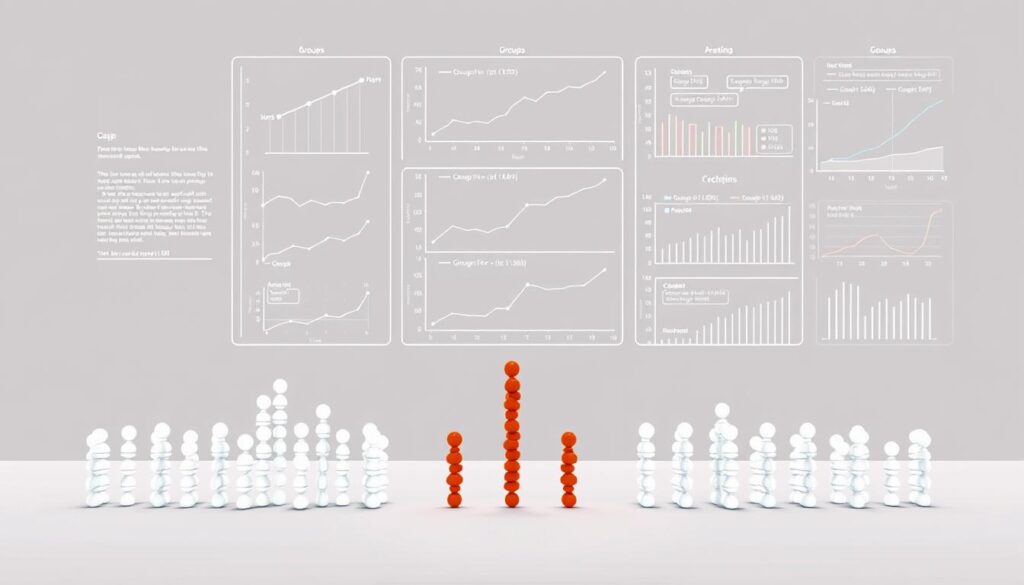
Researchers face a hidden challenge when working with multiple datasets: averages can deceive. Three sales teams might show identical monthly averages—but their daily performance fluctuations could tell radically different stories. This paradox lies at the heart of effective multi-group analysis.
Understanding Group Means and Variance
Individual group means (μ₁, μ₂, μ₃) represent each dataset’s center point. The grand mean—calculated across all observations—acts as the study’s gravitational center. Consider this comparison:
| Metric | Team A | Team B | Team C |
|---|---|---|---|
| Daily Sales Mean | $1,200 | $1,200 | $1,200 |
| Performance Range | $800-$1,600 | $1,100-$1,300 | $400-$2,000 |
While all teams share the same mean, their variance (spread around the average) differs dramatically. This spread determines whether differences matter more than random chance.
Key Terms: Null Hypothesis, F-value, and Degrees of Freedom
The null hypothesis assumes all groups perform equally—like assuming three fertilizers produce identical crop yields. The F-value acts as a reality check: it compares variance between groups to variance within groups. Higher values signal meaningful differences.
Degrees of freedom adjust calculations based on sample size and group count. Think of it as statistical seatbelts—ensuring safety in conclusions regardless of study complexity. Together, these elements form the statistical framework that prevents false discoveries in multi-group studies.
“Variance isn’t noise—it’s the music of meaningful patterns waiting to be heard.”
Types of ANOVA: One-Way, Two-Way, and Factorial Approaches
Imagine analyzing marketing campaigns across multiple regions while accounting for seasonal trends. This common business challenge requires choosing the right analytical framework. Three distinct approaches handle these scenarios: one-way, two-way, and factorial methods—each offering unique advantages based on research complexity.
https://www.youtube.com/watch?v=JgMFhKi6f6Y
Exploring One-Way ANOVA and Its Applications
The simplest form examines differences across three or more groups using a single independent variable. Retail managers might use it to compare quarterly sales figures across 12 store locations. Clinical researchers could assess drug effectiveness across age brackets. Its power lies in simplicity—delivering clear yes/no answers about group differences while controlling error rates.
An Introduction to Two-Way and Factorial ANOVA
When two independent variables interact—like advertising budget and platform choice—two-way ANOVA shines. It reveals:
- Individual impacts of each factor
- Combined effects exceeding simple addition
- Hidden interactions influencing outcomes
Factorial methods handle three or more variables simultaneously. A manufacturing team might analyze production speed using material type, machine model, and operator experience. This approach uncovers complex relationships that simpler methods miss—like how material performs differently across machine-operational combinations.
| Method | Factors | Use Case |
|---|---|---|
| One-Way | 1 variable | Store performance comparison |
| Two-Way | 2 variables | Campaign x platform analysis |
| Factorial | 3+ variables | Multi-factor product testing |
As highlighted in this comparative analysis, choosing the right method prevents oversimplification of complex data relationships. Two-way and factorial approaches particularly excel in detecting interaction effects that drive innovation in fields from pharmacology to consumer research.
Using ANOVA to Test Hypotheses in Data Analysis
Picture a pharmaceutical company evaluating three drug formulations. Researchers need to determine if any formulation outperforms the others—but guessing could risk lives. This scenario illustrates why structured hypothesis testing forms the backbone of reliable conclusions.
From Null Hypothesis to Alternate Hypothesis
Every analysis begins with two competing ideas. The null hypothesis acts as the default position: no meaningful differences exist between groups. Imagine claiming all energy drinks provide equal focus improvement until proven otherwise. The alternate hypothesis counters this—asserting at least one group differs significantly.
Here’s how it works in practice:
- A clinical trial assumes identical recovery rates across therapies (null)
- Researchers seek evidence that one treatment excels (alternate)
- The ANOVA test calculates whether data patterns strongly contradict the null assumption
“Hypotheses aren’t wild guesses—they’re precision tools shaping how we interrogate reality.”
When the F-statistic exceeds critical thresholds, it signals that observed differences outweigh random variation. This moment—rejecting the null hypothesis—transforms uncertainty into actionable insights. Marketing teams use this clarity to allocate budgets, while manufacturers optimize processes based on evidence rather than intuition.
The true power lies in the framework’s rigor. By requiring compelling evidence before accepting group differences, this method prevents costly false claims. It turns abstract questions like “Do these teaching methods differ?” into measurable, test-able propositions—the foundation of data-driven decision-making.
Step-by-Step Guide: Conducting ANOVA in Excel
Professionals often need to compare multiple datasets quickly—like evaluating regional sales performance or product variations. Excel’s built-in tools simplify this process through structured workflows that balance precision with accessibility.
Enabling the Data Analysis Toolpak
First, activate Excel’s statistical toolkit:
- Navigate to File > Options > Add-Ins
- Select Excel Add-Ins in the Manage dropdown
- Check Analysis ToolPak and click OK
This unlocks advanced functions in the Data tab. Users gain immediate access to 19 statistical tests, including critical comparison tools.
Setting Up Data and Running the ANOVA Test
Organize information vertically with groups in columns and observations in rows. For clean results:
- Include clear headers (e.g., “Product A”, “Product B”)
- Ensure equal sample sizes where possible
- Remove blank cells or outliers beforehand
| Test Type | Variables | Use Case | Data Structure |
|---|---|---|---|
| Single Factor | 1 independent | Comparing 3+ versions | Column-based groups |
| Two Factor | 2 independent | Price x Location effects | Matrix with replicates |
Select ANOVA: Single Factor from the Data Analysis menu. Set alpha to 0.05 (standard threshold) and specify your data range. Excel generates results showing F-values, p-values, and variance breakdowns—transforming raw numbers into actionable insights.
Interpreting ANOVA Results and the F-Statistic
Researchers often face a critical crossroads when their calculations produce numerical outputs. The true challenge lies in distinguishing between random noise and meaningful patterns. This is where the F–statistic becomes an indispensable compass—transforming abstract numbers into actionable intelligence.
Decoding the F-Ratio and Its Significance
The F-value acts as a truth-teller. It compares systematic differences between groups to natural fluctuations within them. Higher ratios signal stronger evidence against the null hypothesis. Consider these benchmarks:
| F-Value Range | Interpretation | Practical Implication |
|---|---|---|
| 0.5-1.5 | Weak evidence | Maintain current strategies |
| 1.5-3.0 | Moderate signal | Investigate further |
| 3.0+ | Strong evidence | Implement changes |
“An F-value doesn’t just measure difference—it quantifies conviction in that difference.”
When the ratio exceeds critical thresholds (typically when p-values fall below 0.05), it suggests statistically significant group differences. However, smart analysts always ask: “Are these differences practically meaningful?” A pharmaceutical study might require higher thresholds than consumer preference research.
Three key considerations emerge:
- Compare F-values to industry-specific standards
- Analyze effect sizes alongside ratios
- Contextualize findings within operational realities
This approach prevents teams from chasing insignificant variations while spotlighting opportunities needing immediate attention. By mastering F-statistic interpretation, professionals transform raw outputs into strategic roadmaps.
ANOVA Post-Hoc Testing and Multiple Comparison Techniques
When initial findings reveal significant patterns, the real detective work begins. Discovering which specific groups differ requires specialized tools that balance precision with practicality. These follow-up techniques transform broad insights into targeted strategies.
Tukey’s HSD, Bonferroni, and Other Methods
Tukey’s Honestly Significant Difference (HSD) acts like a magnifying glass for group means. It systematically compares all possible pairs while controlling overall error rates. This method shines in studies with equal sample sizes, offering clear thresholds for meaningful differences.
The Bonferroni correction takes a stricter approach. By dividing significance thresholds by the number of comparisons, it drastically reduces false alarms. However, this conservatism might overlook subtle but genuine variations—a trade-off requiring careful consideration.
Choosing the right statistical test depends on research goals:
- Tukey’s HSD: Ideal for exploratory studies with multiple comparisons
- Bonferroni: Best for confirmatory research with limited hypotheses
- Scheffé’s method: Useful for complex contrasts beyond pairwise checks
These techniques empower analysts to move beyond “something differs” to “here’s exactly where.” By matching method to context, professionals extract maximum insight while maintaining statistical integrity—turning data into decisive action plans.
FAQ
What is the main purpose of using this statistical method?
This technique compares averages across multiple groups to determine if at least one differs significantly from the others. It helps researchers identify whether observed differences are meaningful or due to random chance.
How does a one-way approach differ from a two-way method?
A one-way analysis evaluates the effect of a single independent variable on a dependent variable. A two-way approach examines two independent variables simultaneously, revealing interactions between them and their individual impacts.
What does the null hypothesis state in this context?
The null hypothesis asserts that all group averages are equal. Rejecting it suggests statistically significant differences exist between at least two groups, prompting further investigation through post-hoc tests.
When should post-hoc comparisons like Tukey’s HSD be used?
These tests are applied after finding a significant F-ratio to pinpoint exactly which groups differ. They control error rates when making multiple comparisons, ensuring conclusions remain reliable.
Can this method be applied in Excel without specialized software?
Yes—using Excel’s Data Analysis Toolpak, users can perform basic analyses. Proper data organization and tool configuration are critical for accurate results.
What does the F-statistic reveal about the data?
The F-ratio measures variance between groups relative to variance within groups. A higher value indicates greater likelihood that observed differences aren’t random, supporting rejection of the null hypothesis.
Why choose this approach over multiple t-tests for three or more groups?
Conducting repeated t-tests increases the risk of Type I errors. This method controls overall error rates by testing all group differences simultaneously, maintaining statistical integrity.